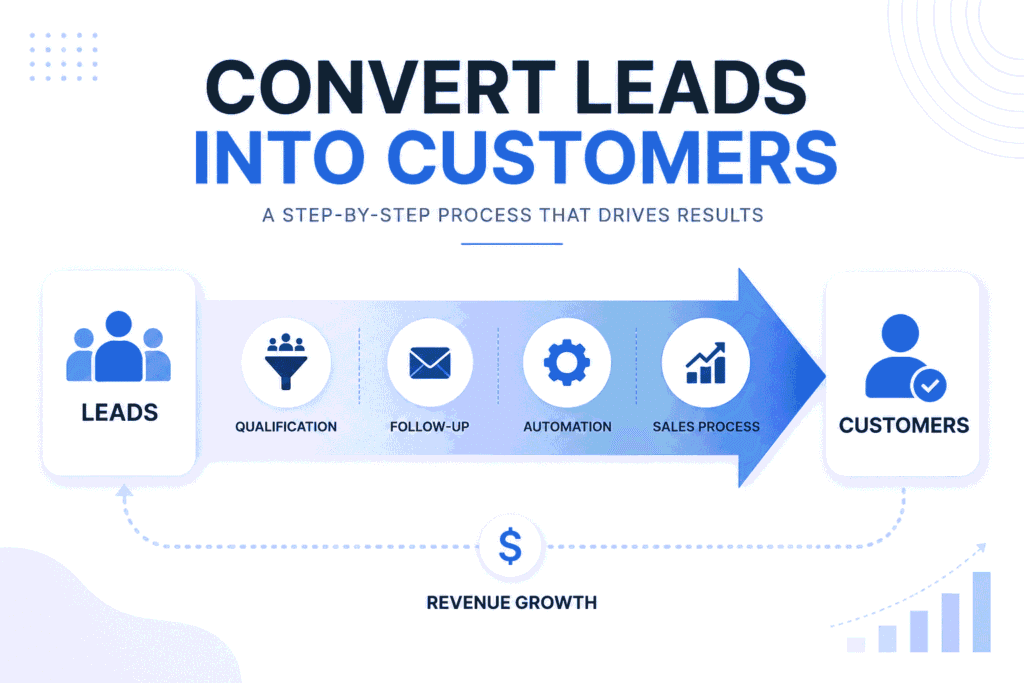
How to Convert Leads Into Customers Effectively (Complete Guide)
Table of Contents
How to Turn Leads Into Paying Customers
Generating leads is only half of the sales equation. The real challenge begins after a lead enters your pipeline.
Many businesses invest heavily in traffic generation, cold outreach, paid ads, SEO, or lead databases, yet still struggle to turn those prospects into paying customers. In most cases, the problem is not a lack of leads — it is the absence of a structured lead conversion process.
A potential customer rarely converts after a single interaction. Modern buyers typically move through multiple stages before making a purchase decision. They compare options, evaluate trust, review pricing, explore competitors, and interact with your brand several times before taking action. Without proper follow-up, personalization, nurturing, and timing, even high-quality leads can disappear from the funnel.
This is where an effective lead conversion strategy becomes critical.
Businesses that consistently convert leads into customers usually rely on a repeatable system that combines:
- Targeted lead qualification
- Personalized communication
- CRM tracking
- Consistent follow-ups
- Trust-building content
- Automation workflows
Instead of treating every lead the same, high-performing sales teams focus on understanding buyer intent, segmenting prospects correctly, and guiding leads through a structured customer journey.
The rise of AI-powered sales tools and automation platforms has also transformed how businesses manage conversions. Today, companies use platforms like HubSpot, Apollo.io, and Reply.io to automate outreach, track engagement signals, personalize communication at scale, and improve conversion efficiency without increasing manual workload.
But tools alone are not enough.
A successful lead conversion process depends on having the right strategy, workflow, and customer experience across every stage of the funnel. From the first interaction to the final sales conversation, every touchpoint influences whether a prospect moves forward or leaves the pipeline.
In this guide, you will learn:
- What lead conversion actually means
- Why most leads fail to convert
- How to build a high-converting lead nurturing workflow
- Proven strategies to improve sales conversions
- How CRM systems and AI automation improve lead management
- Common mistakes that reduce conversion rates
- Practical frameworks businesses use to convert leads consistently
Whether you run a small business, manage outbound sales campaigns, operate a B2B service company, or build automated lead generation systems, understanding how to convert leads into customers effectively can directly impact revenue growth and long-term business scalability.
1. What Does Lead Conversion Mean?
Lead conversion is the process of turning a potential prospect into a paying customer. In simple terms, it happens when someone who initially shows interest in your business eventually takes a revenue-generating action, such as booking a demo, purchasing a product, signing a contract, or subscribing to a paid service.
Many businesses focus heavily on generating leads but overlook the systems required to convert those leads effectively. A large contact database does not automatically translate into sales. Conversion happens when businesses successfully guide prospects through the buying journey using the right communication, follow-up strategy, trust-building, and customer experience.
To understand lead conversion properly, it is important to first distinguish it from lead generation. While both are closely connected, they serve different purposes within the sales funnel.
1.1. Lead Generation vs Lead Conversion
Lead generation focuses on attracting potential prospects into your pipeline, while lead conversion focuses on turning those prospects into customers.
1.2. Lead Generation
Lead generation is the process of capturing interest from potential buyers through channels such as:
- SEO Content
- Cold Outreach
- Paid Advertising
- Social Media Campaigns
- Webinars And Lead Magnets
- Referral Programs
The primary goal at this stage is to collect contact information and identify people who may have an interest in your solution.
1.3. Lead Conversion
Lead conversion begins after a lead enters your funnel. At this stage, businesses focus on moving prospects closer to a buying decision through:
- Personalized Communication
- Lead Qualification
- Follow-Up Sequences
- CRM Tracking
- Sales Conversations
- Trust-Building Content
- Product Demonstrations
This is the stage where relationships are developed and buying intent is nurtured into actual revenue.
A simple way to understand the difference is this:
Lead generation brings people into the pipeline.
Lead conversion moves them toward becoming customers.
For beginners, lead conversion can be compared to a real-world retail experience. Imagine a customer walking into a store. Generating the lead is equivalent to bringing that person into the shop. Converting the lead happens when the customer receives the right assistance, gains confidence in the product, and finally decides to make a purchase.
The same principle applies in digital sales and modern B2B workflows. Businesses use CRM platforms like HubSpot and sales engagement tools like Apollo.io to manage this process more efficiently by tracking interactions, organizing follow-ups, and improving personalization throughout the customer journey.
Without a proper lead conversion strategy, even high-quality leads can lose interest, delay decisions, or move to competitors before a sales conversation ever happens.
2. Understanding The Lead Conversion Funnel
Lead conversion does not happen instantly. Most customers move through several stages before making a purchase decision, especially in modern B2B and service-based buying journeys.
Before becoming paying customers, prospects typically spend time researching solutions, comparing alternatives, evaluating trust signals, and interacting with a business across multiple touchpoints.
This journey is commonly known as the lead conversion funnel.
The lead conversion funnel represents the path prospects follow from their first interaction with a business to becoming long-term customers. Each stage reflects a different level of awareness, intent, and engagement.
Understanding this funnel helps businesses:
- Identify Buyer Intent More Accurately
- Deliver More Relevant Communication
- Improve Lead Nurturing Strategies
- Reduce Funnel Drop-Off
- Increase Conversion Efficiency
- Build Better Customer Experiences
Instead of treating every lead the same, businesses can align their messaging, follow-ups, and sales efforts based on where prospects are within the funnel.
Below are the main stages of a typical lead conversion funnel.
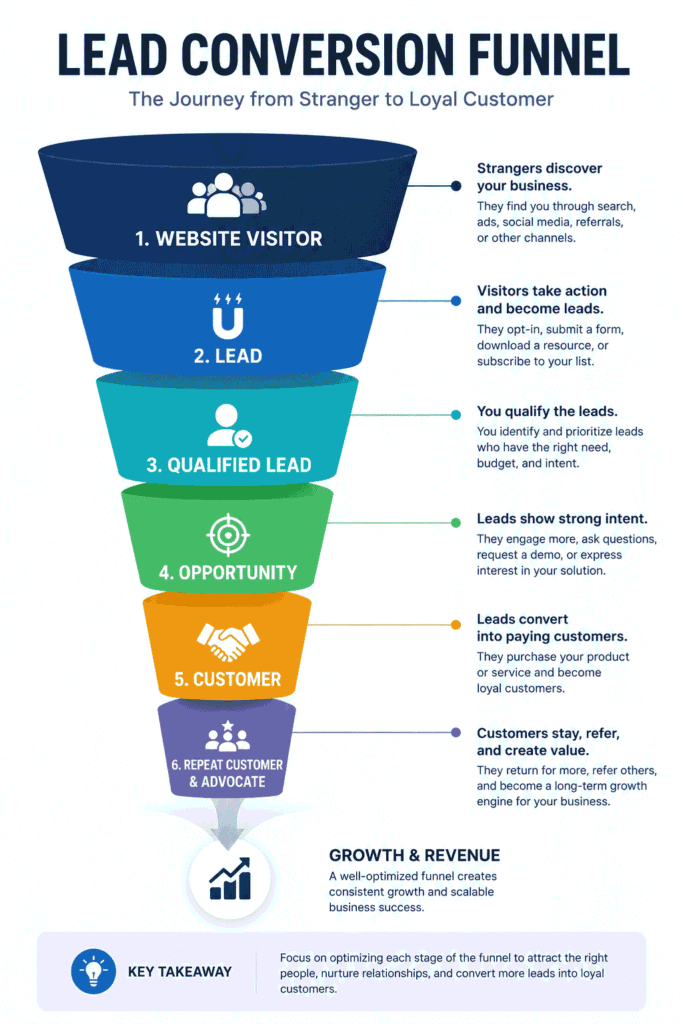
2.1. Awareness Stage
The awareness stage is the beginning of the customer journey.
At this point, prospects are becoming aware of a problem, need, or opportunity but may not yet know which solution is best for them. They are primarily searching for information, education, and guidance.
Businesses usually attract awareness-stage leads through:
- SEO Blog Content
- Social Media Content
- Educational Videos
- Paid Advertising
- Industry Guides
- Lead Magnets
- Webinars
The main goal during this stage is not immediate selling. Instead, businesses should focus on building visibility, trust, and initial engagement.
2.2. Interest Stage
During the interest stage, prospects begin actively exploring potential solutions.
They may subscribe to newsletters, download resources, compare providers, or revisit the website multiple times to learn more about the business and its offerings.
Common interest-stage behaviors include:
- Reading Multiple Blog Articles
- Subscribing To Email Lists
- Visiting Service Pages
- Engaging With Educational Content
- Following The Brand On Social Platforms
At this stage, businesses should focus on nurturing relationships and delivering value-driven communication that keeps prospects engaged.
2.3. Consideration Stage
In the consideration stage, leads begin evaluating whether a specific product or service is the right fit for their needs.
Prospects often compare competitors, review case studies, explore pricing information, and assess implementation requirements before moving closer to a buying decision.
Typical consideration-stage actions include:
- Reviewing Testimonials
- Comparing Solutions
- Checking Pricing Pages
- Watching Demo Videos
- Requesting Additional Information
- Attending Product Demonstrations
This stage requires stronger personalization, trust-building, and problem-focused communication.
2.4. Decision Stage
The decision stage is where prospects are closest to becoming customers.
At this point, leads typically show high purchase intent and are evaluating final details before making a commitment.
Common decision-stage signals include:
- Booking Sales Calls
- Requesting Demos
- Discussing Pricing
- Asking Implementation Questions
- Involving Team Members In Discussions
- Reviewing Contracts Or Proposals
Businesses that respond quickly, address objections effectively, and maintain trust during this stage usually improve conversion outcomes significantly.
2.5. Retention Stage
The customer journey does not end after conversion.
The retention stage focuses on maintaining customer relationships, improving satisfaction, and increasing long-term value after the initial purchase.
Businesses that prioritize retention often achieve:
- Higher Customer Loyalty
- Repeat Purchases
- Upsell Opportunities
- Referral Growth
- Stronger Brand Advocacy
Retention strategies commonly include:
- Customer Onboarding
- Educational Support Content
- Product Training
- Ongoing Communication
- Customer Success Programs
- Feedback Collection
Long-term business growth depends not only on acquiring customers but also on retaining and expanding customer relationships over time.
Before optimizing your lead conversion funnel, it’s important to understand who your ideal prospects are. A well-defined Ideal Customer Profile (ICP) helps businesses attract qualify leads that are more likely to convert into paying customers.
3. Why Most Leads Never Become Customers
Generating leads is relatively easy compared to converting them into paying customers. Many businesses successfully attract prospects through SEO, cold outreach, paid campaigns, or referrals, but the conversion process often breaks down after the initial interaction.
In most cases, leads do not disappear because the product is bad. They disappear because the customer journey lacks clarity, personalization, consistency, or trust. Even highly interested prospects can lose momentum if communication feels generic or follow-ups are delayed.
Modern buyers are more informed than ever. Before making a purchase decision, they typically compare competitors, review pricing, evaluate credibility, and interact with multiple brands simultaneously. Without a structured conversion system, businesses risk losing qualified opportunities long before a sales conversation is completed.
Below are some of the most common reasons why leads fail to convert.
3.1. Poor Lead Qualification
One of the biggest conversion problems begins at the targeting stage. Businesses often prioritize lead volume instead of lead quality, which fills the pipeline with prospects who may never become customers.
When unqualified leads enter the funnel, sales teams spend time on people who:
- Do Not Match The Ideal Customer Profile
- Lack Purchase Intent
- Have No Budget Authority
- Are Not Ready To Buy
- Do Not Need The Solution
This creates wasted effort, inconsistent conversion rates, and poor sales efficiency.
High-performing businesses focus heavily on lead qualification before investing time into outreach and nurturing. They identify whether a lead actually fits their product, industry, business size, pain points, and buying readiness.
Generating leads is only the first step. Without proper lead qualification, even large volumes of prospects may never become paying customers. A structured qualification framework helps identify sales-ready opportunities and improve conversion performance.
3.2. Slow Follow-Up
Speed plays a major role in lead conversion.
When a prospect submits a form, downloads a resource, or requests a demo, their interest level is highest during the first few hours. Delayed responses often reduce engagement significantly because the lead may already be evaluating competitors.
Many businesses lose opportunities simply because follow-up systems are inconsistent or manual.
Common follow-up problems include:
- Late Responses To Inquiries
- Missed Follow-Up Reminders
- No Structured Outreach Sequence
- Long Gaps Between Interactions
- Failure To Re-Engage Interested Leads
Fast and organized communication helps maintain buying momentum and improves trust during the early stages of the sales process.
3.3. Generic Outreach
Modern buyers can easily recognize mass outreach templates.
Generic emails that lack personalization often feel automated, irrelevant, and disconnected from the prospect’s actual challenges. As inbox competition increases, personalization becomes one of the strongest differentiators in lead conversion.
Poor outreach usually focuses too much on selling instead of solving problems.
Common outreach mistakes include:
- Using Generic Email Templates
- Sending The Same Message To Every Lead
- Ignoring Customer Pain Points
- Providing No Context Or Relevance
- Overusing Aggressive Sales Language
Effective lead conversion requires communication that feels tailored, contextual, and valuable to the specific prospect.
Tools like Apollo.io and Reply.io help businesses personalize outreach workflows at scale while maintaining consistency across campaigns.
Personalization is one of the most important factors in successful outreach. Using proven cold email templates as a starting point can help businesses create more relevant messages while maintaining consistency across campaigns.
3.4. No Lead Nurturing
Not every lead is ready to purchase immediately.
Many prospects require multiple touchpoints before they feel confident enough to make a buying decision. Businesses that push for immediate sales without nurturing relationships often lose potential customers prematurely.
Lead nurturing helps educate, build trust, and maintain engagement throughout the decision-making process.
Strong nurturing strategies typically include:
- Educational Email Sequences
- Case Studies And Success Stories
- Industry Insights
- Product Tutorials
- Webinars And Demonstrations
- Value-Driven Follow-Ups
Consistent nurturing keeps your business visible while helping prospects move naturally through the buying journey.
3.5. Weak Trust Signals
Trust is a major factor in every purchasing decision.
Even interested leads may hesitate if a business lacks credibility, authority, or social proof. Buyers want reassurance before investing time or money into a solution.
Weak trust signals often include:
- No Customer Testimonials
- Limited Online Presence
- No Case Studies
- Poor Website Experience
- Unclear Brand Positioning
- Lack Of Reviews Or Social Proof
Businesses that actively demonstrate expertise and customer success typically convert leads more effectively because they reduce perceived risk for potential buyers.
3.6. No CRM System
Without a proper CRM system, lead management becomes disorganized very quickly.
Businesses that rely on spreadsheets, manual notes, or scattered communication channels often struggle to track prospect activity, follow-ups, and sales progress consistently.
This leads to:
- Missed Opportunities
- Duplicate Outreach
- Poor Pipeline Visibility
- Lost Customer Data
- Inconsistent Follow-Ups
CRM platforms like HubSpot and Salesforce help businesses centralize lead tracking, automate workflows, and maintain visibility across the entire customer journey.
3.7. Inconsistent Communication
Consistency plays a major role in building trust and maintaining engagement.
Many businesses communicate actively during the first interaction but fail to maintain momentum afterward. Sporadic outreach can make prospects lose interest or question the reliability of the business itself.
Inconsistent communication often looks like:
- Irregular Follow-Ups
- Changing Messaging Styles
- Long Periods Of Silence
- Disconnected Sales Conversations
- Lack Of Customer Journey Coordination
Strong lead conversion systems create a predictable communication experience from the first interaction to the final sales discussion.
Ultimately, businesses that convert leads effectively are not necessarily generating more traffic than competitors. In many cases, they simply have better systems for qualification, follow-up, personalization, nurturing, and relationship management.
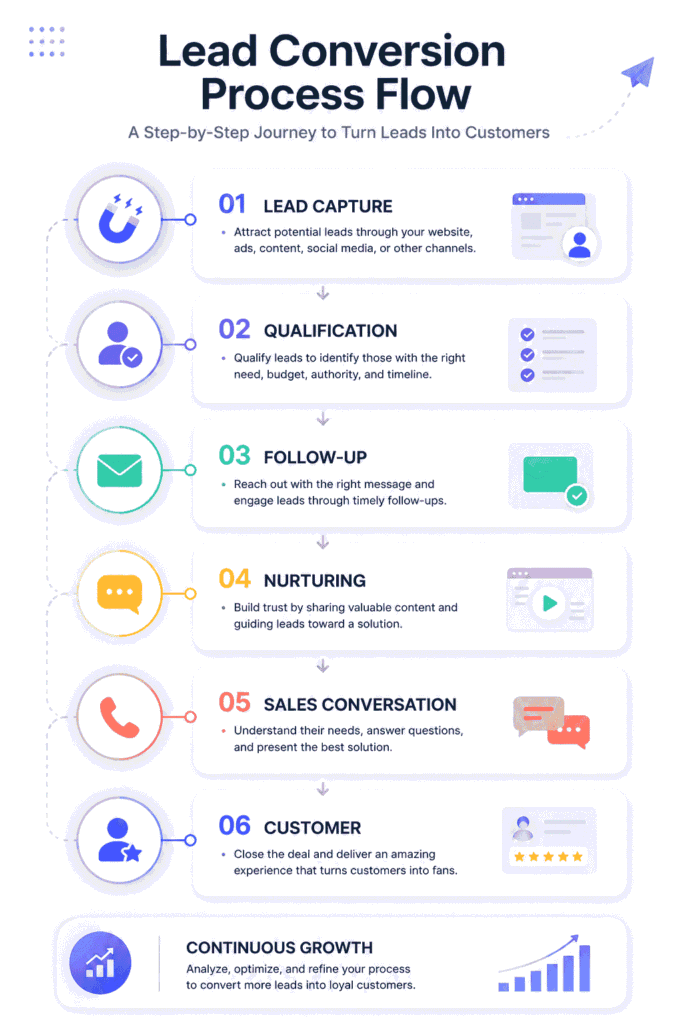
4. Step-by-Step Lead Conversion Process
Converting leads into customers is rarely the result of a single interaction. Most buyers move through multiple stages before making a purchasing decision, especially in modern B2B and service-based sales environments.
A prospect may discover your business through SEO content, paid ads, referrals, cold outreach, or social platforms, but conversion happens through consistent engagement, trust-building, personalization, and strategic follow-ups over time.
Businesses that achieve higher conversion rates usually follow a structured workflow instead of relying on random outreach or manual sales efforts. From lead qualification and segmentation to nurturing and CRM tracking, every stage of the process plays a role in moving prospects closer to becoming customers.
The following framework breaks down the complete lead conversion process businesses use to improve sales efficiency, reduce pipeline leakage, and convert high-intent leads more consistently.
Increasing lead volume does not automatically increase sales. Businesses that focus on lead quality often achieve better conversion rates, stronger customer relationships, and higher return on investment.
4.1. Capture High-Quality Leads
The lead conversion process starts long before a sales conversation happens. If the wrong prospects enter your pipeline, even the best outreach strategy and follow-up system will struggle to produce consistent results.
Many businesses make the mistake of chasing large lead volumes instead of focusing on lead relevance. While a bigger database may look impressive on paper, unqualified contacts usually create lower reply rates, poor engagement, and wasted sales effort.
High-converting businesses prioritize lead quality over quantity. Instead of targeting everyone, they focus on attracting prospects who closely match their ideal customer profile and already show signs of buying intent.
At the core of this process is ICP targeting.
An Ideal Customer Profile (ICP) defines the type of business or buyer most likely to benefit from your solution. This helps sales and marketing teams focus on prospects with a higher probability of conversion instead of relying on broad outreach campaigns.
Strong ICP targeting typically considers factors such as:
- Industry Relevance
- Company Size
- Business Goals
- Pain Points
- Decision-Maker Roles
- Technology Stack
- Budget Potential
When businesses clearly define their ICP, lead acquisition becomes more focused, personalized, and conversion-oriented.
Alongside ICP targeting, intent-based acquisition plays a major role in modern lead generation. Buyer intent refers to signals that indicate a prospect may already be researching or evaluating a solution.
Intent signals often include:
- Visiting Pricing Pages
- Downloading Lead Magnets
- Requesting Product Demos
- Engaging With Sales Emails
- Comparing Competitor Solutions
- Searching For Problem-Specific Keywords
These signals help businesses prioritize leads that are more likely to move forward in the sales funnel.
Platforms like Apollo.io help businesses identify targeted prospects using filters such as industry, company size, job title, hiring activity, and buyer intent signals. Similarly, LinkedIn remains one of the most valuable channels for identifying decision-makers, building professional relationships, and researching potential customers before outreach begins.
Ultimately, the goal is not to collect as many leads as possible. The goal is to capture the right leads — people who genuinely fit your product, have a relevant problem, and are more likely to convert into long-term customers.
4.2. Qualify Leads Properly
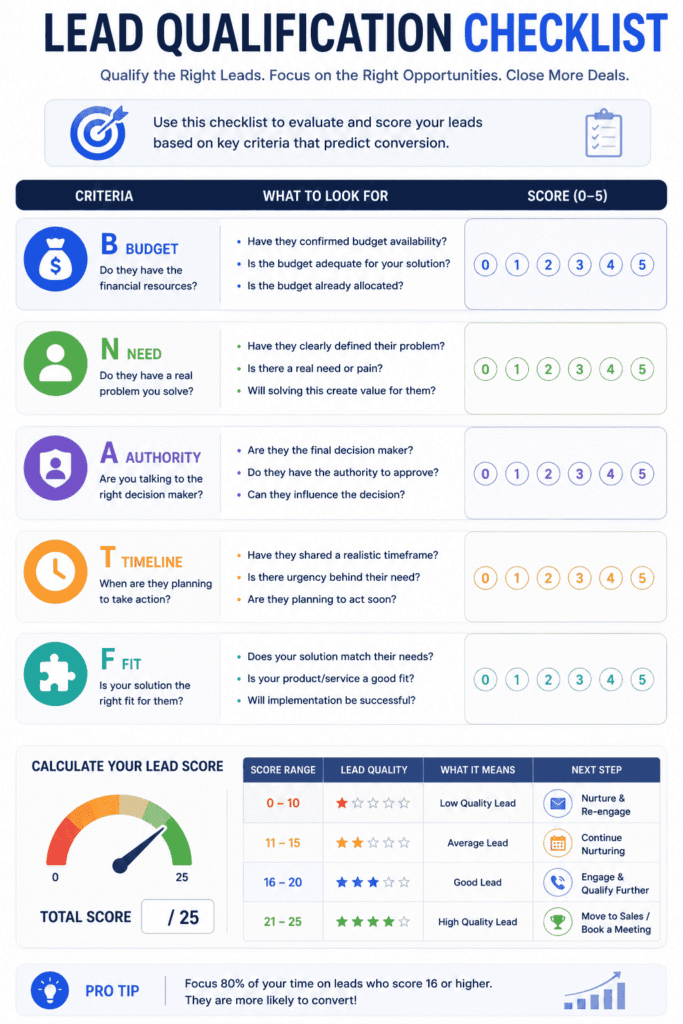
Capturing leads is only the first step. Once prospects enter your pipeline, businesses must determine which leads are genuinely ready for sales engagement and which still require nurturing.
Without a proper qualification process, sales teams often waste time pursuing leads that lack interest, urgency, or purchasing potential. This creates inefficiency across the entire sales funnel and lowers overall conversion performance.
Lead qualification helps businesses prioritize opportunities based on buyer readiness and engagement signals. Instead of treating every lead equally, companies segment prospects according to where they are in the customer journey.
Three common qualification categories used in modern sales workflows are:
- Marketing Qualified Leads (MQLs)
- Sales Qualified Leads (SQLs)
- Product Qualified Leads (PQLs)
4.2.1. Marketing Qualified Leads (MQLs)
MQLs are prospects who have shown interest in your business through marketing-related interactions but may not yet be ready for direct sales conversations.
Typical MQL activities include:
- Downloading Ebooks
- Subscribing To Newsletters
- Visiting Multiple Blog Pages
- Registering For Webinars
- Engaging With Educational Content
These leads usually require further nurturing before moving deeper into the sales process.
4.2.2. Sales Qualified Leads (SQLs)
SQLs are leads that demonstrate stronger buying intent and are considered ready for direct sales engagement.
Common SQL signals include:
- Requesting Product Demos
- Replying To Sales Outreach
- Visiting Pricing Pages Frequently
- Asking About Implementation
- Showing Clear Purchase Interest
At this stage, sales teams typically begin more personalized conversations focused on solving business problems and closing deals.
4.2.3. Product Qualified Leads (PQLs)
PQLs are commonly used in SaaS businesses where prospects experience the product before purchasing.
These leads become qualified based on product usage behavior such as:
- Using Premium Features
- Inviting Team Members
- Reaching Usage Limits
- Completing Key In-App Actions
- Returning To The Platform Frequently
PQLs are highly valuable because their engagement is based on real product interaction rather than only marketing activity.
Beyond qualification categories, many businesses also rely on lead scoring systems to prioritize prospects more efficiently.
Lead scoring assigns values to different actions and characteristics based on conversion potential. This helps teams identify which leads deserve immediate attention and which should remain in nurturing workflows.
Basic lead scoring factors often include:
- Website Engagement
- Email Interaction
- Company Size
- Job Role
- Industry Match
- Demo Requests
- Product Usage Activity
CRM platforms like HubSpot and sales automation tools help businesses automate this qualification process by tracking engagement signals across the customer journey.
A strong qualification system ensures that sales teams focus their time on high-intent prospects instead of manually sorting through low-conversion opportunities.
The conversion process starts with effective lead generation strategies that attract qualified prospects into your sales funnel.
5. Segment Leads Based on Intent
Not every lead enters the sales funnel with the same level of interest or buying readiness. Some prospects may only be exploring solutions, while others are actively comparing vendors and preparing to make a purchase decision.
Treating every lead the same often leads to poor engagement, irrelevant communication, and lower conversion rates. This is why lead segmentation plays such an important role in the conversion process.
Lead segmentation helps businesses organize prospects based on behavior, intent, engagement level, and stage in the customer journey. Instead of sending identical messaging to every contact, companies can deliver more relevant communication tailored to specific buyer needs.
Common lead segments typically include:
- Cold Leads
Prospects with minimal engagement who may have recently entered the funnel through blog content, ads, or lead magnets. - Warm Leads
Contacts who have interacted with emails, visited important pages, or shown recurring interest in your business. - Demo-Request Leads
High-intent prospects actively evaluating your solution and looking for direct sales conversations or product demonstrations. - Returning Visitors
Leads who repeatedly visit your website, pricing pages, or product-related content, indicating growing interest over time.
Segmenting leads properly allows businesses to improve:
- Email Relevance
- Follow-Up Timing
- Sales Prioritization
- Customer Experience
- Conversion Efficiency
For example, a cold lead may require educational nurturing content, while a demo-request lead typically needs faster sales engagement and personalized communication.
Modern CRM and sales engagement platforms help businesses automate segmentation workflows based on behavioral triggers, engagement activity, and customer intent signals. This creates a more organized pipeline and ensures prospects receive communication that matches their stage in the buying process.
Ultimately, effective segmentation helps businesses move away from mass outreach and toward more targeted, conversion-focused engagement strategies.
Not all leads are at the same stage of the buying journey. Segmenting prospects into categories such as Marketing Qualified Leads (MQLs), Sales Qualified Leads (SQLs), and Product Qualified Leads (PQLs) helps businesses personalize communication, prioritize follow-ups, and improve conversion rates.
6. Personalize Communication
Personalization has become one of the most important factors in modern lead conversion. As inbox competition continues to increase, generic outreach messages are easier than ever for prospects to ignore.
Today’s buyers expect communication that feels relevant to their business challenges, goals, and interests. Businesses that rely on mass messaging without context often struggle to build engagement or trust.
Effective personalization is not just about adding a first name to an email. True personalization focuses on understanding the prospect’s situation and delivering communication that feels timely, valuable, and specific.
High-converting businesses typically personalize outreach using factors such as:
- Industry Challenges
- Company Growth Signals
- Buyer Intent Data
- Job Roles And Responsibilities
- Previous Interactions
- Website Behavior
- Pain Points And Business Goals
This approach makes communication more meaningful and increases the likelihood of replies and conversations.
One of the most common personalization strategies involves personalized cold emails. Instead of sending broad templates, businesses tailor messaging around the prospect’s actual business context.
Strong personalized outreach often includes:
- Relevant Pain-Point Discussions
- Industry-Specific Messaging
- Contextual Opening Lines
- Customized Value Propositions
- Behavior-Based Follow-Ups
Dynamic messaging also plays a major role in modern sales workflows. Businesses can automatically adjust messaging based on customer behavior, engagement level, or funnel stage.
For example:
- Returning Visitors may receive product-focused follow-ups
- Inactive Leads may receive re-engagement campaigns
- Demo Leads may receive implementation-related messaging
- Highly Engaged Prospects may receive direct sales outreach
Behavioral personalization helps businesses create more relevant customer experiences without manually managing every interaction.
Sales engagement platforms like Reply.io help businesses scale personalized outreach by combining automation with dynamic messaging workflows, follow-up sequencing, and engagement tracking.
Ultimately, personalization improves lead conversion because it shifts communication away from generic selling and toward problem-solving conversations that feel more human and relevant to the buyer.
Sales intelligence platforms such as Apollo.io can help teams gather prospect insights, build targeted lead lists, and personalize outreach at scale.
7. Follow Up Consistently
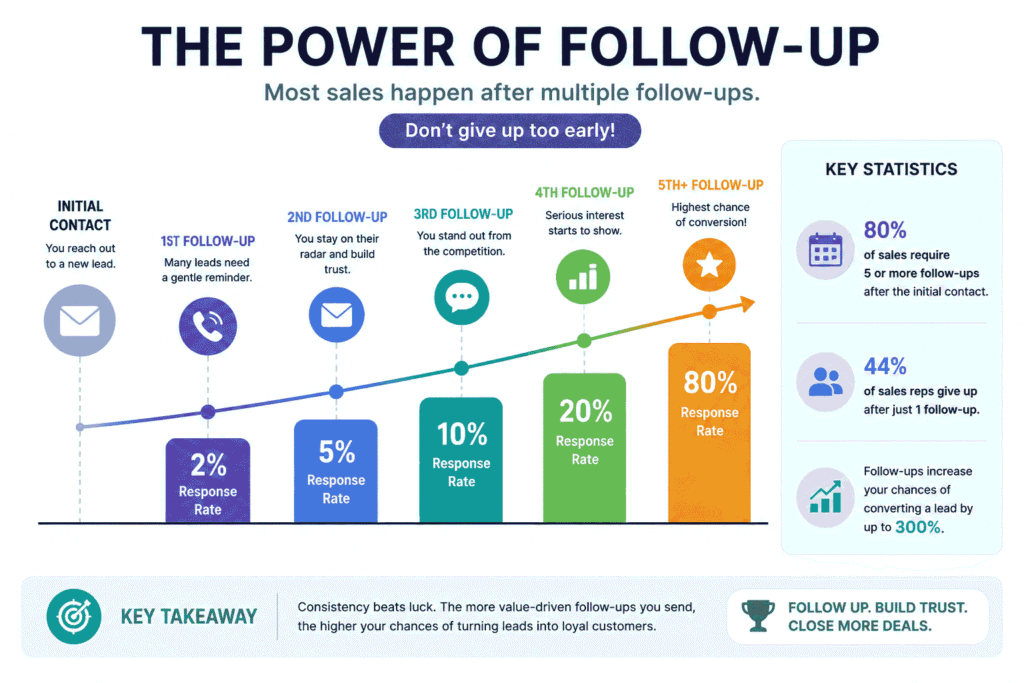
Many leads do not convert because businesses stop communicating too early. In modern sales environments, a single email or one sales call is rarely enough to move prospects toward a purchasing decision.
Most buyers require multiple interactions before they respond, book a meeting, or feel confident enough to move forward. This is why consistent follow-up is one of the most important parts of the lead conversion process.
Businesses that maintain structured follow-up systems usually achieve better engagement and higher conversion rates because they remain visible throughout the buyer journey.
One of the biggest factors in successful follow-up is timing. Reaching out too late can reduce momentum, while excessive outreach within short timeframes can feel intrusive.
Effective follow-up strategies typically focus on:
- Timely Responses To Lead Activity
- Consistent Communication Intervals
- Behavior-Based Outreach Timing
- Fast Engagement After Demo Requests
- Regular Yet Non-Intrusive Follow-Ups
Multi-touch outreach also plays a critical role in improving lead engagement. Instead of relying on a single communication channel, businesses connect with prospects across multiple touchpoints over time.
A structured Multi-touch strategy may include:
- Cold Emails
- LinkedIn Engagement
- Follow-Up Calls
- Educational Content Sharing
- Product Demonstrations
- Retargeting Campaigns
This creates repeated visibility without depending entirely on one interaction to generate a response.
Email sequences help businesses automate this process more efficiently. Rather than manually tracking every lead, businesses can create follow-up workflows that guide prospects through different stages of the funnel.
Well-structured sequences often include:
- Introduction Emails
- Value-Driven Follow-Ups
- Case Study Sharing
- Pain-Point Discussions
- Meeting Requests
- Re-Engagement Messages
Automation tools can also trigger reminders for sales teams when prospects engage with emails, revisit pricing pages, or interact with important content. This improves response timing and reduces missed opportunities.
However, persistence should never feel aggressive or spam-driven.
One of the biggest mistakes businesses make is prioritizing outreach volume over relevance. Excessive follow-ups without personalization or value often damage trust and reduce reply rates.
Strong follow-up systems balance persistence with relevance by focusing on:
- Helpful Communication
- Contextual Messaging
- Clear Value Delivery
- Respectful Timing
- Customer-Centric Conversations
The goal is not simply to send more messages. The goal is to remain consistently helpful and visible while guiding prospects toward a confident buying decision.
Modern sales engagement platforms such as Reply.io make it easier to automate follow-ups while maintaining personalization throughout the customer journey.
8. Use CRM Systems to Track Leads
As lead volume grows, managing prospects manually becomes increasingly difficult. Without a centralized system, businesses often lose track of follow-ups, miss opportunities, and struggle to maintain visibility across the sales pipeline.
This is where CRM systems become essential.
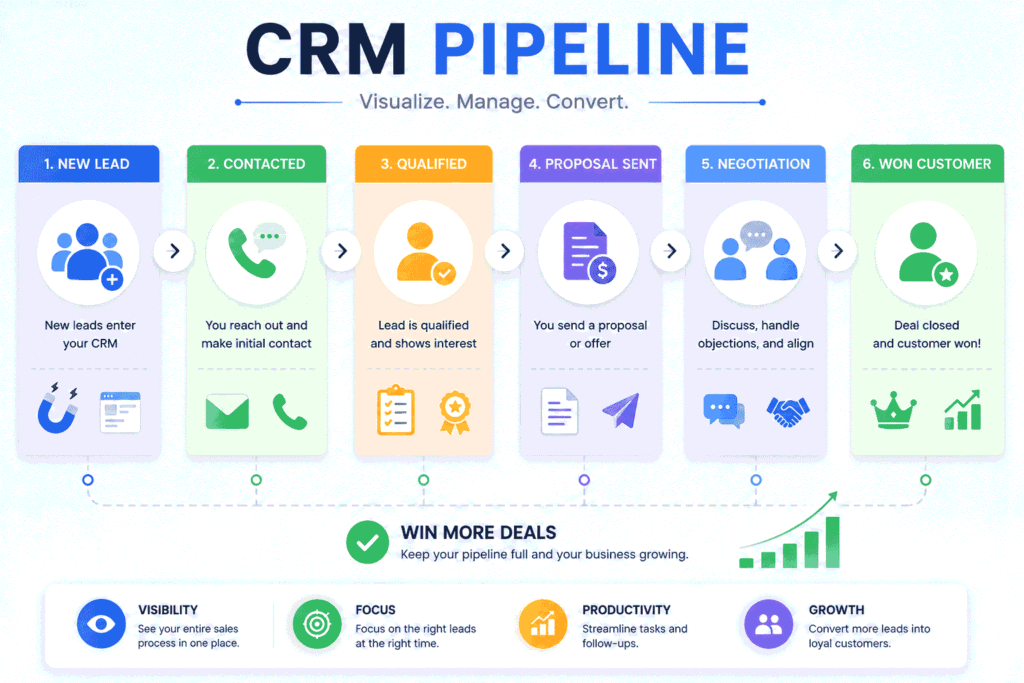
Customer Relationship Management (CRM) platforms help businesses organize, track, and manage every stage of the customer journey from initial contact to final conversion.
Instead of relying on spreadsheets or scattered communication records, CRM systems provide a structured environment for managing lead activity, sales conversations, and follow-up workflows more efficiently.
Popular CRM platforms like HubSpot and Salesforce are widely used by businesses to improve sales organization, automation, and pipeline management.
One of the biggest advantages of CRM software is pipeline tracking. Businesses can clearly visualize where each lead sits within the sales process and identify which opportunities require attention.
Pipeline tracking helps teams:
- Monitor Sales Stages
- Identify Conversion Bottlenecks
- Track Lead Progress
- Improve Sales Forecasting
- Prioritize High-Intent Opportunities
Automation is another major benefit of modern CRM systems. Instead of manually managing repetitive tasks, businesses can automate large portions of the sales workflow.
CRM automation commonly includes:
- Automated Follow-Up Emails
- Lead Assignment Workflows
- Pipeline Status Updates
- Engagement Tracking
- Lead Scoring Rules
- Customer Journey Triggers
This improves operational efficiency while reducing manual workload for sales teams.
Task reminders also play an important role in maintaining follow-up consistency. CRM systems help businesses schedule calls, meetings, email reminders, and outreach tasks to ensure prospects are not forgotten during the sales process.
Strong CRM workflows help prevent:
- Missed Follow-Ups
- Delayed Responses
- Duplicate Outreach
- Lost Customer Information
- Disorganized Communication
Another critical advantage is sales visibility. CRM platforms provide centralized access to customer interactions, engagement history, and pipeline performance, allowing teams to make more informed decisions.
Improved visibility helps businesses:
- Track Team Performance
- Measure Conversion Metrics
- Understand Buyer Behavior
- Improve Forecast Accuracy
- Optimize Sales Workflows
Ultimately, CRM systems help businesses build a more scalable and organized lead conversion process. Instead of managing leads reactively, companies can create structured workflows that improve efficiency, consistency, and long-term sales performance.
A CRM serves as the central hub for managing prospect interactions, tracking opportunities, and improving lead conversion workflows. For growing businesses, choosing the right CRM system can help organize customer data, automate follow-ups, and streamline the sales process.
9. Nurture Leads Before Selling
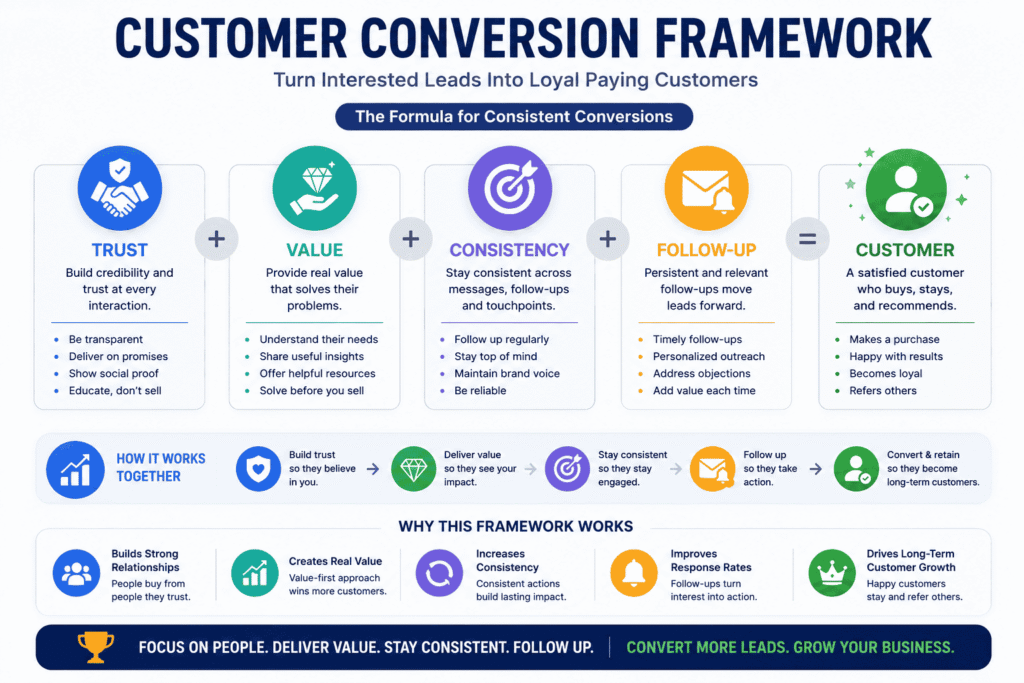
One of the biggest mistakes businesses make is trying to sell too early. Not every prospect is ready to make a purchasing decision immediately after entering the funnel, especially in B2B and high-consideration buying environments.
Modern buyers often spend time researching solutions, comparing competitors, evaluating pricing, and understanding implementation before committing to a product or service. Businesses that focus only on direct selling without nurturing relationships frequently lose potential customers during this evaluation phase.
Lead nurturing helps businesses maintain engagement while gradually building trust, credibility, and buyer confidence over time.
Instead of pushing aggressive sales messaging, effective nurturing focuses on delivering consistent value through relevant content and educational communication.
Strong lead nurturing strategies commonly include:
- Educational Content
- Industry Insights
- Case Studies
- Webinars And Live Sessions
- Email Newsletters
- Product Tutorials
- Customer Success Stories
Educational content plays a major role in helping prospects understand their problems, explore potential solutions, and make informed decisions. Businesses that consistently educate their audience often position themselves as trusted industry resources rather than just service providers.
Case studies are especially powerful because they demonstrate real-world results. Instead of making broad claims, businesses can showcase how their product or service solved specific challenges for actual customers.
Similarly, webinars and live demonstrations help prospects engage more deeply with the solution while building familiarity with the brand. Interactive formats also create opportunities to answer objections and address buyer concerns in real time.
Newsletters help businesses stay visible throughout the customer journey by maintaining ongoing communication with leads who may not yet be ready to purchase. Consistent engagement keeps the brand top-of-mind while reinforcing authority and expertise over time.
At the center of effective nurturing is a value-first approach.
Rather than focusing every interaction on closing a deal, high-performing businesses prioritize:
- Helping Prospects Solve Problems
- Answering Common Questions
- Providing Useful Resources
- Sharing Actionable Insights
- Building Long-Term Relationships
This approach creates stronger trust and improves the likelihood of conversion when prospects eventually become ready to buy.
Ultimately, lead nurturing is about guiding prospects through the decision-making process instead of forcing immediate sales conversations before sufficient trust has been established.
Businesses increasingly use AI-powered sales tools to automate lead nurturing, email sequencing, and prospect engagement.
10. Build Trust Before Asking for the Sale
Trust is one of the most important factors in lead conversion. Even highly interested prospects may hesitate to move forward if they are uncertain about a business’s credibility, expertise, or reliability.
Before making a purchasing decision, buyers typically look for signals that reduce risk and validate their confidence in the solution. Businesses that establish trust early in the customer journey often convert leads more effectively because prospects feel more comfortable engaging in sales conversations.
One of the strongest trust-building elements is customer validation.
Buyers naturally want proof that a product or service has delivered results for other businesses in similar situations. This is why social proof plays such a critical role in modern sales and marketing strategies.
Common trust-building assets include:
- Customer Testimonials
- Case Studies
- Client Reviews
- Social Proof Metrics
- Industry Recognition
- Authority Content
- Product Demonstrations
- Demo Videos
Testimonials help prospects understand how existing customers benefited from the solution, while reviews provide independent validation that reinforces credibility.
Social proof can also include:
- Customer Counts
- User Ratings
- Brand Partnerships
- Success Statistics
- Public Recommendations
These signals help reduce uncertainty and strengthen buyer confidence throughout the decision-making process.
Authority content is another important trust factor. Businesses that consistently publish valuable educational resources often establish themselves as knowledgeable industry leaders. High-quality blog content, research reports, implementation guides, and expert insights all contribute to stronger brand credibility over time.
Demo videos and product walkthroughs further improve trust by helping prospects visualize how the solution works in real-world scenarios. Instead of relying only on written explanations, visual demonstrations allow buyers to better understand features, workflows, and expected outcomes.
Trust-building should happen throughout the entire customer journey — not only at the final sales stage.
Businesses that focus on credibility, transparency, and customer education typically create stronger relationships and improve long-term conversion performance because prospects feel more confident before making a purchase decision.
Personalized outreach supported by accurate prospect data helps businesses establish credibility and trust throughout the buying journey. Tools like Apollo.io can help sales teams identify decision-makers, gather prospect insights, and streamline LinkedIn lead prospecting efforts.
11. Signs A Lead Is Ready To Become A Customer
Not every lead in your pipeline is ready to make a purchase immediately. Some prospects may still be researching solutions, while others are already close to making a buying decision.
One of the biggest advantages experienced sales teams have is their ability to recognize buying intent signals early. Identifying these signals helps businesses prioritize high-intent leads, improve follow-up timing, and focus sales efforts where conversion probability is highest.
Instead of treating every lead equally, businesses should monitor behavioral patterns that indicate growing interest and purchase readiness.
Below are some of the most common signs that a lead may be ready to become a customer.
11.1. Repeated Pricing Page Visits
Pricing page activity is often one of the strongest buying intent signals.
When a prospect repeatedly visits pricing-related pages, it usually indicates they are actively evaluating affordability, comparing plans, or preparing for internal decision-making discussions.
Frequent pricing-page engagement often suggests:
- Growing Purchase Intent
- Solution Evaluation
- Budget Consideration
- Vendor Comparison Activity
Businesses should pay close attention to leads that revisit pricing pages multiple times within short periods.
11.2. Asking Implementation Questions
Prospects who begin asking implementation-related questions are often moving closer to the decision stage.
Instead of only exploring features, these leads start focusing on practical considerations such as:
- Setup Process
- Integration Requirements
- Onboarding Timeline
- Team Adoption
- Workflow Compatibility
- Technical Support
This shift usually indicates that the buyer is visualizing how the solution would function inside their business environment.
11.3. Multiple Email Replies
Leads who consistently respond to outreach emails demonstrate active engagement and interest.
Even short replies often indicate that the prospect is paying attention to communication and evaluating the conversation seriously.
High-engagement email behavior may include:
- Replying To Follow-Ups
- Asking Clarifying Questions
- Requesting More Information
- Continuing Sales Conversations
- Engaging Across Multiple Touchpoints
Consistent communication is typically a stronger buying signal than passive content consumption alone.
11.4. Demo Requests
Demo requests are one of the clearest indicators of sales readiness.
When prospects request product demonstrations, consultation calls, or discovery meetings, they are usually looking for deeper evaluation before making a purchase decision.
Demo-request leads often want to:
- Understand Product Fit
- Evaluate Use Cases
- Discuss Business Challenges
- Explore Pricing And Features
- Assess Implementation Requirements
These leads generally deserve faster follow-up priority within the sales pipeline.
11.5. High Engagement Behavior
Prospects who repeatedly interact with your brand across multiple channels often show stronger purchase intent over time.
High-engagement behavior may include:
- Opening Multiple Emails
- Returning To The Website Frequently
- Downloading Additional Resources
- Watching Demo Videos
- Reading Multiple Blog Articles
- Engaging With Webinars Or Events
The more consistently a lead interacts with your content and communication, the more likely they are progressing through the buying journey.
11.6. Comparing Competitors
Leads evaluating competitor alternatives are often entering the consideration or decision stage of the funnel.
This behavior may appear through:
- Competitor Comparison Questions
- Feature Comparison Requests
- Pricing Evaluation Discussions
- Migration Or Switching Questions
- Alternative Solution Research
Although competitor evaluation can feel risky, it is usually a positive sign because the prospect is actively narrowing down purchasing options.
11.7. Team Involvement In Discussions
One of the strongest B2B buying signals occurs when additional stakeholders become involved in conversations.
As purchase intent increases, businesses often include:
- Decision-Makers
- Managers
- Technical Teams
- Procurement Teams
- Operations Stakeholders
This typically indicates that internal evaluation and approval discussions are already happening behind the scenes.
For many businesses, multi-person involvement signals that the lead is progressing closer toward a final decision.
Recognizing these buying intent signals helps businesses improve prioritization, personalize follow-ups more effectively, and engage high-intent prospects at the right moment.
Instead of relying only on assumptions, modern CRM and sales engagement platforms allow businesses to track behavioral patterns and identify which leads are most likely to convert into customers.
12. Best AI Tools for Lead Conversion
Modern lead conversion is no longer managed entirely through manual spreadsheets, disconnected follow-ups, or scattered outreach efforts. As sales processes become more data-driven and personalized, businesses increasingly rely on AI-powered tools to automate workflows, improve targeting, and manage customer interactions more efficiently.
The right sales and automation stack can help businesses:
- Identify High-Intent Prospects
- Personalize Outreach At Scale
- Automate Follow-Up Sequences
- Track Customer Engagement
- Manage Sales Pipelines
- Improve Lead Nurturing
- Reduce Manual Workload
Instead of replacing human interaction, AI tools help sales and marketing teams operate more strategically by automating repetitive processes and improving decision-making across the customer journey.
Below are some of the most effective AI-powered platforms businesses use to improve lead conversion workflows.
12.1. Apollo.io — For Lead Sourcing And Enrichment
Apollo.io is widely used for B2B lead generation, prospect research, and sales intelligence.
The platform helps businesses identify targeted leads using filters such as:
- Industry
- Company Size
- Job Title
- Hiring Activity
- Technology Stack
- Revenue Range
- Buyer Intent Signals
Beyond lead discovery, Apollo.io also supports contact enrichment, helping businesses access updated company and decision-maker information to improve outreach accuracy.
Many sales teams use Apollo.io to:
- Build Prospect Lists
- Research Decision-Makers
- Segment Leads
- Track Buying Signals
- Improve Outbound Targeting
For businesses focused on scalable outbound lead generation, Apollo.io often becomes a central part of the lead acquisition workflow.
The Apollo.io Chrome Extension helps sales teams research prospects, find contact information, and access company insights directly from LinkedIn and business websites, making lead qualification and personalization more efficient.
12.2. Reply.io — For Outreach Automation
Reply.io helps businesses automate and personalize outbound communication across multiple channels.
Instead of manually sending every follow-up email, businesses can create structured outreach workflows that maintain consistent communication throughout the sales process.
Reply.io supports:
- Automated Email Sequences
- Multi-Touch Outreach
- Personalized Messaging
- Follow-Up Automation
- Engagement Tracking
- Meeting Scheduling
One of its biggest advantages is the ability to combine automation with personalization. Businesses can tailor messaging based on prospect behavior, industry, or engagement history while still scaling outreach efficiently.
This helps sales teams improve:
- Reply Rates
- Follow-Up Consistency
- Pipeline Activity
- Sales Productivity
For outbound sales workflows, Reply.io is commonly used to streamline communication without sacrificing relevance.
Reply.io enables businesses to automate multichannel outreach, manage follow-up sequences, and engage prospects more consistently throughout the lead conversion process.
12.3. HubSpot — For CRM And Lead Nurturing
HubSpot is one of the most widely adopted CRM and marketing automation platforms for managing the full customer journey.
The platform combines CRM functionality with sales, marketing, and customer engagement tools, making it valuable for businesses that want centralized lead management.
HubSpot helps businesses:
- Track Sales Pipelines
- Manage Customer Interactions
- Automate Lead Nurturing
- Monitor Engagement Activity
- Create Email Workflows
- Score And Segment Leads
- Measure Conversion Performance
Its automation capabilities allow businesses to nurture prospects more effectively through personalized workflows and behavioral triggers.
For example, businesses can automatically:
- Send Follow-Up Emails
- Assign Leads To Sales Teams
- Trigger Nurturing Campaigns
- Track Website Activity
- Create Reminder Tasks
This improves visibility across the sales process while helping teams maintain consistent communication with prospects.
HubSpot CRM provides a centralized platform for managing contacts, tracking sales activities, and monitoring pipeline performance, helping businesses improve lead management and customer conversion.
12.4. Zapier — For Workflow Automation
Zapier helps businesses connect different applications and automate repetitive tasks without requiring complex development work.
In lead conversion workflows, businesses often use multiple tools for:
- Lead Generation
- CRM Management
- Email Outreach
- Scheduling
- Analytics
- Customer Support
Zapier acts as a bridge between these platforms by automating data movement and workflow actions across systems.
Common automation examples include:
- Adding New Leads Into CRM Systems
- Sending Slack Notifications For Demo Requests
- Triggering Follow-Up Emails Automatically
- Syncing Form Submissions Across Platforms
- Updating Pipeline Stages
- Creating Sales Tasks Automatically
These automations help reduce manual work while improving operational efficiency and response speed.
Ultimately, AI-powered sales tools are most effective when they support a structured lead conversion strategy rather than replace it. Businesses that combine automation with strong personalization, nurturing, and customer experience typically achieve better long-term conversion results.
13. Lead Conversion Strategies For Different Business Types
Lead conversion strategies are not identical across every business model. The way a SaaS company converts leads is very different from how an ecommerce brand, agency, or local business approaches customer acquisition.
Different industries have:
- Different buyer journeys
- Different sales cycles
- Different trust requirements
- Different communication styles
- Different conversion triggers
Because of this, businesses should adapt their lead conversion strategy based on how their customers make purchasing decisions.
Below are some of the most common lead conversion approaches used across different business types.
13.1. SaaS Businesses
SaaS companies typically operate in highly competitive and education-driven sales environments. Buyers often spend time comparing features, evaluating integrations, and testing products before making a decision.
As a result, SaaS lead conversion strategies heavily focus on:
- Free Trials
- Product Demonstrations
- Email Nurturing
- Product Education
- Behavioral Tracking
- Lead Scoring
- Onboarding Workflows
SaaS businesses also rely heavily on CRM systems and sales automation platforms to track user behavior and identify high-intent prospects.
Common SaaS buying signals include:
- Repeated Product Usage
- Pricing Page Visits
- Feature Exploration
- Team Invitations
- Demo Requests
The overall goal is to guide users from product interest to product adoption while reducing friction during the evaluation process.
13.2. Agencies
Agencies usually convert leads through relationship-building, trust, and expertise demonstration rather than instant purchases.
Potential clients often evaluate:
- Portfolio Quality
- Case Studies
- Industry Experience
- Communication Style
- Results And Testimonials
Because agency services are often customized, conversion usually requires more consultative sales conversations.
Successful agency lead conversion strategies commonly include:
- Discovery Calls
- Personalized Outreach
- Audit-Based Selling
- Proposal Discussions
- Case Study Sharing
- Long-Term Nurturing
Agencies that consistently educate prospects and demonstrate measurable outcomes generally achieve stronger conversion performance.
13.3. B2B Service Businesses
B2B service providers often deal with longer sales cycles and multiple decision-makers.
Unlike impulse-driven purchasing, B2B buyers usually require:
- Internal Approval
- Budget Discussions
- Technical Evaluation
- Stakeholder Alignment
- Trust Validation
Because of this, lead nurturing becomes especially important.
High-performing B2B conversion strategies often focus on:
- Educational Content
- Industry Authority
- Consultative Selling
- Personalized Follow-Ups
- Relationship Building
- CRM-Based Lead Management
Businesses in this category often benefit significantly from structured sales pipelines and multi-touch communication workflows.
13.4. Ecommerce Businesses
Ecommerce lead conversion strategies are usually faster and more behavior-driven compared to B2B sales models.
Instead of long sales conversations, ecommerce businesses focus on reducing friction and improving purchase convenience.
Strong ecommerce conversion strategies commonly include:
- Cart Abandonment Campaigns
- Product Recommendations
- Retargeting Ads
- Discount Offers
- Social Proof
- Email Automation
- Fast Checkout Experiences
Customer behavior tracking is especially important in ecommerce because purchase intent often changes quickly.
Common buying signals include:
- Repeated Product Views
- Cart Activity
- Wishlist Additions
- Email Click Behavior
- Returning Store Visits
The primary goal is to create a smooth and low-friction buying experience.
13.5. Local Businesses
Local businesses often rely heavily on trust, reputation, and quick customer response times.
Unlike large-scale digital funnels, local lead conversion is frequently influenced by:
- Online Reviews
- Local SEO Visibility
- Referral Trust
- Phone Call Response Speed
- Community Reputation
- Google Business Profile Activity
Successful local business conversion strategies usually focus on:
- Fast Inquiry Responses
- Appointment Scheduling
- Review Generation
- Location-Based SEO
- Customer Testimonials
- Simple Contact Workflows
Because local customers often make decisions quickly, businesses that respond faster and build stronger local trust signals typically convert more leads successfully.
Although the core principles of lead conversion remain similar across industries, the execution strategy should always align with the customer journey, sales cycle, and buying behavior specific to the business model.
The quality of leads entering your sales funnel plays a major role in conversion success. Understanding the differences between inbound and outbound lead generation can help businesses attract more qualified prospects and improve overall conversion rates.
14. How AI Is Transforming Lead Conversion
Lead conversion has changed significantly in recent years as businesses increasingly adopt AI-powered tools and automation workflows to improve customer engagement, sales efficiency, and personalization.
Traditional lead conversion processes often relied heavily on manual outreach, spreadsheet tracking, and generalized communication. While those methods can still work, modern businesses now use AI-driven systems to make lead management faster, more scalable, and more data-driven.
Instead of manually analyzing every prospect, AI tools help businesses identify patterns, predict buyer behavior, automate repetitive tasks, and personalize communication across the customer journey.
As competition increases across digital channels, AI-powered lead conversion strategies are becoming a major competitive advantage for modern businesses.
Below are some of the most important ways AI is transforming lead conversion workflows.
14.1. AI Personalization
Personalization is one of the biggest drivers of modern lead conversion, and AI is helping businesses scale personalization far beyond basic first-name email customization.
AI-powered systems can analyze:
- Buyer Behavior
- Website Activity
- Content Engagement
- Industry Data
- Purchase Intent Signals
- Previous Interactions
This allows businesses to deliver more relevant communication based on individual customer behavior and interests.
AI personalization is commonly used for:
- Dynamic Email Messaging
- Content Recommendations
- Behavior-Based Follow-Ups
- Personalized Outreach Campaigns
- Customer Journey Customization
This improves engagement while helping businesses create more human and context-driven customer experiences at scale.
14.2. Predictive Lead Scoring
Traditional lead scoring often depended on manual qualification rules and basic engagement metrics. AI-driven predictive lead scoring goes much deeper by analyzing historical conversion patterns and buyer behavior automatically.
AI systems can identify which leads are more likely to convert based on:
- Engagement Activity
- Buying Signals
- Company Data
- Behavioral Trends
- Previous Customer Patterns
- Intent Indicators
This helps sales teams prioritize high-conversion opportunities instead of spending equal time on every lead.
Platforms like HubSpot increasingly use AI-driven insights to help businesses improve lead prioritization and pipeline management.
14.3. Automated Follow-Ups
One of the biggest challenges in lead conversion is maintaining consistent communication without overwhelming sales teams with manual work.
AI-powered automation tools now help businesses:
- Trigger Follow-Up Sequences Automatically
- Schedule Outreach Based On Engagement
- Send Behavior-Driven Emails
- Automate Reminder Workflows
- Track Customer Responses
- Maintain Multi-Touch Communication
This improves follow-up consistency while reducing missed opportunities.
Automation platforms also help businesses respond faster to high-intent actions such as:
- Demo Requests
- Pricing Page Visits
- Email Replies
- Returning Website Activity
Timely engagement often plays a major role in improving conversion rates.
14.4. Intent Analysis
Modern AI systems can analyze customer behavior patterns to identify buying intent more accurately.
Instead of relying only on form submissions or email replies, businesses can now track signals such as:
- Repeated Website Visits
- Pricing Page Activity
- Content Consumption Patterns
- Competitor Comparison Behavior
- Engagement Frequency
- Product Interaction Data
Intent analysis helps businesses understand which prospects are actively moving closer toward a purchasing decision.
Platforms like Apollo.io help businesses identify intent-based signals that improve prospect targeting and outreach prioritization.
14.5. Conversational AI
Conversational AI tools are increasingly being used to engage leads in real time across websites, chat systems, and customer support channels.
AI-powered chat systems can:
- Answer Common Questions
- Qualify Leads Automatically
- Book Meetings
- Recommend Resources
- Route Prospects To Sales Teams
- Collect Customer Information
This helps businesses maintain engagement even outside standard working hours while improving response speed and customer experience.
Conversational AI also reduces friction by helping prospects access information quickly during the early stages of the buying journey.
14.6. CRM Automation
AI-enhanced CRM systems are becoming central to modern lead conversion workflows.
Instead of acting only as contact databases, CRM platforms now help businesses:
- Predict Lead Quality
- Recommend Follow-Up Actions
- Automate Pipeline Management
- Track Engagement Patterns
- Generate Customer Insights
- Improve Sales Forecasting
AI-powered CRM automation helps sales teams focus more on relationship-building and strategic selling instead of repetitive administrative work.
14.7. Workflow Automation
Lead conversion often involves multiple tools working together across marketing, outreach, CRM management, analytics, and customer communication.
Workflow automation platforms help businesses connect these systems and automate repetitive operational tasks.
Businesses commonly automate workflows such as:
- Adding New Leads Into CRM Systems
- Triggering Follow-Up Sequences
- Sending Internal Notifications
- Updating Pipeline Stages
- Assigning Sales Tasks
- Syncing Customer Data Across Platforms
Platforms like Zapier allow businesses to create scalable automation systems without requiring complex development resources.
AI is not replacing human sales relationships. Instead, it is helping businesses improve efficiency, reduce manual workload, and create more personalized customer experiences throughout the lead conversion process.
Businesses that combine AI automation with strong strategy, trust-building, and customer-focused communication are increasingly gaining a competitive advantage in modern sales environments.
AI-powered sales tools can help businesses automate prospecting, personalize outreach, manage follow-ups, and improve lead conversion efficiency. Choosing the right platform depends on your sales process, team size, and automation requirements.
15. Real-World Lead Conversion Workflow Example
Understanding lead conversion becomes much easier when you see how the process works in a real business scenario.
In most modern sales funnels, prospects do not convert immediately after discovering a company. Instead, they move through multiple engagement stages before becoming customers. Each interaction helps build familiarity, trust, and buying intent over time.
The example below demonstrates how a typical lead conversion workflow functions using CRM systems, automation tools, and personalized follow-ups.
Example Lead Conversion Workflow
Step 1 — Visitor Downloads An Ebook
A potential customer discovers a blog article through SEO, social media, or paid advertising and downloads a lead magnet such as an ebook, checklist, or industry guide.
At this stage, the visitor becomes a lead by submitting their contact information through a form.
Step 2 — Lead Is Added Into The CRM
Once the form is submitted, the lead is automatically added into a CRM platform like HubSpot.
The CRM stores important information such as:
- Contact Details
- Lead Source
- Website Activity
- Engagement History
- Behavioral Data
This creates a centralized system for managing future interactions.
Step 3 — Automated Email Sequence Begins
After entering the CRM, the lead is enrolled into an automated nurturing workflow.
Instead of sending aggressive sales emails immediately, the business starts with value-driven communication such as:
- Educational Content
- Industry Insights
- Case Studies
- Product Benefits
- Problem-Solving Resources
Automation tools help maintain consistent engagement while moving the prospect gradually through the funnel.
Step 4 — Lead Shows Buying Intent
As the lead interacts with emails and website content, the business begins tracking engagement signals.
One important buying signal may include:
- Visiting The Pricing Page
- Checking Product Features
- Viewing Comparison Content
- Returning To The Website Multiple Times
These behaviors indicate growing interest and higher purchase intent.
Step 5 — Sales Representative Follows Up
Once intent signals become strong enough, a sales representative reaches out with more personalized communication.
Instead of generic outreach, the follow-up may focus on:
- Specific Business Challenges
- Relevant Use Cases
- Implementation Questions
- Solution Fit Discussions
- Customized Product Guidance
This stage often combines automation with human interaction to create a more consultative sales experience.
Step 6 — Demo Gets Booked
As trust and interest increase, the prospect schedules a demo or consultation call.
At this stage, the business has usually already:
- Built Familiarity
- Established Credibility
- Educated The Prospect
- Addressed Initial Concerns
- Demonstrated Value
This makes the sales conversation more productive and conversion-focused.
Step 7 — Lead Converts Into A Customer
After the demo, onboarding discussion, or proposal stage, the prospect officially becomes a paying customer.
The conversion did not happen because of a single interaction. It happened because the business created a structured system that guided the lead through multiple stages of engagement, nurturing, and trust-building.
This type of workflow helps businesses:
- Improve Conversion Consistency
- Reduce Manual Sales Work
- Increase Follow-Up Efficiency
- Identify High-Intent Prospects Faster
- Create Scalable Sales Processes
For modern businesses, lead conversion is rarely about one perfect email or sales pitch. The real advantage comes from building a repeatable system that combines automation, personalization, CRM tracking, and timely human engagement throughout the customer journey.
Successful lead conversion requires more than sending a single outreach message. A structured cold email system helps businesses manage prospecting, follow-ups, lead nurturing, and engagement throughout the customer journey.
16. Common Lead Conversion Mistakes to Avoid
Many lead conversion problems are not caused by a lack of leads. In most cases, businesses lose opportunities because of avoidable workflow mistakes, inconsistent processes, or poor customer engagement strategies.
Even strong products and high-quality marketing campaigns can underperform if the conversion system itself is weak. Small operational gaps often create major pipeline leakage over time, reducing reply rates, lowering trust, and slowing overall sales growth.
Understanding these common mistakes can help businesses improve conversion efficiency and build a more scalable sales process.
16.1. Buying Low-Quality Lead Lists
One of the most damaging mistakes businesses make is prioritizing lead quantity over lead quality.
Purchased or poorly targeted lead lists often contain:
- Unverified Contact Information
- Irrelevant Prospects
- Outdated Data
- Low-Intent Buyers
- Poor ICP Matches
This usually leads to lower engagement, higher bounce rates, poor deliverability, and wasted sales effort.
Instead of relying on mass databases, businesses should focus on sourcing leads that align closely with their ideal customer profile and show real buying intent.
16.2. Over-Automation
Automation can improve efficiency, but excessive automation often makes communication feel robotic and impersonal.
Many businesses overuse automated workflows without considering relevance, timing, or personalization. This creates outreach that feels generic and disconnected from the prospect’s actual needs.
Common over-automation problems include:
- Generic Email Sequences
- Repeated Messaging
- Irrelevant Follow-Ups
- No Human Interaction
- Poor Contextual Personalization
Automation should support relationship-building — not replace it entirely.
The most effective lead conversion systems combine automation with thoughtful human engagement.
16.3. Weak Follow-Ups
A large percentage of leads never convert simply because businesses stop following up too early.
Many prospects require multiple interactions before responding or making a purchase decision. Inconsistent outreach often causes leads to lose momentum or move toward competitors.
Weak follow-up systems typically involve:
- Long Gaps Between Messages
- No Structured Outreach Sequence
- Missed Follow-Up Opportunities
- Lack Of Re-Engagement
- Poor Response Timing
Consistent and value-driven follow-ups help businesses stay visible throughout the buying journey.
16.4. Poor Timing
Timing plays a critical role in lead conversion.
Even highly interested prospects may lose interest if responses are delayed or outreach happens at the wrong stage of the customer journey.
Poor timing often includes:
- Slow Responses To Demo Requests
- Late Follow-Ups After Engagement
- Aggressive Sales Outreach Too Early
- Sending Irrelevant Messages At The Wrong Funnel Stage
Businesses that respond quickly and align communication with buyer intent usually achieve stronger engagement and conversion performance.
16.5. Not Qualifying Leads Properly
Treating every lead the same creates inefficiency across the sales process.
Without proper qualification, sales teams spend time on prospects who may:
- Lack Purchase Intent
- Not Match The ICP
- Have No Decision-Making Authority
- Be Outside The Target Market
- Require Long-Term Nurturing
Lead qualification helps businesses prioritize high-intent opportunities and improve overall sales productivity.
16.6. No CRM Tracking
Managing leads without a CRM system often creates disorganized workflows and missed opportunities.
Without centralized tracking, businesses may struggle with:
- Lost Customer Information
- Missed Follow-Ups
- Duplicate Outreach
- Poor Pipeline Visibility
- Disconnected Sales Communication
CRM platforms like HubSpot help businesses maintain structured lead management and improve visibility across the customer journey.
16.7. Ignoring Analytics And Conversion Data
Many businesses focus heavily on outreach activity but fail to analyze what is actually working.
Without proper analytics tracking, it becomes difficult to identify:
- Conversion Bottlenecks
- Low-Performing Campaigns
- Weak Follow-Up Sequences
- Poor Lead Sources
- Customer Drop-Off Points
Tracking performance metrics allows businesses to continuously optimize their sales workflows and improve conversion rates over time.
Important metrics often include:
- Reply Rates
- Demo Booking Rates
- Lead Response Time
- Pipeline Conversion Rates
- Customer Acquisition Cost
- Email Engagement Metrics
Ultimately, successful lead conversion is not just about generating more leads. It is about building a structured, optimized process that consistently moves qualified prospects toward becoming customers.
17. Lead Conversion Best Practices
Successful lead conversion is rarely the result of a single tactic. Businesses that consistently convert leads into customers usually follow a combination of strong targeting, personalized communication, timely follow-ups, and structured sales workflows.
While every business has different sales processes, some lead conversion principles remain effective across almost every industry and business model.
Below are some of the most important lead conversion best practices businesses should follow to improve customer acquisition performance.
17.1. Respond Quickly To Lead Activity
Fast response times often have a direct impact on conversion rates.
When prospects submit forms, request demos, or engage with outreach campaigns, their interest level is usually highest at that moment.
Businesses that respond quickly typically:
- Maintain Buyer Momentum
- Increase Engagement Rates
- Reduce Competitor Risk
- Improve Customer Experience
Delayed responses often result in lost opportunities and reduced buyer interest.
17.2. Personalize Outreach Communication
Generic outreach rarely performs well in modern sales environments.
Buyers expect communication that feels relevant to their business challenges, industry, and goals. Personalized messaging helps businesses build stronger engagement and improve reply rates.
Effective personalization may include:
- Industry-Specific Messaging
- Pain-Point Targeting
- Behavior-Based Follow-Ups
- Contextual Email Introductions
- Customized Value Propositions
The goal is to create communication that feels consultative rather than mass-produced.
17.3. Focus On Ideal Customer Profile (ICP) Fit
High lead volume does not always translate into higher conversions.
Businesses that prioritize ICP alignment usually achieve:
- Better Engagement
- Higher Conversion Rates
- Improved Sales Efficiency
- Lower Customer Acquisition Costs
Strong ICP targeting helps sales teams focus on prospects most likely to benefit from the solution.
17.4. Use CRM Automation Strategically
CRM automation helps businesses improve consistency, organization, and scalability across the lead conversion process.
Automation workflows can help teams:
- Track Customer Interactions
- Trigger Follow-Up Sequences
- Assign Sales Tasks
- Monitor Pipeline Activity
- Reduce Manual Workload
Platforms like HubSpot help businesses centralize customer management while improving operational efficiency.
17.5. Track Buying Intent Signals
Understanding buyer intent helps businesses prioritize leads more effectively.
Modern sales teams often monitor signals such as:
- Pricing Page Visits
- Email Engagement
- Demo Requests
- Repeated Website Activity
- Content Consumption Patterns
These behavioral indicators help businesses identify prospects who may be moving closer toward a purchasing decision.
17.6. Nurture Leads Consistently
Not every lead is ready to buy immediately.
Businesses that consistently nurture prospects through educational content and value-driven communication usually achieve stronger long-term conversion performance.
Effective nurturing strategies commonly include:
- Email Newsletters
- Case Studies
- Webinars
- Industry Insights
- Educational Blog Content
- Customer Success Stories
Consistent nurturing helps maintain trust and keeps the brand visible throughout the buying journey.
17.7. Reduce Friction In The Buying Process
Complex processes often reduce conversion rates.
Businesses should simplify the customer journey by reducing unnecessary obstacles during:
- Form Submission
- Demo Booking
- Checkout Processes
- Sales Conversations
- Onboarding Workflows
A smoother buying experience often improves engagement and reduces drop-off during key conversion stages.
17.8. Measure Conversion Performance Regularly
Lead conversion optimization should always be data-driven.
Businesses that monitor conversion metrics consistently can identify:
- Pipeline Bottlenecks
- Weak Follow-Up Sequences
- Low-Performing Lead Sources
- Engagement Trends
- Sales Workflow Inefficiencies
Tracking performance data helps businesses improve decision-making and continuously optimize their lead conversion systems over time.
Strong lead conversion strategies are built through continuous improvement, customer understanding, and consistent execution. Businesses that combine personalization, automation, nurturing, and performance tracking typically create more scalable and predictable customer acquisition systems.
18. Lead Conversion Metrics You Should Track
Generating leads and running outreach campaigns is only one part of the conversion process. To improve results consistently, businesses must also measure how effectively leads move through the sales funnel.
Without proper tracking, it becomes difficult to identify what is working, where prospects are dropping off, and which parts of the conversion process require optimization.
High-performing sales teams rely heavily on conversion metrics to improve decision-making, refine workflows, and increase revenue predictability over time.
The metrics below help businesses evaluate both sales performance and lead quality across the customer journey.
18.1. Conversion Rate
Conversion rate measures how many leads ultimately become paying customers.
This is one of the most important lead conversion metrics because it reflects the overall effectiveness of your sales and nurturing process.
A low conversion rate may indicate problems such as:
- Poor Lead Quality
- Weak Follow-Ups
- Ineffective Messaging
- Lack Of Personalization
- Pipeline Leakage
A strong conversion rate usually signals that your targeting, qualification, nurturing, and sales process are aligned effectively.
18.2. Reply Rate
Reply rate measures how many prospects respond to your outreach campaigns.
This metric is especially important for businesses using outbound sales strategies such as cold email campaigns or LinkedIn outreach.
Reply rates help evaluate:
- Message Relevance
- Personalization Quality
- Audience Targeting
- Subject Line Effectiveness
- Outreach Timing
Low reply rates often suggest that messaging feels too generic or that the outreach is reaching the wrong audience.
18.3. Close Rate
Close rate measures the percentage of qualified opportunities that successfully convert into customers.
Unlike overall conversion rate, close rate focuses specifically on leads that entered active sales conversations.
This metric helps businesses understand:
- Sales Team Effectiveness
- Proposal Performance
- Objection Handling
- Sales Process Efficiency
- Buyer Readiness
Improving close rates often requires better qualification, stronger trust-building, and more consultative sales conversations.
18.4. Demo Booking Rate
Demo booking rate tracks how many leads schedule a product demo, consultation call, or discovery meeting.
This metric is especially important in SaaS and service-based sales workflows where demos act as a major conversion step.
Strong demo booking rates usually indicate:
- High Buyer Intent
- Effective Lead Nurturing
- Strong Value Proposition
- Good Call-To-Action Positioning
If demo booking rates are low, businesses may need to improve landing pages, follow-up communication, or lead qualification.
18.5. Follow-Up Response Rate
Follow-up response rate measures how many prospects engage after the initial outreach interaction.
Many conversions happen during later stages of communication rather than the first message. Tracking follow-up engagement helps businesses evaluate the effectiveness of their nurturing and persistence strategies.
This metric can help identify:
- Optimal Follow-Up Timing
- Sequence Performance
- Lead Engagement Trends
- Messaging Relevance
- Customer Interest Levels
Consistent follow-up tracking helps businesses avoid losing opportunities due to weak communication workflows.
18.6. Customer Acquisition Cost (CAC)
Customer Acquisition Cost (CAC) measures how much a business spends to acquire a new customer.
This metric includes costs related to:
- Advertising
- Sales Outreach
- Marketing Campaigns
- Software Tools
- Sales Team Effort
CAC is critical because lead conversion is not only about generating customers — it is also about acquiring them efficiently and profitably.
Businesses that improve conversion rates often reduce CAC because they generate more revenue from the same lead acquisition efforts.
18.7. Lead Response Time
Lead response time measures how quickly businesses respond after a prospect takes an action such as:
- Submitting A Form
- Requesting A Demo
- Replying To Outreach
- Downloading A Resource
Fast response times often improve conversion probability because buyer interest is usually highest immediately after engagement.
Slow responses can result in:
- Lost Momentum
- Lower Engagement
- Reduced Trust
- Higher Competitor Risk
Many businesses use CRM automation and notification systems to reduce response delays and improve sales efficiency.
Tracking lead conversion metrics consistently helps businesses move from guesswork to data-driven optimization. Instead of relying on assumptions, teams can identify bottlenecks, improve workflows, and make smarter sales decisions based on measurable performance insights.
Over time, businesses that monitor and optimize these metrics usually build more predictable, scalable.
Lead scoring is one of the most effective ways to measure lead quality and prioritize follow-up efforts. Tracking lead scores alongside conversion metrics can help businesses improve sales efficiency and conversion performance.
19. Final Lead Conversion Checklist
Before scaling your lead generation and sales efforts, make sure your business has a structured conversion system in place. Use this checklist to evaluate whether your lead conversion workflow is optimized for consistent customer acquisition and long-term sales growth.
Lead Conversion Checklist
✔ Define A Clear Ideal Customer Profile (ICP)
Identify the industries, company sizes, buyer roles, and pain points that best match your solution.
✔ Capture High-Quality Leads Instead Of High Lead Volume
Focus on relevant, intent-driven prospects rather than mass lead collection.
✔ Qualify Leads Before Starting Sales Outreach
Separate high-intent leads from low-priority prospects using qualification criteria and lead scoring.
✔ Segment Contacts Based On Buyer Intent And Funnel Stage
Organize leads into categories such as cold leads, warm leads, demo-request leads, and returning visitors.
✔ Personalize Outreach Communication
Tailor emails, follow-ups, and messaging based on customer pain points, industry context, and engagement behavior.
✔ Create Structured Multi-Touch Follow-Up Sequences
Maintain consistent communication across email, calls, LinkedIn, and nurturing campaigns without overwhelming prospects.
✔ Use CRM Systems To Track Every Lead Interaction
Centralize pipeline management, follow-up tracking, and customer engagement within a CRM platform.
✔ Automate Repetitive Sales And Nurturing Workflows
Use automation tools to improve efficiency while maintaining personalization and response consistency.
✔ Track Engagement Signals And Buying Intent
Monitor actions such as pricing page visits, email engagement, demo requests, and returning website activity.
✔ Nurture Leads Before Pushing For Immediate Sales
Build trust through educational content, webinars, newsletters, case studies, and value-driven communication.
✔ Build Credibility With Strong Trust Signals
Use testimonials, reviews, customer success stories, and authority content to reduce buyer hesitation.
✔ Respond Quickly To High-Intent Lead Activity
Fast response times help maintain momentum and improve conversion probability.
✔ Monitor Lead Conversion Metrics Regularly
Track metrics such as conversion rate, reply rate, close rate, demo booking rate, CAC, and follow-up performance.
✔ Continuously Optimize The Sales Funnel Based On Data
Identify bottlenecks, improve weak conversion stages, and refine workflows using analytics and performance insights.
✔ Focus On Long-Term Relationship Building Instead Of Short-Term Selling
Businesses that prioritize trust, consistency, and customer experience typically achieve stronger long-term conversion results.
20. Final Takeaway
The businesses that convert the most customers aren’t always the ones generating the most leads they’re the ones with the best conversion process.
When you combine lead qualification, timely follow-ups, personalization, and consistent nurturing, every lead becomes an opportunity to grow your business. Start optimizing your conversion workflow today, and turn more prospects into loyal customers.
Frequently Asked Questions
-
What Is Lead Conversion?
Lead conversion is the process of turning potential prospects into paying customers through activities such as lead qualification, nurturing, personalized outreach, follow-ups, and sales engagement.
-
What Is A Good Lead Conversion Rate?
A good lead conversion rate varies by industry, traffic source, and business model. In many B2B industries, conversion rates between 2% and 10% are considered common, while highly targeted and optimized funnels may achieve even higher results.
-
What Is The Difference Between Lead Generation And Lead Conversion?
Lead generation focuses on attracting and capturing potential prospects, while lead conversion focuses on nurturing and guiding those leads toward becoming customers.
In simple terms:
Lead Generation Brings Prospects Into The Funnel
Lead Conversion Turns Prospects Into Customers -
Why Are My Leads Not Converting?
Leads may fail to convert because of:
Poor Lead Qualification
Weak Follow-Ups
Generic Outreach
Slow Response Times
Lack Of Personalization
Weak Trust Signals
Poor Customer Targeting
No Structured Nurturing Process
Identifying bottlenecks in the sales funnel is essential for improving conversion performance. -
How Long Does Lead Conversion Usually Take?
Lead conversion timelines depend on the business type, pricing model, and customer journey complexity.
For example:
Ecommerce Purchases may convert within minutes or days
SaaS And B2B Services may require weeks or months of nurturing and evaluation
Enterprise Sales may involve longer multi-stage approval processes -
Why Is Lead Nurturing Important For Conversion?
Lead nurturing helps businesses maintain engagement and build trust before prospects are ready to buy.
Consistent nurturing through:
Educational Content
Email Sequences
Case Studies
Webinars
Value-Driven Communication
can significantly improve conversion rates over time. -
How Do CRM Systems Improve Lead Conversion?
CRM systems help businesses:
Track Lead Activity
Manage Follow-Ups
Organize Sales Pipelines
Automate Workflows
Monitor Customer Engagement
Improve Team Visibility
Platforms like HubSpot and Salesforce help businesses create more organized and scalable lead conversion workflows. -
What Are The Most Important Lead Conversion Metrics?
Some of the most important lead conversion metrics include:
Conversion Rate
Reply Rate
Close Rate
Demo Booking Rate
Lead Response Time
Customer Acquisition Cost (CAC)
Follow-Up Response Rate
Tracking these metrics helps businesses optimize their sales and nurturing processes. -
Which AI Tools Help Improve Lead Conversion?
Many businesses use AI-powered tools to improve lead sourcing, personalization, automation, and CRM management.
Popular lead conversion tools include:
Apollo.io
Reply.io
HubSpot
Zapier
These tools help businesses automate repetitive tasks and improve customer engagement workflows. -
What Are Common Signs That A Lead Is Ready To Buy?
High-intent buying signals often include:
Repeated Pricing Page Visits
Demo Requests
Multiple Email Replies
Implementation Questions
Competitor Comparisons
High Engagement Activity
Team Involvement In Discussions
Recognizing these signals helps sales teams prioritize opportunities more effectively. -
How Can Small Businesses Improve Lead Conversion?
Small businesses can improve lead conversion by:
Defining A Clear ICP
Using CRM Systems
Following Up Consistently
Personalizing Communication
Building Trust Through Reviews And Testimonials
Nurturing Leads With Educational Content
Tracking Conversion Metrics
Even simple workflow improvements can significantly increase conversion efficiency over time.