
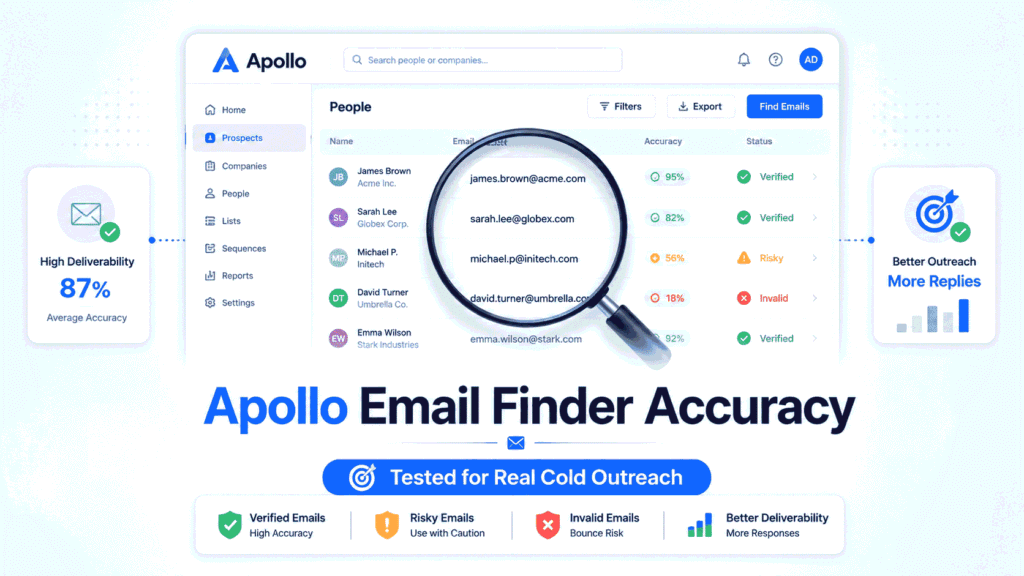
Apollo Email Finder Accuracy: Can You Trust Apollo Emails for Cold Outreach?
Table of Contents
Understanding Apollo Email Accuracy
Finding accurate business emails is one of the biggest challenges in modern cold outreach.
Many businesses rely on Apollo.io to generate leads, discover decision-makers, and scale outbound campaigns. But before launching cold emails, one important question usually comes up:
How accurate is Apollo Email Finder?
Email accuracy directly affects the success of your cold email workflow. Even a strong outreach strategy can fail if your lead data is outdated or unverified.
Poor-quality email lists can lead to:
• High bounce rates
• Lower email deliverability
• Spam folder placement
• Damaged sender reputation
• Low reply rates
That’s why understanding Apollo Email Finder accuracy is important before scaling outreach campaigns.
Why Apollo Email Accuracy Matters
In cold email outreach, verified business emails help improve:
✔ Deliverability
✔ Inbox placement
✔ Campaign performance
✔ Lead quality
✔ Reply rates
On the other hand, sending emails to invalid or risky contacts can negatively affect your entire outbound workflow.
This becomes even more important when:
• Scaling campaigns
• Warming up domains
• Running B2B outreach
• Building long-term sender reputation
What You’ll Learn in This Guide
In this guide, we’ll break down:
• How Apollo Email Finder works
• How Apollo verifies business emails
• Why some Apollo emails bounce
• Apollo verified vs unverified emails
• Best practices to improve email accuracy
• How to reduce bounce rates in cold outreach
• Whether additional email verification tools are necessary
We’ll also cover practical tips to help businesses build more reliable lead generation and cold email systems.
If you’re new to outbound campaigns, understanding a proper cold email workflow is equally important for improving deliverability and reply rates.
What Is Apollo Email Finder?
Apollo.io Email Finder is a B2B lead generation and prospecting tool designed to help businesses discover professional contact information for potential customers.
It allows teams to find:
• Business email addresses
• Decision-maker contacts
• Company information
• Job titles
• Professional data for outbound outreach
Apollo is widely used in modern cold email workflows because it combines:
✔ Lead generation
✔ Prospecting
✔ Contact enrichment
✔ Outreach tools
inside a single platform.
This makes it especially useful for businesses running scalable outbound campaigns.
What Apollo Email Finder Is Used For
Apollo Email Finder is commonly used for:
🔹Cold Email Outreach
Businesses use Apollo to build targeted lead lists and contact prospects through personalized cold emails.
Businesses using outbound prospecting often combine Apollo with email warm-up strategies to improve inbox placement before scaling campaigns.
🔹B2B Lead Generation
Sales teams use Apollo to discover companies and decision-makers that match their Ideal Customer Profile (ICP).
🔹Sales Prospecting
Apollo helps SDRs and sales teams identify:
• Founders
• Marketing heads
• Sales managers
• Recruiters
• Operations leaders
across different industries.
🔹Recruitment Outreach
Recruiters and hiring agencies use Apollo to connect with candidates, hiring managers, and business contacts.
🔹Agency Lead Sourcing
Marketing agencies and service providers often use Apollo to find businesses that may need:
• SEO services
• SaaS solutions
• Automation tools
• Lead generation support
What Data Apollo Provides
Apollo Email Finder offers more than just email discovery.
The platform also provides valuable prospecting and company insights that help businesses personalize outreach campaigns.
🔸Business Email Addresses
Apollo helps users discover professional business emails connected to company domains.
Example:
firstname@company.com
or
firstname.lastname@company.com
🔸Company Information
Users can access:
• Company size
• Industry
• Revenue estimates
• Website details
• Technology stack
This helps improve lead qualification and targeting.
🔸Job Titles & Roles
Apollo allows businesses to filter prospects by:
• Founder
• CEO
• Marketing Manager
• SDR
• HR Manager
• Operations Head
This makes outreach more targeted and relevant.
🔸Contact Enrichment
Apollo enriches lead data using professional databases and business information sources.
This helps businesses build more detailed prospect profiles before outreach.
Why Apollo Email Finder Is Popular
Apollo has become popular because it simplifies multiple outbound sales tasks inside one platform.
Instead of using separate tools for:
• Lead discovery
• Contact databases
• Email finding
• Outreach tracking
businesses can manage much of the workflow directly inside Apollo.
Who Uses Apollo Email Finder?
Apollo is commonly used by:
♦ SDRs (Sales Development Representatives)
To build lead lists and start outbound prospecting campaigns.
♦ SaaS Businesses
To generate demo bookings and scale outbound sales pipelines.
♦ Marketing Agencies
To identify businesses that may need digital marketing or automation services.
♦ Recruiters
To source candidates and connect with hiring contacts.
♦ Small Businesses
To run affordable lead generation and cold outreach campaigns without expensive enterprise tools.
Why Apollo Is Common in Cold Email Workflows
Modern outbound marketing relies heavily on:
✔ Accurate lead data
✔ Verified business emails
✔ Targeted prospecting
Apollo helps businesses streamline this process by combining prospecting and outreach preparation inside one workflow.
This is one reason why Apollo is frequently used alongside:
• Cold email tools
• CRM systems
• Email verification platforms
• Outbound automation workflows
Key Takeaway
Apollo Email Finder is more than just an email discovery tool.
It functions as a complete B2B prospecting platform that helps businesses:
✔ Find leads
✔ Identify decision-makers
✔ Build targeted outreach lists
✔ Improve outbound workflows
However, the success of cold outreach still depends on:
• Lead quality
• Email accuracy
• Personalization
• Follow-up systems
• Proper targeting
Why Businesses Use Apollo for Cold Outreach
Many businesses use Apollo.io because it simplifies the entire cold outreach and lead generation process inside one platform.
Instead of relying on multiple disconnected tools, Apollo combines:
✔ Lead database
✔ Prospecting filters
✔ Email finding
✔ Contact enrichment
✔ Outreach workflows
to help businesses build scalable outbound systems more efficiently.
This makes Apollo especially popular among:
• SaaS businesses
• Marketing agencies
• SDR teams
• Recruiters
• Small businesses
• B2B sales teams
How Apollo Simplifies Cold Outreach
Traditional lead generation often involves:
• Manual research
• LinkedIn searching
• Spreadsheet management
• Separate email verification tools
• Disconnected workflows
Apollo reduces much of this manual work by centralizing prospecting and outreach preparation.
Instead of manually searching for contacts, businesses can quickly build targeted lead lists based on:
• Industry
• Company size
• Role
• Location
• Technology stack
• Hiring activity
• Revenue estimates
• Employee count
• Job seniority
This helps businesses identify more relevant prospects before sending cold emails.
Faster Lead Generation Workflows
Apollo allows businesses to generate prospect lists much faster compared to manual prospecting.
For example, users can:
✔ Filter SaaS companies hiring SDRs
✔ Target founders of small businesses
✔ Find marketing decision-makers
✔ Identify companies using specific software tools
This improves:
• Outreach relevance
• Targeting quality
• Personalization opportunities
which are critical for cold email success.
Better ICP Targeting
One major reason businesses use Apollo is to improve Ideal Customer Profile (ICP) targeting.
Instead of sending cold emails to broad audiences, businesses can narrow outreach based on:
• Company type
• Business stage
• Team size
• Job role
• Buying intent signals
This usually leads to:
✔ Higher reply rates
✔ Better lead quality
✔ Improved conversions
because outreach becomes more relevant.
Why Apollo Is Popular for Outbound Sales
Modern outbound sales depends heavily on:
✔ Accurate prospect data
✔ Verified business emails
✔ Scalable workflows
✔ Fast lead sourcing
Apollo helps businesses manage these tasks more efficiently without needing expensive enterprise-level sales tools.
For many small businesses and agencies, Apollo provides an affordable way to:
• Build prospect lists
• Organize outreach
• Manage lead generation workflows
• Support cold email campaigns
Apollo Helps Personalize Cold Emails
Cold outreach performs better when emails feel relevant and personalized.
Apollo provides prospect details such as:
• Job title
• Company information
• Hiring activity
• Industry
• Company size
This helps businesses create more targeted messaging instead of generic cold emails.
Example:
❌ Generic outreach:
“We help businesses grow.”
✔ Personalized outreach:
“Noticed your company is actively hiring SDRs—many growing sales teams struggle with reply rates during outbound scaling.”
This type of personalization can improve:
✔ Response rates
✔ Conversation quality
✔ Outreach relevance
Building a strong Ideal Customer Profile (ICP) usually improves lead quality and makes cold outreach more effective.
Why Businesses Combine Apollo With Other Outbound Tools
Although Apollo includes prospecting and outreach features, many businesses also combine it with:
• Email verification tools
• Cold email platforms
• CRM systems
• Deliverability tools
A common outbound workflow may look like this:
Apollo → Email Verification → Outreach Platform → CRM → Follow-Ups
This helps businesses create more reliable and scalable cold email systems.
Key Benefits of Using Apollo for Cold Outreach
Businesses commonly use Apollo because it helps:
✔ Discover decision-makers faster
✔ Build targeted lead lists
✔ Reduce manual prospecting work
✔ Improve cold email personalization
✔ Scale outbound workflows
✔ Support B2B lead generation
✔ Organize prospecting systems
Key Takeaway
Apollo is popular for cold outreach because it combines lead generation, prospecting, and business contact discovery inside one platform.
For businesses running outbound campaigns, this can simplify:
• Lead sourcing
• Audience targeting
• Outreach preparation
• Prospect management
However, successful cold outreach still depends on:
• Proper ICP targeting
• Accurate email verification
• Strong messaging
• Personalization
• Consistent follow-ups
How Apollo Email Finder Works
Apollo.io Email Finder works by collecting, enriching, organizing, and verifying business contact data from multiple professional and public data sources.
The platform helps businesses discover professional email addresses connected to decision-makers and company employees for cold outreach and B2B lead generation.
Apollo combines:
✔ Contact databases
✔ Company information
✔ Email pattern recognition
✔ Data enrichment systems
✔ Verification processes
to help users build targeted prospect lists more efficiently.
Many outbound teams also use additional email verification tools before launching high-volume cold email campaigns.
What Data Sources Apollo Uses
Apollo Email Finder typically gathers and processes business information using:
• Public business data
• Company domains
• Professional databases
• Contact enrichment systems
• Email pattern matching
• Verification checks
• Web data signals
• Business technology data
This data is then organized into searchable prospect profiles inside the platform.
How Apollo Predicts Business Email Addresses
One of the core functions of Apollo Email Finder is identifying professional email patterns associated with company domains.
For example:
If a company website domain is:
company.com
Apollo may predict common email structures such as:
firstname.lastname@company.com
or
firstname@company.com
The platform then performs verification checks to estimate whether the email address is likely active and deliverable.
How Email Pattern Matching Works
Many businesses use standardized email formats for employees.
Common patterns include:
john@company.com
john.doe@company.com
johndoe@company.com
j.doe@company.com
Apollo analyzes:
• Company domains
• Employee naming conventions
• Existing contact records
to identify the most likely email structure.
This process helps Apollo generate professional email addresses even when direct contact data is limited.
What Is Contact Enrichment?
Apollo Email Finder also uses contact enrichment to improve lead profiles.
Contact enrichment means adding additional business information to a lead record, such as:
• Job title
• Company size
• Industry
• LinkedIn-style professional data
• Technology stack
• Hiring activity
• Revenue estimates
This helps businesses:
✔ Personalize outreach
✔ Improve ICP targeting
✔ Create better cold email campaigns
instead of relying only on basic email lists.
How Apollo Verifies Emails
After generating or discovering an email address, Apollo performs verification checks to estimate deliverability and reduce bounce risks.
These checks may include:
✔ Domain validation
✔ Mail server verification
✔ Activity checks
✔ Format validation
✔ Business domain analysis
The goal is to identify whether the email address is likely:
• Valid
• Active
• Deliverable
before businesses use it in cold outreach campaigns.
Why Verification Matters in Cold Outreach
Email verification is important because inaccurate lead data can negatively affect:
• Email deliverability
• Sender reputation
• Inbox placement
• Cold email performance
High bounce rates may signal spam behavior to email providers.
This is why businesses often prioritize:
✔ Verified emails
✔ Accurate lead data
✔ Targeted outreach lists
when building outbound workflows.
Why Apollo Email Accuracy Can Vary
Even with verification systems, no email finder tool can guarantee perfect accuracy.
Apollo Email Finder accuracy may vary because:
• Employees change jobs
• Domains become inactive
• Companies update email structures
• Business databases constantly change
This is normal across most B2B prospecting tools.
The quality of results usually depends on:
✔ Data freshness
✔ Company size
✔ Industry
✔ Verification status
✔ Outreach practices
How Businesses Use Apollo Data in Outbound Workflows
Apollo Email Finder is often part of a larger outbound sales process.
A common workflow may look like this:
Lead Search → Email Discovery → Verification → Outreach → Follow-Ups → CRM Tracking
Businesses often combine Apollo with:
• Email warm-up tools
• Outreach platforms
• CRM systems
• Deliverability monitoring tools
to build scalable cold email workflows.
Common Use Cases for Apollo Email Finder
Businesses use Apollo Email Finder for:
🟢B2B Lead Generation
Finding decision-makers for outbound sales campaigns.
🟢Cold Email Outreach
Building prospect lists for personalized email campaigns.
🟢Recruitment Prospecting
Connecting with hiring managers and potential candidates.
🟢Agency Outreach
Identifying businesses that may need marketing or automation services.
🟢SaaS Sales Prospecting
Targeting businesses based on technology usage and hiring signals.
Key Takeaway
Apollo Email Finder works by combining business data, email pattern recognition, contact enrichment, and verification systems to help businesses discover professional contact information for cold outreach.
While Apollo can significantly simplify lead generation workflows, successful outbound campaigns still depend on:
• Proper targeting
• Verified lead data
• Personalization
• Deliverability setup
• Consistent follow-up systems
Apollo Verified vs Unverified Emails
One important thing businesses should understand before launching cold outreach campaigns is that not every contact inside Apollo.io has the same accuracy or verification quality.
Apollo Email Finder typically categorizes business emails into different confidence levels based on verification checks and data signals.
These categories may include:
• Verified emails
• Likely valid emails
• Catch-all domains
• Unverified contacts
Understanding the difference between these email types is extremely important for:
✔ Cold email deliverability
✔ Sender reputation
✔ Bounce rate reduction
✔ Outbound campaign performance
Verified contacts usually perform better when combined with proper cold email personalization and follow-up systems.
Why Email Verification Status Matters
In cold email outreach, email verification quality directly affects:
• Inbox placement
• Bounce rates
• Domain health
• Spam risk
• Campaign success
Even a strong cold email sequence can perform poorly if businesses send emails to invalid or risky contacts.
This is why many outbound teams prioritize:
✔ Verified business emails
✔ Clean lead lists
✔ Deliverability-friendly outreach systems
before scaling campaigns.
What Are Verified Emails in Apollo?
Verified emails are contacts that typically pass Apollo’s email validation and deliverability checks.
These emails are generally considered safer for cold outreach because the platform has stronger confidence that the email address is active and reachable.
Verified emails usually have:
✔ Lower bounce rates
✔ Better deliverability
✔ Stronger inbox placement potential
✔ Safer outbound performance
How Apollo Verifies Emails
Apollo Email Finder may use multiple validation systems to estimate whether an email address is deliverable.
This may include:
• Domain validation
• Mail server checks
• Email format analysis
• Business domain verification
• Data enrichment confidence signals
The goal is to identify whether the email address is likely:
✔ Active
✔ Professional
✔ Deliverable
before businesses use it in outbound campaigns.
Why Verified Emails Are Important for Cold Outreach
Verified emails help businesses:
✔ Protect sender reputation
✔ Reduce spam complaints
✔ Improve email deliverability
✔ Lower bounce rates
✔ Increase outreach reliability
This becomes especially important when:
• Warming up email domains
• Scaling cold outreach
• Sending high-volume campaigns
• Running B2B outbound systems
What Are Unverified Emails?
Unverified emails are contacts that may not fully pass verification checks or may contain limited confidence signals.
These emails can sometimes:
• Be outdated
• Belong to former employees
• Use inactive domains
• Fail deliverability checks
• Come from uncertain email patterns
Because of this, unverified emails may increase:
❌ Bounce rates
❌ Spam risk
❌ Sender reputation issues
❌ Deliverability problems
What Are Catch-All Domains?
One important category many businesses overlook is catch-all domains.
A catch-all domain accepts incoming emails for multiple addresses temporarily, even if the mailbox may not actually exist.
Example:
A company server may initially accept:
randomname@company.com
even if the mailbox is inactive.
This makes verification more difficult because the email server appears responsive.
Catch-all domains can sometimes:
• Increase uncertainty
• Affect bounce prediction accuracy
• Create deliverability risks during large campaigns
Why Some Verified Emails Still Bounce
Even verified emails are not guaranteed to work forever.
Business data changes constantly because:
• Employees leave companies
• Domains change
• Inboxes become inactive
• Organizations restructure teams
This is why occasional bounce rates are normal across nearly all B2B lead generation tools.
No email finder platform can guarantee 100% accuracy.
Signs Your Apollo Lead List Needs Cleaning
Even when using Apollo.io, lead lists can become outdated over time.
Business data changes constantly because:
• Employees switch jobs
• Companies restructure
• Domains become inactive
• Contact records expire
Poor-quality lead lists can gradually damage:
✔ Deliverability
✔ Sender reputation
✔ Outreach performance
Knowing when to clean your lead list is important for maintaining healthy cold email campaigns.
Common Signs of Poor Lead List Quality
Rising Bounce Rates
Increasing bounce rates usually indicate:
• Outdated contacts
• Inactive inboxes
• Risky lead data
High bounce rates can negatively affect:
❌ Domain reputation
❌ Inbox placement
❌ Cold outreach scalability
Low Open Rates
If open rates suddenly decline, it may signal:
• Poor deliverability
• Low-quality contacts
• Spam folder placement
This often happens when old lead lists are reused repeatedly.
Spam Folder Placement
Emails landing in spam consistently may indicate:
• Unhealthy lead quality
• Poor sending reputation
• Aggressive outreach behavior
Spam placement can reduce future campaign performance significantly.
Many Inactive Companies or Employees
Lead lists containing:
• Inactive businesses
• Former employees
• Outdated company records
usually require cleaning or re-verification before outreach.
Low Reply Rates Despite Good Messaging
If:
✔ Personalization is strong
✔ Targeting looks relevant
but:
❌ rReplies remain very low
The issue may be:
👉 Poor lead quality
instead of the email copy itself.
How Often Should You Refresh Lead Lists?
Lead databases naturally decay over time.
Even high-quality prospecting platforms cannot keep every business record perfectly updated at all times.
This is why businesses should refresh lead lists regularly instead of relying on old exports for months.
Best Practices for Refreshing Lead Lists
Re-Verify Before Important Campaigns
Before launching major outreach campaigns:
✔ Re-verify important contacts
✔ Clean risky emails
✔ Remove inactive records
This helps reduce:
✔ Bounce rates
✔ Spam risks
✔ Deliverability problems
Avoid Reusing Old Lead Lists Repeatedly
Old lead lists become less reliable over time.
Repeatedly using stale prospect databases can increase:
❌ Invalid contacts
❌ Bounce risks
❌ Outreach inefficiency
Refreshing lead data regularly helps maintain healthier outbound workflows.
Update Lists More Frequently During Scaling
Businesses running:
• High-volume outreach
• Agency campaigns
• SDR workflows
• SaaS outbound systems
should refresh lead lists more frequently because scaling increases deliverability sensitivity.
Key Takeaway
Healthy cold outreach depends heavily on:
✔ Clean lead lists
✔ Updated prospect data
✔ Regular verification
Businesses should monitor warning signs like:
• Rising bounce rates
• Low opens
• Spam placement
• Outdated contacts
And refresh lead lists regularly to maintain:
✔ Better deliverability
✔ Healthier sender reputation
✔ Stronger cold email performance.
Best Practices for Using Apollo Verified Emails
To improve cold email performance, businesses should still follow strong outreach and deliverability practices.
1. Prioritize Verified Contacts
Whenever possible:
✔ Filter for verified emails only.
This usually improves:
• Deliverability
• List quality
• Campaign reliability
2. Re-Verify Important Leads
For high-value outreach campaigns, many businesses use additional email verification tools before sending cold emails.
This provides another layer of protection.
Popular verification tools include:
• NeverBounce
• ZeroBounce
• MillionVerifier
3. Avoid Bulk Outreach to Risky Lists
Sending large campaigns to unverified contacts may:
❌ Damage sender reputation
❌ Trigger spam filters
❌ Increase bounce rates
Instead:
✔ Start gradually
✔ Monitor bounce rates
✔ Clean lead lists regularly
4. Monitor Deliverability Metrics
Businesses should regularly track:
• Bounce rate
• Open rate
• Spam complaints
• Reply rate
to identify whether lead quality problems exist.
Apollo Verified vs Unverified Emails: Quick Comparison
| Feature | Verified Emails | Unverified Emails |
|---|---|---|
| Deliverability Confidence | Higher | Lower |
| Bounce Risk | Lower | Higher |
| Sender Reputation Safety | Better | Riskier |
| Outreach Reliability | More stable | Less predictable |
| Recommended for Scaling | Yes | Limited caution |
Why This Matters for Cold Email Deliverability
Cold email success depends heavily on:
✔ Accurate business emails
✔ Clean lead data
✔ Sender reputation
✔ Proper outreach workflows
Using too many risky or unverified contacts can negatively affect long-term outbound performance.
This is why many businesses build workflows like:
Lead Generation → Email Verification → Outreach → Follow-Ups → CRM Tracking
instead of relying only on raw lead lists.
Key Takeaway
Apollo Verified Emails are generally safer for cold outreach because they pass stronger verification checks and deliverability signals.
However, businesses should still understand that:
✔ No email database is perfect
✔ Lead data changes constantly
✔ Deliverability depends on workflow quality
The best outbound systems combine:
• Verified lead generation
• Proper email warm-up
• Personalization
• Audience targeting
• Ongoing deliverability monitoring
How Accurate Is Apollo Email Finder?
Apollo.io Email Finder is generally considered one of the more reliable B2B lead generation and prospecting tools for cold outreach.
Many businesses use Apollo to:
• Discover business emails
• Build outbound lead lists
• Identify decision-makers
• Support cold email campaigns
Compared to manual lead sourcing, Apollo can significantly speed up prospecting workflows and improve targeting efficiency.
However, one important thing businesses should understand is:
👉 No email finder tool is 100% accurate.
This applies not only to Apollo, but also to most B2B lead generation platforms.
Understanding realistic bounce rate expectations can help businesses scale outreach more safely without damaging deliverability.
What Affects Apollo Email Finder Accuracy?
Apollo Email Finder accuracy can vary depending on several important factors.
The actual quality of business emails often depends on:
• Industry
• Company size
• Job changes
• Database freshness
• Email verification status
• Prospect activity
• Domain health
• Data enrichment quality
These factors influence whether a contact remains active and deliverable over time.
Why Apollo Accuracy Matters for Cold Outreach
In cold email outreach, email accuracy directly impacts:
✔ Bounce rates
✔ Sender reputation
✔ Inbox placement
✔ Deliverability
✔ Campaign performance
Even strong cold email copy and personalization may fail if businesses use outdated or invalid contact data.
This is why accurate lead generation is essential for scalable outbound workflows.
Realistic Accuracy Expectations
Businesses should approach Apollo Email Finder with realistic expectations.
For verified business emails:
✔ Accuracy is usually strong enough for professional cold outreach workflows.
Many businesses successfully use Apollo for:
• B2B lead generation
• Outbound sales
• Agency prospecting
• Recruitment outreach
• SaaS sales workflows
However, businesses should still expect:
• Some invalid contacts
• Occasional bounce rates
• Outdated employee records
• Inactive domains
• Catch-all email issues
This is completely normal across most lead generation and email finder platforms.
Why No Email Database Is Perfect
Business contact data changes constantly.
People regularly:
• Change jobs
• Switch companies
• Update domains
• Leave organizations
• Move into different roles
Because of this, even the best prospecting platforms cannot instantly update every business contact record.
This is one reason why occasional email bounce rates are unavoidable in outbound prospecting.
Why Apollo Accuracy Varies Between Industries
Apollo Email Finder accuracy may also vary by industry.
For example:
Large SaaS Companies
Large companies often maintain stable domains and structured email systems, making contact prediction easier.
Startups & Small Businesses
Smaller businesses may:
• Change domains frequently
• Restructure teams
• Use temporary inboxes
• Lack standardized email patterns
which can affect accuracy.
Recruitment & Fast-Growth Industries
Industries with high employee turnover may experience more outdated contacts due to frequent role changes.
Why Some Apollo Emails Bounce
Email bounce rates are one of the most important metrics in cold outreach and email deliverability.
Even with verified leads, some Apollo emails may still bounce for several reasons.
This does not always mean the platform failed entirely — business data simply changes quickly.
Common Reasons Apollo Emails Bounce
1. Employee Job Changes
A prospect may no longer work at the company.
This is one of the most common causes of outdated business emails.
2. Inactive or Expired Domains
Some company domains may:
• become inactive
• stop accepting emails
• change providers
• restrict external mail delivery
which can cause bounce issues.
3. Catch-All Email Domains
Catch-all domains temporarily accept many incoming emails, making verification more difficult.
This can reduce prediction accuracy.
4. Email Structure Changes
Companies sometimes update internal email formatting.
Example:
Old structure:
firstname.lastname@company.com
New structure:
firstinitiallastname@company.com
This can affect older records.
5. Outdated Lead Databases
Even frequently updated databases may temporarily contain inactive contacts.
This is normal across:
• Apollo
• ZoomInfo
• Hunter.io
• Snov.io
• Lusha
and other prospecting platforms.
Why Bounce Rates Matter in Cold Email Outreach
High bounce rates can negatively affect:
• Email deliverability
• Sender reputation
• Domain trust
• Inbox placement
Email providers may interpret repeated bounces as:
❌ Spam-like behavior
❌ Poor list quality
❌ Risky outreach activity
This is why businesses should monitor bounce rates carefully when scaling outbound campaigns.
What Is a Safe Bounce Rate?
In most cold email workflows:
✔ Lower bounce rates are healthier for deliverability.
Generally:
• Under 3% is considered safer
• High bounce rates may indicate poor lead quality
Businesses should regularly clean and verify lead lists to maintain strong outreach performance.
Best Practices to Improve Apollo Email Accuracy
Although Apollo provides verification systems, businesses can further improve results using better outbound practices.
1. Prioritize Verified Emails
Whenever possible:
✔ Filter for verified contacts only.
This can help reduce:
• Invalid emails
• Deliverability risks
• Bounce rates
2. Re-Verify Important Leads
For high-value campaigns, many outbound teams use additional email verification tools before sending outreach.
Popular tools include:
• NeverBounce
• ZeroBounce
• MillionVerifier
This provides extra validation before scaling campaigns.
3. Avoid Massive Bulk Sending
Sending thousands of cold emails immediately can damage deliverability if lead quality is inconsistent.
Instead:
✔ Start gradually
✔ Monitor bounce rates
✔ Optimize targeting
4. Use Better ICP Targeting
Well-targeted outreach usually performs better than broad lead blasting.
Businesses should focus on:
• Relevant industries
• Decision-makers
• Active companies
• Clear pain points
This improves:
✔ Reply rates
✔ Personalization
✔ Campaign efficiency
Apollo Accuracy vs Manual Prospecting
Compared to manual lead sourcing, Apollo can dramatically improve:
✔ Prospecting speed
✔ Lead discovery
✔ Workflow scalability
✔ Outreach efficiency
Instead of manually researching every contact, businesses can quickly build targeted lead lists using:
• Company filters
• Role filters
• Technology filters
• Hiring signals
This saves significant time during outbound campaigns.
Key Takeaway
Apollo Email Finder is generally reliable for B2B prospecting and cold outreach, especially when businesses prioritize verified emails and proper targeting.
However, businesses should understand that:
✔ No lead database is perfectly accurate
✔ Business data changes constantly
✔ Occasional bounce rates are normal
The best outbound systems combine:
• Verified lead generation
• Deliverability best practices
• Personalization
• Proper email warm-up
• Consistent list maintenance
to improve long-term cold outreach performance.
Many outbound teams also use Apollo Chrome Extension workflows to speed up LinkedIn prospecting and lead collection.
What Bounce Rate Should You Expect With Apollo?
One important thing businesses should understand is that no lead generation platform — including Apollo.io — can guarantee zero email bounces.
Business data changes constantly because:
• Employees switch jobs
• Domains expire
• Inboxes become inactive
• Companies restructure teams
Because of this, some bounce rates are completely normal in cold outreach.
Apollo Bounce Rate Expectations by Lead Quality
The quality of your lead list usually has the biggest impact on bounce rates.
Verified Email Lists
Lists filtered with:
✔ Verified business emails
✔ Active companies
✔ Targeted ICP filters
usually have:
✔ Lower bounce risk
✔ Healthier deliverability
✔ Better cold outreach performance
These lists are generally safer for outbound campaigns.
Mixed Lead Lists
Lists containing:
• Partially verified contacts
• Older data
• Broad prospect filters
May create:
⚠ Moderate bounce risk
⚠ Inconsistent deliverability
This is more common when businesses prioritize volume over lead quality.
Unverified or Catch-All Domains
Lead lists containing:
• Unverified contacts
• Catch-all domains
• Outdated exports
usually carry:
❌ Higher bounce risk
❌ Stronger deliverability concerns
❌ Greater sender reputation risk
These lists often require additional verification before scaling outreach.
Why Zero Bounce Rates Are Unrealistic
Even high-quality prospecting platforms cannot maintain perfectly updated records at all times.
No email finder tool can fully prevent:
• Job changes
• Inactive inboxes
• Domain updates
• Company restructuring
This is why businesses should focus on:
✔ Reducing bounce rates
Instead of expecting:
❌ Zero bounces forever.
Why Workflow Quality Matters More Than Perfect Accuracy
Cold outreach success depends far more on:
✔ Targeting
✔ Verification
✔ Personalization
✔ Deliverability setup
✔ Gradual scaling
than simply expecting perfect lead accuracy.
Businesses using:
Lead Verification + Email Warm-Up + Proper ICP Targeting
usually achieve healthier outbound performance than teams relying only on large lead volumes.
Best Practice Recommendation
To maintain healthier cold email campaigns:
✔ Prioritize verified emails
✔ Re-verify important lead lists
✔ Avoid blasting massive campaigns immediately
✔ Monitor bounce rates regularly
✔ Scale outreach gradually
These practices usually improve:
✔ Deliverability
✔ Inbox placement
✔ Sender reputation
✔ Long-term cold outreach performance.
Common Causes of Bounce Rates
Email bounce rates are one of the biggest challenges in cold email outreach and B2B lead generation.
Even when using platforms like Apollo.io, some business emails may still bounce because professional contact data changes constantly.
Understanding the common causes of bounce rates can help businesses:
✔ Improve email deliverability
✔ Protect sender reputation
✔ Reduce spam risks
✔ Build healthier outbound workflows
This is especially important when scaling cold outreach campaigns.
1. Employee Job Changes
One of the most common reasons for email bounce rates is employee turnover.
The contact may:
• Leave the company
• Switch departments
• Move to another organization
• Stop using the previous business email address
For example:
A verified contact from several months ago may no longer be active today if the employee has changed roles.
This is very common in:
• SaaS companies
• Startups
• Recruitment-heavy industries
• Fast-growing sales teams
Why This Affects Cold Outreach
Even verified business emails can become inactive over time.
Since job changes happen frequently, outdated employee records may eventually cause:
❌ hard bounces
❌ lower deliverability
❌ inaccurate prospect lists
This is one reason why businesses should regularly refresh lead databases instead of reusing old lists repeatedly.
2. Outdated Lead Databases
Business contact information changes constantly, and no lead generation platform updates every record instantly.
Sometimes lead information may:
• Become outdated
• Contain inactive inboxes
• Include older employee records
• Use discontinued domains
Even large prospecting platforms can temporarily store stale data before updates occur.
This affects not only Apollo, but also:
• ZoomInfo
• Hunter.io
• Snov.io
• Lusha
and many other B2B lead generation tools.
Why Database Freshness Matters
Fresh lead data is important for:
✔ Accurate prospecting
✔ Cold email deliverability
✔ Lower bounce rates
✔ Better campaign performance
Older lead lists usually become less reliable over time.
Businesses running outbound campaigns should regularly:
✔ Clean lists
✔ Update contacts
✔ Remove inactive leads
to maintain healthy outreach systems.
3. Catch-All Domains
Catch-all domains are one of the most misunderstood causes of bounce rates in cold email outreach.
A catch-all domain temporarily accepts incoming emails for many addresses, even if the mailbox may not truly exist.
Example:
A mail server may initially accept:
randomperson@company.com
even if the actual inbox is inactive.
This makes email verification more difficult because the domain appears responsive during validation checks.
Why Catch-All Domains Are Risky
Catch-all domains can:
• Reduce verification accuracy
• Increase uncertainty
• Create delayed bounce issues
• Affect deliverability performance
Some emails may initially appear valid but later bounce after delivery attempts.
This is why businesses should be cautious when sending large campaigns to catch-all contacts.
4. Incorrect Email Patterns
Many email finder tools predict professional email addresses using company naming conventions.
Example patterns include:
firstname.lastname@company.com
firstname@company.com
johndoe@company.com
However, businesses sometimes use unique or inconsistent email structures.
If the predicted pattern is incorrect, the email address may bounce.
Why Email Pattern Prediction Can Fail
Email structure prediction may fail when:
• Companies change internal email formats
• Employees use aliases
• Departments use separate domains
• Businesses use hidden email systems
Even advanced email finder tools cannot always identify every internal company structure perfectly.
5. Company Domain Issues
Sometimes the problem is not the employee — it’s the business domain itself.
A company domain may:
• Become inactive
• Expire
• Stop accepting emails
• block external outreach
• Restrict unknown senders
This can cause:
❌ Delivery failures
❌ Bounce rates
❌ Verification inconsistencies
Small Business & Startup Domain Risks
Smaller businesses and startups may:
• Change domains frequently
• Migrate websites
• Rebrand companies
• Switch email providers
which can affect email reliability over time.
Why Bounce Rates Matter in Cold Email Campaigns
High bounce rates can negatively impact:
• Sender reputation
• Domain trust
• Inbox placement
• Outreach scalability
Email providers like:
• Gmail
• Outlook
• Yahoo Mail
monitor bounce behavior closely.
If too many emails bounce, future campaigns may:
❌ Land in spam folders
❌ Face deliverability restrictions
❌ Experience lower inbox rates
How to Reduce Bounce Rates in Cold Outreach
Businesses can improve deliverability by following a few important best practices.
Prioritize Verified Emails
Whenever possible:
✔ Use verified business emails only.
This usually improves:
• Deliverability
• Outreach quality
• Campaign stability
Re-Verify Important Contacts
Before launching large campaigns:
✔ Re-check lead lists using email verification tools.
Popular options include:
• NeverBounce
• ZeroBounce
• MillionVerifier
Avoid Sending to Old Lead Lists
Very old prospect databases often contain:
• Inactive contacts
• Outdated companies
• Abandoned domains
Refreshing lead data regularly is important for healthy outbound campaigns.
Monitor Bounce Rates Frequently
Businesses should track:
• Bounce percentage
• Spam complaints
• Open rates
• Reply rates
to identify list quality problems early.
Key Takeaway
Bounce rates are a normal part of B2B cold outreach because business contact information changes constantly.
Common causes of bounce rates include:
• Employee job changes
• Outdated lead databases
• Catch-all domains
• Incorrect email patterns
• Inactive company domains
The best way to reduce bounce rates is by combining:
✔ Verified lead generation
✔ Proper email verification
✔ List maintenance
✔ Targeted outreach
✔ Deliverability best practices
instead of relying only on large bulk email lists.
Apollo Email Finder Accuracy by Use Case
The accuracy of Apollo.io Email Finder can vary depending on how businesses use the platform.
While Apollo is widely used for B2B lead generation and cold outreach, different industries and workflows may experience different levels of email accuracy, deliverability, and lead quality.
For example:
• Recruitment teams may prioritize active employee records
• Agencies may focus heavily on deliverability
• SaaS outbound teams may require scalable prospecting systems
This is why understanding Apollo Email Finder accuracy by use case is important before launching large outreach campaigns.
Why Use Case Matters for Email Accuracy
No lead generation tool performs identically across every industry and workflow.
Apollo Email Finder accuracy may vary based on:
• Database freshness
• Industry changes
• Employee turnover
• Outreach volume
• Verification practices
• Campaign type
Businesses using structured workflows and proper verification usually achieve better results than teams relying on raw bulk lead lists.
Apollo for Sales Prospecting
Apollo is commonly used for B2B sales prospecting because it helps businesses:
✔ Discover decision-makers
✔ Build targeted lead lists
✔ Filter prospects by role and company data
✔ Support outbound sales workflows
Sales teams often use Apollo to find:
• Founders
• CEOs
• Marketing heads
• SDR leaders
• Sales managers
Where Apollo Performs Well for Sales Prospecting
Apollo generally performs strongly when:
✔ Targeting active B2B companies
✔ Filtering verified contacts
✔ Using proper ICP segmentation
✔ Focusing on decision-makers
The platform’s filtering system helps outbound teams narrow prospects using:
• Company size
• Industry
• Job title
• Hiring activity
• Technologies used
This supports more targeted and scalable prospecting workflows.
Where Extra Verification Is Important
Sales prospecting campaigns with:
• Large outreach volumes
• Aggressive scaling
• Enterprise targets
may still benefit from additional email verification tools.
This helps reduce:
✔ Bounce rates
✔ Deliverability risks
✔ Sender reputation issues
especially during high-volume cold outreach.
Apollo for Agency Outreach
Marketing agencies and lead generation agencies frequently use Apollo for client outreach campaigns.
Apollo helps agencies:
✔ Build prospect databases
✔ Discover business emails
✔ Organize outreach systems
✔ Support outbound workflows
Agencies often value Apollo because it combines:
• Lead generation
• Prospecting filters
• Outreach preparation
inside one platform.
Where Apollo Performs Well for Agencies
Apollo is useful for agencies that:
✔ Target SMBs
✔ Manage outbound prospecting
✔ Run cold email campaigns
✔ Build scalable lead lists
Its workflow structure helps agencies quickly organize prospect data across multiple campaigns.
Where Extra Verification Matters for Agencies
Agency outreach campaigns often send larger email volumes across:
• Multiple clients
• Multiple domains
• Multiple campaigns
This increases deliverability sensitivity.
Additional verification tools become more important for agencies because:
✔ Bounce rates can affect client deliverability
✔ Sender reputation impacts long-term outreach
✔ Large lead databases require regular cleaning
Many agencies combine Apollo with:
• NeverBounce
• ZeroBounce
• MillionVerifier
before launching campaigns.
Apollo for Recruitment Outreach
Recruiters and staffing professionals often use Apollo Email Finder to discover:
• Hiring managers
• HR contacts
• Founders
• Department heads
Recruitment outreach relies heavily on current employee information.
Where Apollo Performs Well for Recruitment
Apollo can work well for:
✔ Discovering business contacts
✔ Identifying company decision-makers
✔ Filtering prospects by industry or company size
This helps recruiters build targeted outreach campaigns faster than manual prospecting.
Where Extra Verification Matters for Recruitment
Recruitment databases can become outdated quickly because:
• Employees change jobs frequently
• Hiring teams restructure often
• Company roles evolve rapidly
Because of this, recruiters should regularly:
✔ Re-verify lead lists
✔ Refresh contact databases
✔ Avoid relying on old prospect exports
Freshness matters heavily in recruitment outreach.
Apollo for SaaS Outbound Campaigns
SaaS businesses commonly use Apollo to support:
✔ Outbound sales
✔ Demo generation
✔ Lead sourcing
✔ SDR workflows
✔ Pipeline building
Apollo’s filters help SaaS companies target:
• Specific industries
• Funding stages
• Hiring signals
• Company technologies
This supports more refined outbound targeting.
Where Apollo Performs Well for SaaS Outbound
Apollo is particularly useful for SaaS outbound because it supports:
✔ Scalable lead generation
✔ ICP filtering
✔ Decision-maker targeting
✔ Workflow organization
SaaS teams often combine Apollo with:
• Cold email tools
• CRM systems
• Verification platforms
• Outbound automation software
to build complete prospecting systems.
Where Extra Verification Matters for SaaS Outreach
SaaS outbound teams often scale aggressively.
As outreach volume increases:
✔ Deliverability becomes more sensitive
✔ Sender reputation becomes critical
✔ Bounce rates matter more
Additional email verification helps SaaS businesses:
✔ Protect domain health
✔ Improve inbox placement
✔ Maintain scalable outbound performance
especially when sending large cold email campaigns.
Apollo for SMB Lead Generation
Small businesses often choose Apollo because it combines:
✔ Lead generation
✔ Business email discovery
✔ Outreach preparation
✔ Prospecting workflows
inside one accessible platform.
This makes Apollo attractive for:
• Startups
• Consultants
• Agencies
• Small outbound teams
that may not want multiple expensive tools.
Where Apollo Performs Well for SMBs
Apollo works well for SMBs because:
✔ Prospecting is centralized
✔ Filtering is beginner-friendly
✔ Lead generation becomes faster
✔ Workflows are easier to organize
Small businesses can quickly identify:
• Target industries
• Ideal customer profiles
• Business decision-makers
without needing enterprise-level software systems.
Where SMBs Should Be Careful
Many small businesses make mistakes such as:
❌ Blasting massive lead lists
❌ Skipping verification
❌ Ignoring deliverability
❌ Scaling too quickly
Even with accurate lead generation tools, outbound success still depends on:
✔ Personalization
✔ Proper targeting
✔ Follow-up systems
✔ Email warm-up
Why Structured Workflows Matter Across Every Use Case
Regardless of industry or business type, Apollo Email Finder performs best when businesses use:
✔ Verified contacts
✔ Proper ICP targeting
✔ Structured outreach workflows
✔ Deliverability best practices
instead of relying only on large lead volumes.
Businesses combining:
Lead Generation + Verification + Personalization + Follow-Ups
usually achieve stronger cold outreach performance.
Key Takeaway
Apollo Email Finder can perform well across:
✔ Sales prospecting
✔ Agency outreach
✔ Recruitment
✔ SaaS outbound
✔ SMB lead generation
However, accuracy and outreach success still depend heavily on:
• Verification practices
• Gatabase freshness
• Deliverability setup
• Targeting quality
• Outbound workflow structure
The businesses that achieve the best results usually focus on:
✔ Structured systems
✔ Verified contacts
✔ Personalized outreach
✔ Gradual scaling
rather than relying only on bulk lead generation.
Why Email Accuracy Matters in Cold Outreach
Email accuracy is one of the most important factors in successful cold email outreach.
Many businesses focus heavily on:
• Email copy
• Subject lines
• Personalization
• Outreach tools
but overlook the quality of their lead data.
Even the best cold email campaign can fail if the business emails being used are outdated, invalid, or poorly verified.
This is why accurate business emails are critical for:
✔ Deliverability
✔ Sender reputation
✔ Inbox placement
✔ Cold email performance
✔ Outbound scalability
A structured outbound workflow usually performs far better than random bulk outreach campaigns.
Poor Email Accuracy Affects More Than Reply Rates
Many beginners assume inaccurate emails only reduce reply rates.
In reality, poor-quality lead lists can affect the entire outbound system.
Poor email accuracy can directly impact:
• Deliverability
• Sender reputation
• Domain health
• Inbox placement
• Email account trust
• Outreach scalability
Over time, repeated sending to invalid contacts may damage long-term email performance.
What Happens When Emails Bounce
When emails are sent to inactive or invalid addresses, email providers may detect this as risky or spam-like behavior.
High bounce rates can signal problems to:
• Gmail
• Outlook
• Yahoo Mail
• Microsoft 365
• spam filtering systems
As a result:
❌ Future emails may land in spam folders
❌ Inbox placement may decline
❌ Sender trust may decrease
❌ Domain reputation may weaken
This can reduce the chances of future cold emails reaching real inboxes.
Why Deliverability Matters in Cold Email Outreach
Email deliverability refers to the ability of your emails to successfully reach inboxes instead of spam folders.
Even if a campaign has:
✔ Strong messaging
✔ Targeted prospects
✔ Personalization
poor deliverability can still destroy results.
Businesses with unhealthy lead lists often experience:
• Lower open rates
• Lower reply rates
• More spam filtering
• Weaker campaign performance
What Is Sender Reputation?
Sender reputation is the trust score email providers assign to your domain and sending accounts.
This reputation is influenced by:
• Bounce rates
• Spam complaints
• Engagement rates
• Sending behavior
• Email list quality
A strong sender reputation improves:
✔ Inbox placement
✔ Deliverability
✔ Campaign reliability
while poor sender reputation can make cold outreach significantly harder.
How Poor Lead Data Damages Domain Health
When businesses repeatedly send emails to invalid contacts, their domain reputation can gradually decline.
This may affect:
• Current campaigns
• Future outreach
• Email warm-up performance
• Long-term outbound scalability
In severe cases, email providers may:
❌ Throttle sending
❌ Limit inbox placement
❌ Flag outreach behavior as suspicious
This is why businesses should avoid sending bulk campaigns to low-quality lead lists.
Why Verified Emails Are Important
Using verified business emails helps reduce:
✔ Bounce rates
✔ Deliverability issues
✔ Spam risks
✔ Sender reputation damage
Verified contacts are generally more reliable for:
• Cold outreach
• Outbound prospecting
• B2B lead generation
• Sales workflows
This is why many businesses prioritize:
✔ Verified lead lists
✔ Email validation
✔ Clean prospecting databases
before scaling outreach campaigns.
Cold Outreach Success Depends on Data Quality
Many businesses try to improve cold email results by:
• Rewriting copy
• Changing subject lines
• Adding personalization
But if the underlying lead data is poor, these optimizations may not matter.
Accurate lead generation is often the foundation of:
✔ Better deliverability
✔ Healthier domains
✔ Scalable outbound systems
✔ Higher reply rates
Why Email Providers Monitor Bounce Rates
Email providers use bounce behavior to identify potentially harmful sending activity.
Consistently high bounce rates may suggest:
• Spam behavior
• Purchased email lists
• Outdated prospect databases
• Poor outreach practices
This is why maintaining low bounce rates is important for long-term outbound success.
What Is Considered a Healthy Bounce Rate?
In most cold email workflows:
✔ Lower bounce rates are healthier for deliverability.
Generally:
• Lower bounce rates help protect sender reputation
• High bounce rates may indicate poor list quality
Businesses should regularly:
✔ Verify contacts
✔ Clean lead lists
✔ Remove inactive prospects
to maintain healthy outreach systems.
Best Practices to Improve Email Accuracy
Businesses can improve cold email performance by following a few important lead generation and deliverability practices.
1. Use Verified Business Emails
Prioritize verified contacts whenever possible.
This usually improves:
• Deliverability
• Inbox placement
• Outreach reliability
2. Clean Lead Lists Regularly
Old lead lists become less reliable over time.
Businesses should remove:
• Inactive contacts
• Bounced emails
• Outdated records
from outreach databases.
3. Re-Verify High-Value Leads
For important outbound campaigns, businesses often use dedicated email verification tools before sending outreach.
Popular tools include:
• NeverBounce
• ZeroBounce
• MillionVerifier
4. Avoid Bulk Blasting
Sending thousands of emails to unverified contacts can damage domain health quickly.
Instead:
✔ Start gradually
✔ Monitor bounce rates
✔ Optimize targeting
5. Improve ICP Targeting
Well-targeted outreach generally produces:
✔ Better engagement
✔ Higher reply rates
✔ Healthier deliverability
compared to generic mass outreach.
Why Email Accuracy Is Essential for Scaling Outreach
As businesses scale cold outreach campaigns, lead quality becomes even more important.
Larger campaigns increase the risk of:
• Bounce spikes
• Spam filtering
• Sender reputation issues
Without accurate business emails, scaling outbound campaigns becomes difficult and unsustainable.
Key Takeaway
Email accuracy matters because it directly affects:
✔ Deliverability
✔ Inbox placement
✔ Sender reputation
✔ Domain health
✔ Cold outreach performance
Poor-quality lead lists can damage long-term outbound results, even when businesses use strong cold email copy or advanced outreach tools.
The best cold email systems combine:
• Verified lead generation
• Clean contact databases
• Proper email verification
• Personalized outreach
• Deliverability best practices
to create scalable and sustainable outbound workflows.
Best Practices to Improve Apollo Email Accuracy
Using Apollo.io correctly is just as important as the platform itself.
Even strong lead generation tools can produce poor cold outreach results if businesses:
• Use unverified contacts
• Send bulk campaigns too quickly
• Target the wrong audience
• Ignore deliverability practices
Improving Apollo Email Finder accuracy is not only about finding business emails — it’s also about building healthier outbound systems.
The right prospecting and outreach practices can help businesses:
✔ Reduce bounce rates
✔ Improve deliverability
✔ Protect sender reputation
✔ Increase reply rates
✔ Build scalable cold email workflows
1. Prioritize Verified Emails
One of the simplest ways to improve Apollo email accuracy is to prioritize verified business emails whenever possible.
Inside Apollo, businesses should:
✔ Filter for verified contacts only.
This helps reduce:
• Bounce rates
• Invalid contacts
• Deliverability risks
• Spam filtering issues
• Sender reputation damage
Why Verified Emails Matter
Verified emails generally pass stronger validation checks and are considered safer for cold outreach.
These contacts usually provide:
✔ Better inbox placement
✔ Healthier deliverability
✔ More reliable prospecting data
Compared to unverified contacts, verified business emails are less likely to:
❌ Bounce
❌ Fail delivery
❌ Trigger spam concerns
Best Practice Tip
For new outbound campaigns:
✔ Start with highly verified contacts first.
This is especially important when:
• Warming up domains
• Launching new outreach systems
• Scaling cold email campaigns
2. Avoid Sending to Massive Lists Immediately
Many beginners make the mistake of blasting thousands of cold emails immediately after building a lead list.
This can damage:
❌ Sender reputation
❌ Email deliverability
❌ Inbox placement
especially when using untested or partially verified lead databases.
Instead:
✔ Start gradually
✔ Test smaller lead lists
✔ Monitor bounce rates
✔ Optimize outreach quality
Why Gradual Scaling Matters
Email providers like:
• Gmail
• Outlook
• Microsoft 365
monitor sending behavior carefully.
Sudden high-volume outreach may appear suspicious if:
• Bounce rates are high
• Domains are new
• Engagement is low
• Outreach patterns look automated
Gradual scaling helps businesses build healthier sender trust over time.
Recommended Outreach Approach
Instead of sending massive campaigns immediately:
✔ Test small prospect batches
✔ Analyze deliverability performance
✔ Identify bounce issues early
✔ Refine targeting before scaling
This creates a more stable outbound workflow.
3. Re-Verify Important Leads
Even verified contacts may become outdated over time because:
• Employees change jobs
• Companies switch domains
• Inboxes become inactive
For high-value campaigns, businesses should consider using additional email verification tools before outreach.
This adds another layer of validation and helps improve overall lead quality.
Why Re-Verification Is Important
Re-verification helps:
✔ Reduce bounce risks
✔ Improve deliverability
✔ Clean prospect databases
✔ Protect sender reputation
This is especially useful for:
• Agency outreach
• Enterprise prospecting
• Large outbound campaigns
• Sensitive domain warm-up stages
Popular Email Verification Tools
Many outbound teams combine Apollo with:
• NeverBounce
• ZeroBounce
• MillionVerifier
to verify contacts before launching campaigns.
A common workflow may look like this:
Apollo → Email Verification → Outreach Platform → CRM
This creates a safer and more scalable cold email process.
4. Segment Your ICP Properly
One of the biggest cold outreach mistakes is sending generic campaigns to poorly targeted audiences.
A targeted lead list usually performs much better than a large generic database.
Businesses should focus on:
• Relevant industries
• Ideal company size
• Decision-makers
• Clear pain points
• Buying intent signals
• Business relevance
Why ICP Segmentation Improves Email Accuracy
Proper ICP (Ideal Customer Profile) segmentation helps businesses:
✔ Improve lead quality
✔ Personalize outreach
✔ Reduce irrelevant contacts
✔ Increase reply rates
When outreach is more targeted:
• Engagement improves
• Deliverability often improves
• Bounce rates may decrease
because businesses send emails to more relevant prospects.
Example of Better Targeting
❌ Poor targeting:
Sending generic emails to thousands of random businesses.
✔ Better targeting:
Reaching SaaS founders actively hiring SDRs who may need outbound workflow improvements.
More relevant targeting usually creates:
✔ Stronger engagement
✔ Healthier outreach performance
✔ Better conversion potential
5. Clean Your Lead Lists Regularly
Many businesses overlook ongoing lead list maintenance.
Even verified databases become outdated over time.
Businesses should regularly:
✔ Remove bounced contacts
✔ Clean inactive leads
✔ Update prospect data
✔ Refresh old lists
This helps maintain healthier outbound systems.
Why Lead List Hygiene Matters
Poor list hygiene can gradually:
❌ Increase bounce rates
❌ Weaken sender reputation
❌ Reduce inbox placement
Clean lead databases support:
✔ Stronger deliverability
✔ Better campaign stability
✔ More scalable outreach
6. Monitor Deliverability Metrics
Businesses should consistently track important outreach metrics such as:
• Bounce rate
• Open rate
• Reply rate
• Spam complaints
These signals help identify:
✔ Lead quality problems
✔ Targeting issues
✔ Deliverability risks
before larger problems occur.
7. Personalize Cold Outreach
Even accurate business emails may underperform if outreach feels generic.
Apollo provides prospect data that can support personalization using:
• Company details
• Job roles
• Hiring activity
• Business context
Personalized cold emails often generate:
✔ Better replies
✔ Healthier engagement
✔ Improved campaign quality
8. Combine Accuracy With Deliverability Best Practices
Email accuracy alone is not enough for successful cold outreach.
Businesses should also focus on:
✔ Email warm-up
✔ Proper sending volumes
✔ Domain reputation
✔ Personalization
✔ Follow-up workflows
The best outbound systems combine:
Lead Quality + Deliverability + Targeting + Messaging
instead of relying only on large lead lists.
Recommended Cold Outreach Workflow
A healthier outbound process often looks like this:
Lead Generation → Email Verification → ICP Segmentation → Outreach → Follow-Ups → CRM Tracking
This structure helps businesses build more sustainable cold email systems.
Key Takeaway
Improving Apollo Email Finder accuracy is not only about the platform — it’s about using better prospecting and outreach practices.
Businesses that prioritize:
✔ Verified business emails
✔ Proper ICP targeting
✔ Lead verification
✔ Gradual scaling
✔ Deliverability monitoring
usually achieve:
• Lower bounce rates
• Healthier sender reputation
• Better inbox placement
• Stronger cold outreach performance
The most successful outbound campaigns combine accurate lead generation with sustainable cold email workflows.
Best Apollo Filters for Better Email Accuracy
Using the right filters inside Apollo.io can significantly improve lead quality and reduce bounce risks.
Instead of building massive generic lists, businesses should focus on:
✔ Targeted
✔ Verified
✔ Active prospects
for healthier cold outreach performance.
✔ Verified Email Filter
Whenever possible:
✔ Prioritize verified business emails only.
This usually helps reduce:
• Invalid contacts
• Bounce rates
• Deliverability risks
✔ Active Companies
Focus on:
✔ Currently operating businesses
✔ Active outbound targets
Inactive or outdated company records can reduce outreach efficiency.
✔ Recent Hiring Activity
Companies actively hiring often indicate:
✔ Growth
✔ Outbound activity
✔ Operational expansion
These businesses may respond better to relevant outreach.
✔ Company Size Filters
Filtering by company size helps improve:
✔ ICP targeting
✔ Personalization
✔ Offer relevance
Example:
SMB outreach and enterprise outreach usually require different messaging.
✔ Decision-Maker Roles
Prioritize:
✔ Founders
✔ Marketing heads
✔ Sales leaders
✔ Operations managers
instead of generic employee lists.
Better targeting often improves:
✔ Reply quality
✔ Outreach relevance
✔ Meeting opportunities
Key Takeaway
The best Apollo workflows focus on:
✔ Verified contacts
✔ Relevant companies
✔ Strong ICP targeting
instead of maximizing lead volume alone.
Smaller, cleaner lead lists usually perform better than large unfiltered databases.
Should You Use Extra Email Verification Tools?
Many businesses assume that using a lead generation platform like Apollo.io alone is enough for cold outreach.
However, many experienced outbound teams still combine Apollo with dedicated email verification tools before launching campaigns.
This is especially common for:
• High-volume outreach
• Agency campaigns
• New email domains
• Cold email scaling
• Enterprise prospecting
• Deliverability-sensitive campaigns
Using extra verification tools adds another layer of protection and helps businesses build healthier outbound workflows.
Why Extra Email Verification Matters
Even verified business emails can become outdated because:
• Employees change jobs
• Domains become inactive
• Inboxes are disabled
• Organizations restructure teams
Since business data changes constantly, additional email verification helps businesses:
✔ Validate risky emails
✔ Reduce bounce rates
✔ Improve deliverability
✔ Protect sender reputation
✔ Maintain domain health
This becomes increasingly important as outreach volume grows.
Why Apollo Alone May Not Be Enough
Apollo Email Finder already includes verification systems, but no lead generation platform can guarantee perfect email accuracy.
Some contacts may still:
• Bounce
• Belong to former employees
• Use catch-all domains
• Fail inbox delivery later
This is normal across nearly all B2B prospecting platforms.
Extra email verification tools help identify:
✔ Risky contacts
✔ Invalid inboxes
✔ Undeliverable emails
✔ High-risk domains
before outreach begins.
When Businesses Should Use Additional Email Verification
Extra verification becomes especially valuable in certain cold outreach situations.
1. High-Volume Outreach Campaigns
When businesses send large cold email campaigns, even small bounce rate increases can negatively affect:
• Deliverability
• Inbox placement
• Sender reputation
Verifying lead lists before outreach helps reduce risk at scale.
2. New Email Domains
New outreach domains are more sensitive to:
• Bounce spikes
• Spam complaints
• Poor sender behavior
Using extra verification tools can help businesses protect newly warmed-up domains during early campaigns.
3. Agency Outreach Campaigns
Agencies often manage outreach for:
• Multiple clients
• Multiple domains
• Multiple campaigns
This increases deliverability complexity.
Extra email verification helps agencies:
✔ Reduce client risk
✔ Improve campaign reliability
✔ Protect domain reputation
4. Cold Email Scaling
As outbound systems scale, list quality becomes more important.
Sending thousands of emails to partially verified contacts can damage:
❌ Domain health
❌ Inbox rates
❌ Long-term deliverability
Additional verification supports healthier scaling strategies.
Popular Email Verification Tools
Many outbound teams combine Apollo with dedicated verification platforms.
Popular tools include:
• NeverBounce
• ZeroBounce
• MillionVerifier
These tools are commonly used alongside:
• Apollo.io
• CRM systems
• Cold email platforms
• Outbound automation tools
What Extra Verification Tools Actually Do
Email verification tools help analyze whether an email address is likely deliverable before sending outreach.
These tools may perform:
✔ Domain validation
✔ SMTP verification
✔ Mailbox checks
✔ Catch-all detection
✔ Spam trap analysis
✔ Risky email identification
The goal is to reduce outreach risk before campaigns begin.
Benefits of Using Extra Email Verification
Businesses using additional email validation tools often experience:
✔ Lower bounce rates
✔ Better deliverability
✔ Healthier sender reputation
✔ Stronger inbox placement
✔ Improved campaign stability
This is especially valuable for long-term outbound scaling.
Why Lower Bounce Rates Matter
High bounce rates can signal spam-like behavior to email providers such as:
• Gmail
• Outlook
• Yahoo Mail
If bounce rates become too high:
❌ Emails may land in spam
❌ Domain trust may weaken
❌ Outreach performance may decline
This is why list quality is critical for successful cold email systems.
Typical Cold Outreach Verification Workflow
Many outbound teams follow workflows like:
Lead Generation → Email Verification → ICP Segmentation → Outreach → Follow-Ups
Instead of sending raw Apollo lead lists directly into campaigns.
This extra verification step helps create more reliable outreach systems.
Should Small Businesses Use Extra Verification Tools?
For smaller campaigns, Apollo verified emails may often be sufficient.
However, businesses should strongly consider additional verification if they:
✔ scale outreach aggressively
✔ use new domains
✔ run agency campaigns
✔ prioritize deliverability
✔ experience rising bounce rates
The larger the outreach volume, the more important verification becomes.
Extra Verification Does Not Replace Good Outreach Practices
Even the best email verification tools cannot guarantee successful cold outreach alone.
Businesses still need:
✔ Proper ICP targeting
✔ Personalization
✔ Domain warm-up
✔ Strong messaging
✔ Consistent follow-ups
Cold email performance depends on the entire outbound workflow — not only lead validation.
Best Practice Recommendation
For healthier cold outreach systems:
✔ Use Apollo for lead generation
✔ Re-verify important contacts
✔ Start with smaller campaigns
✔ Monitor bounce rates carefully
✔ Scale gradually
This approach usually creates more sustainable outbound growth.
Key Takeaway
Extra email verification tools are not always mandatory, but they can significantly improve:
✔ Deliverability
✔ Sender reputation
✔ Bounce rate control
✔ Outbound scalability
Many professional outbound teams combine Apollo with dedicated verification tools to create safer and more reliable cold email workflows.
For businesses scaling cold outreach, additional verification is often a smart long-term deliverability investment.
Recommended Apollo Workflow Stack
Many outbound teams combine Apollo.io with other tools to build healthier and more scalable cold email systems.
A common outbound workflow stack looks like this:
Apollo → MillionVerifier → Instantly/Smartlead → HubSpot
Each tool plays a different role inside the outreach process.
✔ Apollo — Lead Generation
Apollo is commonly used for:
✔ Lead discovery
✔ Business emails
✔ Prospect filtering
✔ ICP targeting
It helps businesses build targeted lead lists faster.
✔ MillionVerifier — Email Verification
MillionVerifier helps:
✔ Validate risky emails
✔ Reduce bounce rates
✔ Improve deliverability
Many businesses verify important lead lists before launching campaigns.
✔ Instantly or Smartlead — Outreach Scaling
Instantly and Smartlead are commonly used for:
✔ Cold email sending
✔ Inbox rotation
✔ Campaign scaling
✔ Outreach automation
These tools help manage outbound workflows more efficiently.
✔ HubSpot — CRM & Pipeline Management
HubSpot helps businesses organize:
✔ Replies
✔ Leads
✔ Meetings
✔ Sales pipelines
This improves long-term lead management and follow-up workflows.
Key Takeaway
Most scalable cold outreach systems rely on:
Lead Generation → Verification → Outreach → CRM Management
instead of using a single tool for everything.
Combining specialized tools often creates:
✔ healthier deliverability
✔ cleaner workflows
✔ better outbound scalability
Apollo Email Finder vs Other Lead Generation Tools
Apollo.io is one of the most widely used platforms for B2B prospecting and cold outreach, but it is not the only lead generation tool available.
Many businesses compare Apollo with other popular platforms such as:
• Hunter.io
• Snov.io
• Lusha
• ZoomInfo
• Clearbit
Each tool offers different strengths depending on:
• Database size
• Verification quality
• Pricing
• SMB suitability
• Enrichment capabilities
• Prospecting workflows
• Outreach automation
Choosing the right platform depends heavily on:
✔ Business size
✔ Outreach goals
✔ Budget
✔ Lead generation strategy
Why Businesses Compare Apollo With Other Prospecting Tools
Modern outbound sales relies heavily on:
✔ Accurate lead data
✔ Verified business emails
✔ Contact enrichment
✔ Scalable prospecting systems
Since no platform is perfect, businesses often compare tools based on:
• Data quality
• Usability
• Deliverability support
• Outreach features
• Pricing efficiency
The best platform usually depends on the type of outbound workflow being built.
What Makes Apollo Popular for SMBs
Apollo is especially popular among small businesses and growing outbound teams because it combines:
✔ Lead generation
✔ Outreach workflows
✔ Prospecting filters
✔ Email discovery
✔ Contact enrichment
inside one platform.
Instead of paying separately for:
• Lead databases
• Email finders
• Outreach tools
• Prospecting software
many SMBs use Apollo as an all-in-one outbound solution.
Apollo vs Hunter.io
What Hunter.io Is Known For
Hunter.io is widely known for:
• Email finding
• Domain searches
• Simple verification workflows
Hunter is often preferred for:
✔ Lightweight prospecting
✔ Domain-based email discovery
✔ Smaller outreach workflows
Apollo vs Hunter.io: Key Difference
Apollo generally offers:
✔ Larger prospect databases
✔ More prospecting filters
✔ Broader company insights
✔ Outreach workflow features
while Hunter.io focuses more heavily on:
✔ Email lookup simplicity
✔ Domain search functionality
✔ Quick verification tasks
Apollo vs Snov.io
What Snov.io Is Known For
Snov.io combines:
• Email finding
• Drip campaigns
• Outreach automation
• Lead management
It is commonly used by:
• Startups
• Agencies
• Outbound marketers
Apollo vs Snov.io: Key Difference
Apollo often provides:
✔ Stronger prospect filtering
✔ Broader company-level data
✔ Larger B2B lead databases
while Snov.io is frequently appreciated for:
✔ Automation workflows
✔ Lightweight campaign management
✔ Outreach simplicity
Apollo vs Lusha
What Lusha Is Known For
Lusha focuses heavily on:
• Contact enrichment
• Direct contact discovery
• LinkedIn-based prospecting
It is commonly used by:
✔ Recruiters
✔ SDR teams
✔ B2B sales representatives
Apollo vs Lusha: Key Difference
Apollo generally provides:
✔ Broader lead generation workflows
✔ Integrated outreach features
✔ Larger filtering systems
while Lusha is often preferred for:
✔ Quick contact enrichment
✔ Direct prospect lookup
✔ Sales prospecting support
Apollo vs ZoomInfo
What ZoomInfo Is Known For
ZoomInfo is considered one of the larger enterprise-level B2B databases.
It focuses heavily on:
• Enterprise prospecting
• Large-scale sales intelligence
• Advanced enrichment data
Apollo vs ZoomInfo: Key Difference
ZoomInfo is often used by:
✔ Large enterprise sales teams
✔ Corporations
✔ Advanced outbound organizations
because of its extensive data ecosystem.
However, ZoomInfo is generally:
❌ More expensive
❌ Less SMB-friendly for smaller budgets
Apollo is often considered more accessible for:
✔ Startups
✔ Agencies
✔ Small businesses
✔ Growing outbound teams
Apollo vs Clearbit
What Clearbit Is Known For
Clearbit is heavily focused on:
• Data enrichment
• Firmographic insights
• Company intelligence
It is commonly used inside:
✔ CRM systems
✔ SaaS workflows
✔ Marketing automation systems
Apollo vs Clearbit: Key Difference
Apollo focuses more directly on:
✔ Outbound prospecting
✔ Lead generation
✔ Business email discovery
while Clearbit is frequently used for:
✔ Enrichment automation
✔ CRM enhancement
✔ Marketing segmentation
Key Factors Businesses Compare
When evaluating lead generation tools, businesses usually compare several important factors.
1. Database Size
Larger databases may improve:
✔ Lead discovery
✔ Prospecting opportunities
✔ Outbound scalability
However, larger databases do not always guarantee:
❌ Better accuracy
❌ Fresher lead data
2. Verification Quality
Verification quality is extremely important for:
✔ Deliverability
✔ Bounce rate reduction
✔ Sender reputation
Some businesses prioritize:
✔ Highly verified contacts
over massive lead volume.
3. Pricing & SMB Suitability
For many small businesses, affordability matters heavily.
Apollo is often attractive because it combines:
✔ Prospecting
✔ Outreach preparation
✔ Lead generation
inside a relatively accessible pricing structure.
Enterprise platforms may offer more advanced data but at significantly higher costs.
4. Contact Enrichment
Strong enrichment capabilities help businesses personalize outreach using:
• Job titles
• Company size
• Industry data
• Hiring signals
• Technology stack insights
This supports:
✔ Better ICP targeting
✔ Stronger personalization
✔ Higher-quality outbound campaigns
5. Outreach Workflow Features
Some tools focus only on:
• Email discovery
• Verification
while others also include:
✔ Outreach workflows
✔ Sequencing
✔ CRM integrations
✔ Pipeline management
Apollo is often valued because it combines multiple outbound functions inside one system.
Which Tool Is Best for Small Businesses?
For many SMBs, Apollo is attractive because it offers:
✔ Prospecting filters
✔ Lead databases
✔ Business email discovery
✔ Outreach preparation
✔ Workflow scalability
without requiring multiple separate subscriptions.
However, the best tool depends on:
• Campaign goals
• Outreach volume
• Budget
• Deliverability priorities
• Workflow complexity
Why Many Outbound Teams Use Multiple Tools
Many professional outbound teams combine multiple platforms together.
Example workflow:
Apollo → Email Verification Tool → Outreach Platform → CRM
This helps businesses:
✔ Improve lead quality
✔ Reduce bounce rates
✔ Increase deliverability
✔ Create scalable outbound systems
Instead of relying entirely on a single tool.
Key Takeaway
Apollo Email Finder is one of the most popular B2B prospecting platforms because it combines:
✔ Lead generation
✔ Prospecting filters
✔ Outreach workflows
✔ Email discovery
inside one platform.
Compared to tools like Hunter.io, Snov.io, Lusha, ZoomInfo, and Clearbit, Apollo is often considered:
✔ SMB-friendly
✔ Scalable
✔ Feature-rich for outbound workflows
However, the best lead generation tool ultimately depends on:
• Business goals
• Outreach strategy
• Deliverability needs
• Budget
• Workflow preferences
Apollo Accuracy vs LinkedIn Manual Prospecting
Many businesses compare Apollo.io with manual LinkedIn prospecting when building cold outreach workflows.
Both approaches can work well for lead generation, but they differ heavily in:
• Speed
• Scalability
• Personalization
• Workflow efficiency
The best option usually depends on:
✔ Outreach volume
✔ Team size
✔ Campaign goals
✔ Personalization requirements
Manual LinkedIn Prospecting
Manual prospecting usually involves:
• Searching LinkedIn profiles
• Researching companies manually
• Finding decision-makers individually
• Building lead lists one contact at a time
Advantages of Manual Prospecting
Manual prospecting can improve:
✔ Personalization quality
✔ Research depth
✔ Prospect relevance
✔ Custom outreach opportunities
Because businesses manually review prospects, outreach often feels:
✔ More targeted
✔ More human
✔ More context-aware
This approach works especially well for:
• High-ticket outreach
• Smaller lead volumes
• Relationship-driven sales
Limitations of Manual Prospecting
However, manual prospecting is usually:
❌ Slower
❌ Time-consuming
❌ Difficult to scale consistently
Building large lead lists manually can become inefficient for:
• Agencies
• SDR teams
• SaaS outbound campaigns
• High-volume prospecting workflows
Apollo Prospecting Workflow
Apollo helps automate large parts of the lead generation process.
Businesses can quickly:
✔ Discover business emails
✔ Filter decision-makers
✔ Segment lead lists
✔ Organize outbound workflows
using:
• ICP filters
• Company data
• Hiring signals
• Industry targeting
Advantages of Apollo for Prospecting
Apollo is often preferred for:
✔ Scalable lead generation
✔ Faster prospect discovery
✔ Outbound workflow efficiency
✔ SMB outreach systems
Compared to manual prospecting, Apollo can significantly reduce:
✔ Research time
✔ Lead sourcing effort
✔ Workflow complexity
especially during outbound scaling.
Limitations of Apollo Prospecting
Although Apollo improves scalability, businesses still need:
✔ Verification discipline
✔ Deliverability management
✔ Proper targeting
✔ Personalization workflows
Large automated lead lists without quality control can still create:
❌ Bounce risks
❌ Spam issues
❌ Weak reply rates
Which Approach Is Better?
The best prospecting strategy often combines:
✔ Apollo scalability
with:
✔ Manual personalization
Example workflow:
Apollo for lead discovery → Manual research for personalization → Cold outreach
This hybrid approach helps businesses balance:
✔ Efficiency
✔ Personalization
✔ Outreach quality
✔ Scalable prospecting
Key Takeaway
Manual LinkedIn prospecting usually offers:
✔ Stronger personalization
✔ Deeper research
but:
❌ Slower scalability
Apollo prospecting offers:
✔ Faster lead generation
✔ Scalable workflows
✔ Outbound efficiency
but still requires:
✔ Proper verification
✔ Targeting discipline
✔ Personalized outreach
The most effective cold outreach systems often combine:
Automation + Verification + Personalization
instead of relying entirely on either manual prospecting or automation alone.
Apollo Email Finder Pros and Cons
Apollo.io is widely used for B2B prospecting, lead generation, and cold outreach, especially among startups, agencies, SaaS businesses, and SMBs.
However, like any lead generation platform, Apollo has both strengths and limitations.
Understanding the real pros and cons of Apollo Email Finder helps businesses:
✔ Set realistic expectations
✔ Improve outreach workflows
✔ Choose the right outbound strategy
✔ Decide whether Apollo fits their business needs
Instead of viewing Apollo as a “perfect lead database,” it is better to think of it as:
👉 A prospecting and outreach system that works best when combined with proper verification, targeting, and deliverability practices.
Apollo Email Finder Pros
Apollo offers several advantages that make it popular for cold outreach and outbound prospecting.
✔ Large B2B Contact Database
One of Apollo’s biggest advantages is its large B2B prospect database.
Businesses can discover:
• Business emails
• Decision-makers
• Company information
• Job titles
• Company technologies
• Hiring signals
This helps outbound teams build targeted lead lists faster compared to manual prospecting.
Why This Matters
Large prospect databases improve:
✔ Outbound scalability
✔ Lead discovery speed
✔ Prospecting efficiency
✔ Workflow automation
This is especially useful for:
• SDR teams
• SaaS outbound campaigns
• Agencies
• Recruiters
• Small businesses
running consistent cold outreach.
✔ Good SMB Pricing Compared to Enterprise Platforms
Apollo is often considered more SMB-friendly compared to enterprise lead generation tools like ZoomInfo.
Many businesses prefer Apollo because it combines:
✔ Lead generation
✔ Prospecting filters
✔ Email discovery
✔ Workflow organization
inside a relatively accessible pricing structure.
Why SMBs Like Apollo
Small businesses and startups often want:
✔ Affordable prospecting
✔ Scalable workflows
✔ Multiple outbound features in one platform
instead of paying separately for:
• Lead databases
• Enrichment tools
• Outreach preparation systems
Apollo helps simplify outbound operations for growing teams.
✔ Strong Prospecting Filters
Apollo provides advanced filtering systems that help businesses narrow prospect lists based on:
• Industry
• Company size
• Job role
• Location
• Revenue
• Hiring activity
• Technologies used
These filters help businesses create:
✔ More targeted outreach
✔ Better ICP segmentation
✔ Stronger personalization opportunities
Why Prospect Filters Matter
Poor targeting is one of the biggest reasons cold outreach fails.
Strong filtering systems help businesses:
✔ Reduce irrelevant outreach
✔ Improve reply quality
✔ Focus on qualified prospects
instead of relying on broad generic lead lists.
✔ Built-In Workflow Features
Unlike some basic email finder tools, Apollo also supports parts of the outbound workflow itself.
Businesses can organize:
✔ Prospect lists
✔ Lead workflows
✔ Outreach preparation
✔ Contact management
inside one platform.
This makes Apollo useful for businesses wanting:
✔ Centralized prospecting systems
✔ Simplified outbound operations
✔ Scalable workflows
✔ Useful for Multiple Business Use Cases
Apollo can support:
✔ Cold email outreach
✔ SaaS prospecting
✔ Agency lead generation
✔ Recruitment outreach
✔ SMB outbound campaigns
This flexibility is one reason the platform remains widely used across industries.
✔ Faster Than Manual Prospecting
Manual lead sourcing through:
• LinkedIn searches
• Company websites
• Manual enrichment
can become extremely time-consuming.
Apollo helps businesses:
✔ Speed up prospecting
✔ Organize outbound workflows
✔ Build lead lists faster
especially during campaign scaling.
Apollo Email Finder Cons
Despite its strengths, Apollo also has limitations businesses should understand before scaling outreach campaigns.
❌ Some Contacts May Be Outdated
One of the most common challenges with any lead generation platform is outdated business data.
Some Apollo contacts may:
• No longer work at the company
• Use inactive domains
• Have changed job roles
• Contain older information
This happens because business data changes constantly.
Why This Matters
Outdated contacts can increase:
❌ Bounce rates
❌ Deliverability risks
❌ Wasted outreach volume
Businesses should regularly:
✔ Refresh lead lists
✔ Re-verify important contacts
✔ Monitor campaign quality
instead of relying on old exports repeatedly.
❌ Additional Verification Is Still Important at Scale
Apollo includes built-in verification systems, but many businesses still use additional verification tools for large campaigns.
This is especially important for:
• Agency outreach
• Cold email scaling
• New outreach domains
• High-volume campaigns
Why Extra Verification Helps
Additional verification tools can help:
✔ Reduce bounce rates
✔ Improve deliverability
✔ Protect sender reputation
✔ Identify risky contacts
Many outbound teams combine Apollo with:
• NeverBounce
• ZeroBounce
• MillionVerifier
before launching campaigns.
❌ Catch-All Domains Can Still Create Bounce Risks
Some business domains use:
“catch-all email systems”
which temporarily accept incoming emails even when inboxes may not fully exist.
This makes verification more difficult.
As a result:
✔ Some emails may appear valid initially
but still:
❌ Bounce later
❌ Reduce deliverability quality
This is a common challenge across many prospecting platforms — not only Apollo.
❌ Learning Curve for Beginners
Apollo offers many filters and workflow features, which can initially feel overwhelming for beginners.
New users may struggle with:
• ICP targeting
• List segmentation
• Verification setup
• Deliverability management
• Outreach workflows
without proper outbound knowledge.
Why Beginners Sometimes Get Poor Results
Many beginners:
❌ Scrape huge lead lists
❌ Skip verification
❌ Send bulk outreach immediately
❌ Ignore warm-up practices
This often causes:
• Spam issues
• Low reply rates
• Poor deliverability
The problem is usually:
👉 workflow strategy
not Apollo alone.
Cold Outreach Success Still Depends on Workflow Quality
Even highly accurate lead data does not guarantee successful outreach.
Businesses still need:
✔ Strong targeting
✔ Personalization
✔ Follow-up systems
✔ Deliverability setup
✔ Relevant messaging
to achieve consistent cold email performance.
Apollo supports prospecting — but the overall outbound strategy still matters most.
Who Apollo Is Best For
Apollo is often best suited for:
✔ Startups
✔ SMBs
✔ Agencies
✔ Recruiters
✔ Outbound sales teams
✔ SaaS businesses
that want:
✔ Scalable lead generation
✔ Prospect filtering
✔ Business email discovery
✔ Workflow organization
inside one platform.
Who May Need Additional Tools
Some businesses may still require:
✔ Advanced enterprise data
✔ Dedicated verification systems
✔ Advanced CRM workflows
✔ Complex outbound infrastructure
especially when operating large-scale outbound organizations.
Key Takeaway
Apollo Email Finder offers several strong advantages for B2B lead generation, including:
✔ Large prospect databases
✔ Strong filtering systems
✔ SMB-friendly pricing
✔ Workflow organization features
However, businesses should also understand its limitations, including:
❌ Occasional outdated contacts
❌ Verification challenges at scale
❌ Deliverability sensitivity
❌ Learning curve for beginners
The best cold outreach results usually happen when businesses combine:
Lead Quality + Verification + Targeting + Deliverability + Personalization
inside a structured outbound workflow.
Cold Email Success Depends on More Than Accuracy
Having accurate business emails is important, but email accuracy alone does not guarantee successful cold outreach.
Many businesses assume that once they build a verified lead list using tools like Apollo.io, results will automatically follow.
In reality, cold email success depends on multiple connected factors working together inside a structured outbound system.
Even highly accurate email lists may fail if businesses ignore:
• Audience targeting
• Personalization
• Offer relevance
• Follow-up systems
• Deliverability setup
This is why strong cold outreach performance depends on more than just lead generation.
What Actually Makes Cold Email Campaigns Work
Successful cold outreach is usually a combination of:
✔ Accurate lead data
✔ Strong ICP targeting
✔ Relevant messaging
✔ Personalization
✔ Consistent follow-ups
✔ Healthy deliverability practices
When these elements work together, businesses are far more likely to generate:
• Replies
• Conversations
• Meetings
• Qualified leads
• Clients
Cold Outreach Success Depends on These Core Factors
Cold email performance is influenced by several important components.
1. Targeting
One of the biggest reasons cold emails fail is poor audience targeting.
Sending outreach to random businesses often leads to:
❌ Low reply rates
❌ Weak engagement
❌ Higher spam risks
Instead, successful outbound campaigns focus on:
✔ Relevant industries
✔ Ideal company size
✔ Decision-makers
✔ Businesses with clear pain points
Why ICP Targeting Matters
Proper ICP (Ideal Customer Profile) targeting helps businesses:
✔ Reach relevant prospects
✔ Personalize outreach better
✔ Improve conversion potential
Example:
❌ Generic targeting:
Sending the same cold email to thousands of unrelated companies.
✔ Better targeting:
Reaching SaaS companies actively hiring SDRs that may need outbound automation support.
Targeted outreach usually performs significantly better than broad bulk outreach.
2. Offer Quality
Even accurate emails and strong targeting may fail if the offer itself is weak or unclear.
Businesses should focus on:
✔ Solving real problems
✔ Providing clear value
✔ Communicating practical outcomes
Cold emails generally perform better when prospects quickly understand:
• What problem is being solved
• Why it matters
• How the solution helps them
Why Relevance Matters
Modern cold outreach is highly competitive.
Prospects receive many emails daily, so generic offers are often ignored.
Businesses that communicate:
✔ Clear value
✔ Practical outcomes
✔ Business relevance
usually generate stronger engagement.
3. Personalization
Cold email personalization is one of the most important factors for improving reply rates.
Generic outreach often feels automated and spam-like.
Instead, businesses should personalize using:
• Company details
• Hiring activity
• Business challenges
• Industry context
• Job roles
Example of Better Personalization
❌ Generic cold email:
“We help businesses grow.”
✔ Personalized outreach:
“Noticed your company is hiring SDRs — many growing outbound teams struggle with reply consistency during scaling.”
This feels more relevant and conversation-driven.
Why Personalization Improves Performance
Personalized cold emails often:
✔ Increase replies
✔ Improve engagement
✔ Reduce spam perception
✔ Create better conversations
because the outreach feels more targeted and human.
4. Follow-Ups
Many cold outreach campaigns fail simply because businesses stop after the first email.
In reality, follow-ups are often where replies actually happen.
Consistent follow-up systems help businesses:
✔ Stay visible
✔ Restart conversations
✔ Increase response opportunities
Why Follow-Ups Matter
Prospects may ignore initial outreach because:
• They are busy
• Timing is poor
• Emails are overlooked
This does not always mean they are uninterested.
Structured follow-up workflows often improve:
✔ Response rates
✔ Meeting opportunities
✔ Outreach consistency
5. Deliverability Setup
Even strong messaging may fail if emails never reach inboxes.
Cold outreach success also depends heavily on:
✔ Email warm-up
✔ Domain reputation
✔ Sender trust
✔ Inbox placement
✔ Bounce rate control
Without proper deliverability setup:
❌ Emails may land in spam
❌ Open rates may decline
❌ Campaigns may underperform
Why Deliverability Is Critical
Email providers like:
• Gmail
• Outlook
• Yahoo Mail
monitor:
• Sending behavior
• Bounce rates
• Spam complaints
• Engagement signals
Healthy deliverability systems help businesses maintain:
✔ Inbox placement
✔ Sender reputation
✔ Long-term outreach scalability
Why Random Bulk Outreach Usually Fails
Random bulk outreach often creates:
❌ poor targeting
❌ low engagement
❌ spam signals
❌ weak deliverability
This approach usually focuses on:
“sending more emails”
instead of:
“sending better-targeted outreach.”
Structured Cold Email Workflows Perform Better
A structured cold email workflow usually performs far better than random bulk outreach because it combines:
✔ Targeting
✔ Verification
✔ Personalization
✔ Follow-ups
✔ Deliverability best practices
inside one repeatable outbound system.
This creates more sustainable cold email performance over time.
Recommended Cold Outreach Workflow
A strong outbound system typically looks like this:
Lead Generation → Email Verification → Outreach → Follow-Ups → Replies → Meetings → Clients
Each stage supports the next part of the outbound process.
Breakdown of the Workflow
1. Lead Generation
Identify relevant businesses and decision-makers using:
• Apollo.io
• Prospecting tools
• ICP filters
• Industry targeting
2. Email Verification
Validate contacts before outreach to reduce:
✔ Bounce rates
✔ Deliverability risks
✔ Sender reputation issues
3. Outreach
Send personalized cold emails focused on:
• Relevance
• Business pain points
• Clear value propositions
4. Follow-Ups
Maintain consistent communication through structured follow-up sequences.
Many replies happen after multiple touchpoints.
5. Replies & Conversations
Interested prospects begin engaging with outreach.
This stage often reveals:
✔ Qualified leads
✔ Pain points
✔ Buying intent
6. Meetings & Sales Opportunities
Qualified conversations can turn into:
• Demos
• Discovery calls
• Consultations
• Client opportunities
Why Systems Matter More Than Volume
The best cold outreach systems focus on:
✔ Workflow quality
✔ Targeting precision
✔ Personalization
✔ Consistency
instead of simply increasing email volume.
Businesses that optimize systems usually achieve:
• Healthier deliverability
• Stronger replies
• Better lead quality
• More scalable outbound growth
Key Takeaway
Cold email success depends on much more than accurate business emails.
Even verified lead lists can underperform without:
✔ Proper targeting
✔ Relevant offers
✔ Personalization
✔ Follow-up systems
✔ Deliverability setup
The most effective outbound campaigns combine:
Lead Quality + Targeting + Personalization + Follow-Ups + Deliverability
inside a structured cold outreach workflow.
Mini Best Practices Checklist
Successful cold outreach depends on more than just finding business emails.
Even with Apollo.io, businesses still need strong targeting, healthy deliverability, and structured outreach systems to achieve consistent results.
Use this quick checklist before scaling outbound campaigns.
✔ USE VERIFIED EMAILS
Prioritize verified business contacts whenever possible to reduce bounce rates and improve deliverability.
✔ WARM UP EMAIL ACCOUNTS
Gradually warm up domains before scaling cold outreach to build sender reputation and improve inbox placement.
✔ AVOID SPAM-HEAVY MESSAGING
Keep cold emails clear, relevant, personalized, and conversation-focused instead of overly promotional.
✔ PERSONALIZE OUTREACH
Use company details, hiring activity, industry context, and prospect pain points to improve reply rates.
✔ FOLLOW UP CONSISTENTLY
Many replies happen after follow-ups — not the first email. Build structured follow-up sequences.
✔ MONITOR BOUNCE RATES
Track bounce percentages regularly to identify lead quality or deliverability issues early.
✔ TARGET THE RIGHT ICP
Smaller targeted lead lists usually perform better than large generic databases.
✔ VERIFY IMPORTANT LEADS AGAIN
For high-value campaigns, consider using additional verification tools before sending outreach.
✔ SCALE OUTREACH GRADUALLY
Avoid blasting large email volumes immediately, especially from new domains.
✔ MAINTAIN CLEAN LEAD LISTS
Refresh old prospect databases regularly to avoid outdated contacts and inactive companies.
Why These Best Practices Matter
Healthy cold outreach systems usually combine:
✔ Lead quality
✔ Verification
✔ Personalization
✔ Deliverability
✔ Consistent follow-ups
instead of relying only on bulk email volume.
Businesses following these practices often experience:
✔ Healthier inbox placement
✔ Stronger reply rates
✔ Lower bounce risks
✔ More scalable outbound performance.
Common Mistakes to Avoid
Many cold outreach campaigns fail because of avoidable workflow mistakes — not necessarily because of the lead generation tool itself.
Businesses often damage deliverability and outreach performance by scaling too quickly or ignoring basic outbound best practices.
Here are some of the most common mistakes to avoid when using Apollo.io for cold outreach.
❌ SENDING UNVERIFIED BULK LISTS
Large unverified lead lists often create:
• High bounce rates
• Spam filtering
• Poor deliverability
Instead:
✔ Prioritize verified business emails whenever possible.
❌ IGNORING BOUNCE RATES
Continuing outreach while bounce rates increase can gradually damage:
❌ Sender reputation
❌ Domain trust
❌ Inbox placement
Bounce monitoring should always be part of healthy outbound management.
❌ POOR ICP TARGETING
Generic outreach to unrelated businesses usually leads to:
❌ Weak engagement
❌ Low reply rates
❌ Poor conversions
Instead:
✔ Focus on ideal customer profiles
✔ Relevant industries
✔ Decision-makers
✔ Clear pain points
Smaller targeted lead lists often outperform large generic databases.
❌ NO FOLLOW-UP SYSTEM
Many businesses stop after sending one cold email.
However, a large percentage of replies often happen during follow-ups — not the first message.
Instead:
✔ Build structured follow-up sequences
✔ Maintain outreach consistency
✔ Track conversations properly
❌ POOR PERSONALIZATION
Generic cold emails usually feel:
❌ Automated
❌ Irrelevant
❌ Spam-like
Personalized outreach based on:
• Company context
• Hiring activity
• Industry challenges
• Prospect roles
often improves:
✔ Replies
✔ Engagement
✔ Conversation quality
❌ SCALING TOO QUICKLY
Aggressive outreach scaling without:
• Domain warm-up
• Verification
• Deliverability monitoring
can create serious inbox placement problems.
Instead:
✔ Scale gradually
✔ Monitor performance
✔ Optimize workflows before increasing volume
Why Structured Workflows Matter
Cold outreach usually performs far better when businesses focus on:
✔ Systems
✔ Targeting
✔ Personalization
✔ Deliverability health
✔ Consistent follow-ups
instead of random bulk emailing.
Structured workflows often create:
✔ Healthier inbox placement
✔ Stronger reply rates
✔ Cleaner lead management
✔ More scalable outbound growth
Recommended Cold Outreach Workflow
A healthier outbound system typically follows this process:
Lead Generation → Email Verification → Outreach → Follow-Ups → Replies → Meetings → Clients
Each stage supports the next part of the outbound workflow and helps improve long-term cold email performance.
Beginner Mistakes With Apollo
Many businesses get poor cold outreach results not because of Apollo itself — but because of workflow mistakes.
Here are some common beginner mistakes to avoid when using Apollo.io for lead generation and cold outreach.
❌ Scraping Huge Lead Lists Immediately
Many beginners focus on:
“more leads”
instead of:
“better leads.”
Large unfiltered lists often create:
• Bounce risks
• Spam issues
• Weak targeting
❌ Ignoring Email Verification
Even verified platforms can contain outdated contacts.
Skipping verification completely can increase:
❌ Bounce rates
❌ Deliverability problems
❌ Sender reputation risks
❌ No Email Warm-Up
Sending cold emails from new domains without warm-up can damage:
• Inbox placement
• Domain reputation
• Outreach performance
Gradual scaling is usually safer.
❌ Poor Personalization
Generic outreach often leads to:
❌ Low reply rates
❌ Weak engagement
❌ Spam perception
Simple personalization usually performs far better than mass generic messaging.
❌ Scaling Too Quickly
Aggressive outreach volume without:
✔ Verification
✔ Warm-up
✔ Monitoring
can create long-term deliverability problems.
Healthy cold outreach usually scales gradually over time.
Key Takeaway
The most successful Apollo workflows focus on:
✔ Targeting quality
✔ Verification
✔ Personalization
✔ Deliverability health
instead of simply sending more emails faster.
Final Thoughts
Apollo.io Email Finder can be a valuable tool for lead generation and cold outreach when used properly.
While no lead database is perfectly accurate, Apollo provides enough verified business data to support effective outbound campaigns for many businesses.
However, successful cold outreach depends on much more than simply building large lead lists.
The businesses that achieve the best results usually focus on:
✔ Lead quality
✔ ICP targeting
✔ Email verification
✔ Personalization
✔ Deliverability setup
✔ Consistent follow-ups
instead of relying only on bulk outreach volume.
A healthy outbound system typically follows this workflow:
Lead Generation → Verification → Outreach → Follow-Ups → Replies → Meetings → Clients
Ultimately, Apollo works best when combined with:
✔ Proper targeting
✔ Clean lead management
✔ Gradual scaling
✔ Structured outreach systems
rather than aggressive mass emailing.
Recommended Next Reads
If you’re building a cold outreach system, these guides may also help:
• Cold Email Workflow Guide
• How to Warm Up an Email Domain
• ICP & Lead Generation Guide
• Cold Email Follow-Up Strategies
• Apollo Chrome Extension Guide
• Apollo vs Reply.io Comparison
These resources can help improve:
✔ Deliverability
✔ Targeting
✔ Reply rates
✔ Outbound workflow performance
✔ Long-term cold email scalability.
FAQs
-
Is Apollo Email Finder accurate?
Apollo Email Finder is generally considered reliable for B2B lead generation and cold outreach, especially when using verified business emails. However, like all prospecting tools, it is not 100% accurate because business data changes constantly.
-
Why do some Apollo emails bounce?
Apollo emails may bounce due to:
• employee job changes
• outdated lead records
• inactive company domains
• catch-all email systems
• incorrect email patterns
Occasional bounce rates are normal across most lead generation platforms. -
What are verified emails in Apollo?
Verified emails are business email addresses that pass Apollo’s validation checks and are considered safer for cold outreach. These emails usually have:
✔ lower bounce rates
✔ better deliverability
✔ healthier outreach performance -
Should I use extra email verification tools with Apollo?
Many outbound teams combine Apollo with additional email verification tools like:
• NeverBounce
• ZeroBounce
• MillionVerifier
This helps reduce:
✔ bounce rates
✔ risky contacts
✔ deliverability issues
especially during large cold email campaigns. -
Is Apollo good for small businesses?
Yes. Apollo is popular among small businesses because it combines:
✔ lead generation
✔ prospecting filters
✔ email discovery
✔ outreach workflows
inside one platform, making outbound prospecting more manageable for SMBs. -
Can Apollo help improve cold email outreach?
Apollo can support cold outreach by helping businesses:
✔ find decision-makers
✔ build targeted lead lists
✔ discover business emails
✔ organize prospecting workflows
However, outreach success also depends on:
• personalization
• targeting
• deliverability setup
• follow-up systems -
What industries use Apollo Email Finder?
Apollo is commonly used by:
• SaaS businesses
• marketing agencies
• SDR teams
• recruiters
• B2B sales teams
• small businesses running outbound campaigns -
Is Apollo better than Hunter.io or Snov.io?
Apollo, Hunter.io, and Snov.io serve different outbound needs.
Apollo is often preferred for:
✔ broader prospecting workflows
✔ company-level filters
✔ lead generation systems
while Hunter.io and Snov.io are commonly used for:
✔ lightweight email finding
✔ outreach automation
✔ domain-based prospecting
The best choice depends on:
• budget
• workflow needs
• campaign size
• prospecting goals -
What is a healthy bounce rate for cold emails?
Lower bounce rates are generally healthier for deliverability.
High bounce rates may negatively affect:
• sender reputation
• inbox placement
• domain health
Businesses should regularly:
✔ clean lead lists
✔ verify contacts
✔ monitor outreach metrics
to maintain healthy outbound systems. -
Does Apollo verify business emails automatically?
Apollo includes built-in email verification systems that help estimate whether an email address is likely deliverable. However, many businesses still use additional verification tools for important campaigns.
-
Why is email accuracy important in cold outreach?
Email accuracy directly affects:
✔ deliverability
✔ inbox placement
✔ sender reputation
✔ cold email performance
Poor-quality lead lists can increase:
❌ bounce rates
❌ spam risks
❌ deliverability issues
even if outreach messaging is strong. -
Can Apollo be used for lead generation?
Yes. Apollo is widely used for:
✔ B2B lead generation
✔ sales prospecting
✔ recruitment outreach
✔ agency lead sourcing
✔ cold email workflows
Businesses can filter leads based on:
• industry
• company size
• job title
• location
• technology stack -
What is the best workflow for cold email outreach?
A common outbound workflow looks like this:
Lead Generation → Email Verification → Outreach → Follow-Ups → Replies → Meetings → Clients
This structure helps businesses create healthier and more scalable cold email systems. -
Does cold email success depend only on accurate emails?
No. Accurate business emails are important, but cold outreach success also depends on:
✔ ICP targeting
✔ personalization
✔ offer quality
✔ follow-ups
✔ deliverability setup
Structured workflows usually perform far better than random bulk outreach. -
Is Apollo suitable for beginners?
Yes. Apollo is beginner-friendly compared to many enterprise-level prospecting platforms because it combines:
✔ lead generation
✔ prospecting filters
✔ outreach preparation
inside one dashboard, making it easier for SMBs and new outbound teams to start cold outreach.