MQL vs SQL vs PQL: What They Mean & How to Use Them to Increase Sales
Table of Contents
Understanding Lead Types
Most businesses generate leads—but still struggle to convert them into paying customers.
Why does this happen?
Because not all leads are the same.
Some people are just exploring solutions.
Some are actively comparing options.
And some are already using your product and close to making a decision.
👉 Treating all these leads the same leads to:
- Wasted time on low-intent prospects
- Missed opportunities with high-intent buyers
- Lower conversion rates despite high traffic
That’s where MQL, SQL, and PQL come in.
These are three essential lead qualification types that help you understand where your prospects are in the buying journey—and what action to take next.
Why This Matters for Your Business
When you clearly identify lead types, you can:
- Focus your time on leads that are more likely to convert
- Send the right message at the right stage
- Align your marketing, sales, and product efforts
- Build a more predictable and scalable sales process
👉 Instead of chasing every lead, you start working smarter with qualified opportunities.
What MQL, SQL, and PQL Actually Help You Do
These three categories allow you to:
- Understand buyer intent → Who is just browsing vs ready to buy
- Prioritize the right prospects → Focus on high-value leads
- Improve conversion rates → Better targeting = better results
- Reduce wasted effort → Less time on unqualified leads
What You’ll Learn in This Guide
In this complete guide, you’ll learn:
- What MQL, SQL, and PQL really mean (in simple terms)
- The key differences between each lead type
- Real-life examples to understand how they work
- How to use them in your sales and marketing process
- Practical strategies to improve your lead conversion
👉 By the end, you’ll have a clear system to identify, prioritize, and convert the right leads—without wasting time or resources.
If you’re new to lead generation strategies, you can start with our guide on AI tools for lead generation and automation to understand how businesses attract and capture high-quality leads.
MQL vs SQL vs PQL: What’s the Difference?
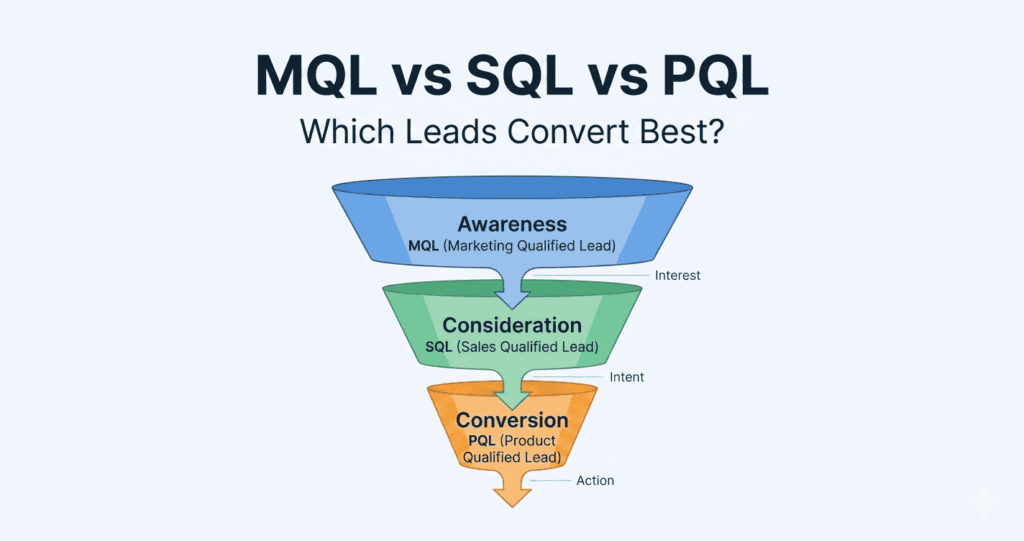
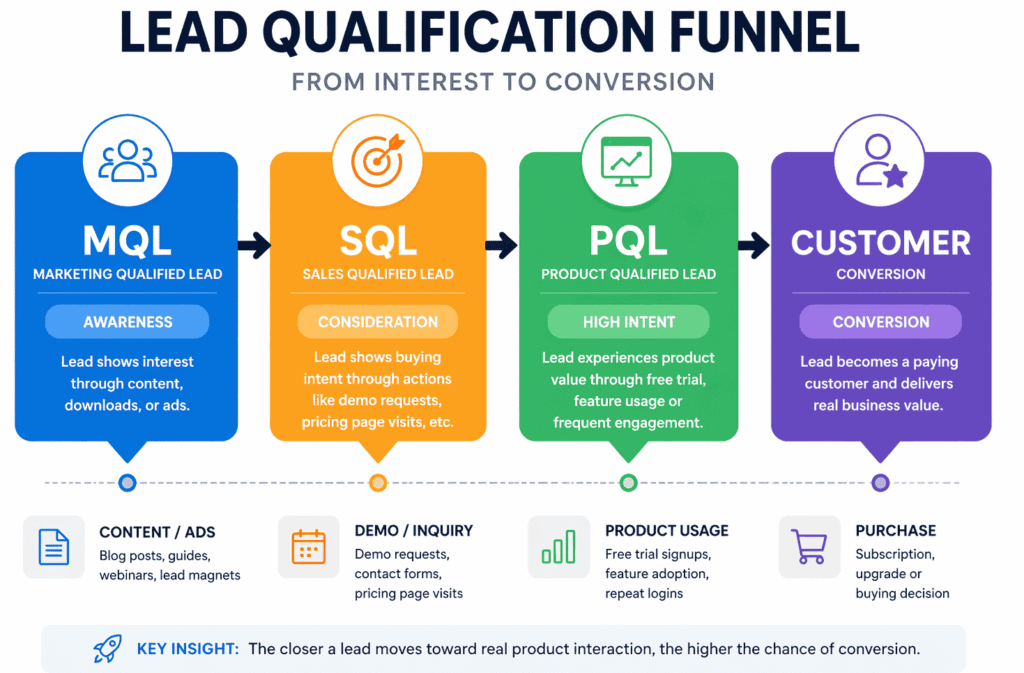
- MQL (Marketing Qualified Lead): A lead that has shown interest (e.g., downloads, visits) but is not ready to buy yet
- SQL (Sales Qualified Lead): A lead that is ready to speak with sales and evaluate your offer
- PQL (Product Qualified Lead): A user who has already used your product and is highly likely to convert
👉 The key difference lies in intent, engagement level, and readiness to purchase
Where MQL, SQL, and PQL Fit in the Funnel
Understanding where each lead type fits in your funnel helps you deliver the right message at the right time—which is what actually drives conversions.
Top & Middle of Funnel → MQL (Interest Stage)
At this stage, people are:
- Exploring solutions
- Learning about their problem
- Consuming educational content
👉 Typical actions:
- Reading blog posts
- Downloading guides
- Signing up for newsletters
What to do:
- Focus on education, not selling
- Build trust with helpful content
- Nurture through email sequences
➡️ Goal: Move them from interest → consideration
Bottom of Funnel → SQL (Decision Stage)
Here, leads are:
- Comparing options
- Evaluating solutions
- Ready to talk to sales
👉 Typical actions:
- Requesting a demo
- Visiting pricing pages
- Booking calls
What to do:
- Respond quickly
- Provide clear value and differentiation
- Personalize your communication
➡️ Goal: Convert interest → paying customer
Product Stage → PQL (Experience-Based Intent)
At this stage, users:
- Have already used your product
- Understand its value
- Are close to upgrading
👉 Typical actions:
- Using key features regularly
- Hitting usage limits
- Inviting team members
What to do:
- Highlight results and ROI
- Trigger upgrade prompts at the right time
- Remove friction in the buying process
➡️ Goal: Convert product usage → revenue
Why This Funnel Mapping Matters
When you clearly map MQL, SQL, and PQL to your funnel:
- You avoid sending the wrong message to the wrong audience
- You improve conversion rates at every stage
- You align marketing, sales, and product teams
👉 Instead of treating all leads the same, you create a structured system that moves prospects smoothly toward conversion.
What Is an MQL (Marketing Qualified Lead)?
A Marketing Qualified Lead (MQL) is someone who has shown clear interest in your business but isn’t ready to make a purchase yet.
They’re not cold—but they’re not sales-ready either.
👉 These leads are in the early to mid stage of the buying journey, where they are:
- Understanding their problem
- Exploring possible solutions
- Evaluating different approaches
Real-World Examples of MQL Behavior
An MQL typically interacts with your content or brand in meaningful ways:
- Downloading a free guide, checklist, or template
- Subscribing to your email newsletter
- Visiting multiple blog posts or resource pages
- Engaging with your social content
- Clicking on educational email campaigns
👉 These actions show interest and engagement, but not strong buying intent yet.
Why MQLs Matter
MQLs are the foundation of your sales pipeline.
If handled correctly, they can turn into high-quality customers over time.
Here’s why they’re important:
- Early opportunity capture: You engage potential customers before competitors
- Audience building: Helps grow a targeted, interested user base
- Pipeline creation: Feeds your future SQLs and PQLs
- Brand trust: Builds familiarity before the buying decision
👉 Without MQLs, your funnel becomes dependent only on high-intent leads—which limits growth.
Common Mistake with MQLs
Many businesses:
- Push sales too early
- Treat MQLs like SQLs
- Focus on conversion instead of nurturing
👉 This often leads to:
- Lower engagement
- Lost trust
- Missed long-term opportunities
How to Effectively Handle MQLs
The goal is simple:
👉 Nurture, educate, and build trust—NOT sell aggressively
1. Email Nurturing Sequences
- Send helpful, value-driven emails
- Focus on solving problems
- Gradually introduce your solution
2. Educational Content
- Blog posts, guides, tutorials
- Comparison articles
- “How-to” content
👉 This builds authority and keeps them engaged.
3. Retargeting Campaigns
- Show relevant ads based on behavior
- Bring them back to your website
- Reinforce your solution
4. Lead Scoring (Optional but Powerful)
- Assign points based on actions
- Identify when an MQL is ready to become an SQL
Key Insight
👉 MQLs don’t convert immediately—but they convert predictably when nurtured properly.
If you focus on:
- Consistent value
- Relevant content
- Timely engagement
➡️ You turn early interest into real revenue over time.
What Is an SQL (Sales Qualified Lead)?
A Sales Qualified Lead (SQL) is a prospect who has shown strong buying intent and is ready for direct interaction with your sales team.
Unlike MQLs, SQLs are no longer just exploring—they are:
- Evaluating specific solutions
- Comparing options
- Looking to make a decision soon
👉 These are high-priority leads that require immediate attention.
Real-World Examples of SQL Behavior
SQLs take clear, action-driven steps that signal readiness to buy:
- Requesting a product demo
- Asking for pricing or proposals
- Booking a sales call or consultation
- Replying to outreach with specific questions
- Visiting pricing or comparison pages multiple times
👉 These actions indicate strong intent + urgency
Why SQLs Matter (Strategic Insight)
SQLs are where real revenue opportunities begin.
Here’s why they are critical:
- High conversion probability: These leads are close to making a decision
- Sales efficiency: Your team spends time on leads that matter
- Faster deal cycles: Less nurturing, more closing
- Better ROI: Higher return from marketing efforts
👉 SQLs bridge the gap between interest and revenue
Common Mistakes with SQLs
Even high-intent leads can be lost if handled poorly:
- Slow response times
- Generic or templated replies
- Lack of personalization
- Overloading with unnecessary information
👉 Result:
- Lost deals
- Lower conversion rates
- Poor customer experience
How to Effectively Handle SQLs
The goal is simple:
👉 Respond fast, personalize deeply, and guide them to a decision
1. Fast Follow-Ups (Speed = Revenue)
- Respond within minutes or hours—not days
- Strike while intent is high
👉 Speed often determines who wins the deal.
2. Personalized Outreach
- Reference their needs, behavior, or company
- Tailor your message to their use case
👉 Avoid generic pitches—be specific and relevant.
3. Sales Conversations That Add Value
- Focus on solving their problem
- Show clear benefits and outcomes
- Address objections confidently
👉 Don’t just “sell”—consult and guide
4. Clear Next Steps
- Offer demos, trials, or proposals
- Make it easy to move forward
👉 Reduce friction in decision-making.
Key Insight
👉 SQLs are your highest-leverage opportunities in the funnel.
If you:
- Respond quickly
- Personalize effectively
- Focus on value
➡️ You can significantly increase your close rates and revenue.
What Is a PQL (Product Qualified Lead)?
A Product Qualified Lead (PQL) is a user who has already experienced your product and demonstrated strong intent to upgrade or purchase.
Unlike MQLs and SQLs, PQLs don’t rely on assumptions—they’ve seen real value firsthand.
👉 These leads are typically in the final stage of the buying journey, where decisions are based on actual product experience.
Real-World Examples of PQL Behavior
PQLs actively engage with your product in ways that signal readiness to convert:
- Using core features frequently
- Reaching or exceeding usage limits (e.g., free plan restrictions)
- Inviting team members or collaborators
- Returning regularly and spending significant time in the product
- Exploring premium features or upgrade pages
👉 These actions indicate high intent + product validation
Why PQLs Matter
PQLs are often your highest-converting leads because they already understand your product’s value.
Here’s why they’re powerful:
- Experience-driven decisions: No need for heavy persuasion
- Shorter sales cycles: Less nurturing required
- Higher conversion rates: Strong alignment between need and solution
- Better customer fit: Users already know how your product works
👉 PQLs shift your strategy from selling to helping users upgrade
Common Mistakes with PQLs
Even high-intent users can drop off if handled poorly:
- Not identifying PQL signals early
- Delayed or no upgrade prompts
- Poor onboarding experience
- Overcomplicating pricing or upgrade steps
👉 Result:
- Lost conversions
- Frustrated users
- Missed revenue opportunities
How to Effectively Handle PQLs
The goal is simple:
👉 Convert product experience into a paid decision—at the right moment
1. Smart Upgrade Prompts
- Trigger upgrades based on usage behavior
- Show prompts when users hit limits or key milestones
👉 Timing is critical—don’t push too early or too late.
2. Feature Unlocks & Value Highlights
- Showcase premium features at the right time
- Let users experience limited access before upgrading
👉 Help users feel the value before asking them to pay.
3. ROI-Focused Messaging
- Highlight time saved, results achieved, or efficiency gained
- Use data and outcomes, not just features
👉 Focus on results, not just functionality
4. Assisted Conversion (Optional but Powerful)
- Offer demos or support for high-value users
- Provide onboarding help for teams
👉 Especially useful for B2B or higher-ticket products.
Key Insight
👉 PQLs convert not because of marketing—but because of product experience.
If you:
- Track the right behavior
- Trigger actions at the right time
- Communicate clear value
➡️ You can turn active users into paying customers faster and more efficiently.
MQL vs SQL vs PQL: Key Differences Explained
Understanding the difference between MQL, SQL, and PQL is critical because each represents a different stage of buyer intent and conversion readiness.
Instead of treating all leads the same, this comparison helps you prioritize the right leads at the right time, improving both efficiency and revenue.
Quick Comparison: MQL vs SQL vs PQL
| Factor | MQL (Marketing Qualified Lead) | SQL (Sales Qualified Lead) | PQL (Product Qualified Lead) |
|---|---|---|---|
| Intent Level | Low to Medium (interest stage) | High (decision stage) | Very High (experience-based intent) |
| Source | Marketing activities (content, ads, downloads) | Direct sales engagement (demo, inquiry) | Product usage (trial, freemium activity) |
| Behavior Signals | Blog visits, ebook downloads, email signups | Demo requests, pricing page visits, replies | Feature usage, onboarding completion, repeated actions |
| Conversion Probability | Low | Medium to High | Very High |
| Sales Readiness | Not ready yet | Ready for sales conversation | Already experiencing value |
| Example | Downloaded a guide | Requested a demo | Actively using key product features |
| Primary Focus | Lead nurturing | Closing deals | Driving activation & upgrades |
Key Insight
The biggest difference is not just in definition—but in how close the lead is to making a buying decision:
- MQLs need education and nurturing
- SQLs need direct sales engagement
- PQLs need timely conversion triggers
👉 This is why businesses that focus on PQLs often see higher conversion rates, especially in SaaS and product-led growth models.
When to Use MQL vs SQL vs PQL (Decision Framework for Better Conversions)
Knowing the definitions of MQL, SQL, and PQL is not enough—the real advantage comes from understanding when to prioritize each type of lead based on your business model, funnel stage, and growth goals.
This framework helps you decide where to focus your efforts for maximum ROI instead of spreading resources across all leads equally.
1. When to Prioritize MQL (Early-Stage Growth & Awareness)
MQLs are most valuable when your goal is to build awareness and generate a consistent pipeline of potential customers.
✔ Use MQL strategy when:
- You’re in the traffic-building phase
- Running content marketing or paid ads
- Targeting cold audiences unfamiliar with your brand
- Launching a new product or entering a new market
Practical Example:
If you’re publishing blogs like:
- “Best AI tools for sales teams”
- “How to automate lead generation”
👉 Most users are in the research phase, not ready to buy
Focus here:
- Lead magnets (ebooks, guides)
- Email nurturing sequences
- Educational content
Key Insight:
MQLs are not about immediate sales—they are about building trust and warming up future buyers.
2. When SQL Matters Most (Sales-Driven Funnel)
SQLs become critical when your focus shifts from generating leads to closing deals and generating revenue.
✔ Use SQL strategy when:
- Leads show clear buying intent
- You have a dedicated sales team
- Your product requires explanation or demos
- You’re targeting high-ticket or B2B clients
Practical Example:
A lead:
- Visits pricing page multiple times
- Requests a demo
- Replies to outreach emails
👉 This is a ready-to-buy SQL
Focus here:
- Fast follow-ups (within minutes)
- Personalized outreach
- Sales calls and demos
Pro Insight:
SQLs don’t need more information—they need confidence and quick engagement to convert.
3. When PQL Dominates (SaaS & Product-Led Growth)
PQLs are the most powerful leads in product-led businesses, where users experience value before purchasing.
✔ Use PQL strategy when:
- You offer free trials or freemium plans
- Your product can demonstrate value quickly
- You rely on self-serve onboarding
- You want scalable growth without heavy sales dependency
Practical Example:
A user:
- Signs up for trial
- Uses core feature multiple times
- Invites team members
👉 This user is a high-intent PQL
Focus here:
- Improving onboarding experience
- Tracking activation milestones
- Triggering upgrade prompts at the right time
Key Insight:
PQLs convert better because they’ve already seen the value—you’re not selling, you’re just enabling the decision.
How to Decide What to Focus On (Quick Framework)
Ask yourself:
- Are you trying to generate awareness? → Focus on MQL
- Are you trying to close deals faster? → Focus on SQL
- Are you trying to scale conversions efficiently? → Focus on PQL
Real-World Strategy (Balanced Approach)
High-performing businesses don’t rely on just one—they:
- Use MQLs to fill the funnel
- Convert SQLs through sales engagement
- Maximize revenue with PQLs through product experience
👉 This creates a balanced, high-converting funnel
MQL vs PQL: Is Product-Led Growth Replacing Traditional Lead Qualification?
As SaaS and product-led growth models evolve, a key question is emerging:
Is PQL replacing MQL as the primary driver of conversions?
This isn’t just a trend—it reflects a fundamental shift in how buying intent is identified and acted upon.
Why This Debate Matters Today
Traditionally, businesses relied on MQLs generated through marketing activities like content downloads, ads, and email campaigns.
But modern SaaS companies are increasingly noticing:
- High MQL volume doesn’t always translate into revenue
- Many “qualified” leads are not actually ready to buy
- Sales teams spend time filtering instead of closing
👉 This has led to a growing focus on product-driven signals (PQLs).
MQL vs PQL: Core Difference in Approach
- MQL (Marketing Qualified Lead):
Based on interest signals (clicks, downloads, visits) - PQL (Product Qualified Lead):
Based on value-driven behavior (actual product usage)
Key Insight:
Product usage reveals intent more accurately than marketing engagement because users are already interacting with what they may purchase.
Why Many SaaS Companies Are Shifting Toward PQL
✔ 1. Stronger Buying Intent Signals
PQLs are based on real actions inside the product, not assumptions.
Example:
- A user actively using features is far more valuable than someone reading a blog.
✔ 2. Shorter Sales Cycles
Users who experience value:
- Need less convincing
- Require fewer touchpoints
- Convert faster
✔ 3. Better Resource Allocation
Sales teams:
- Spend less time qualifying
- Focus only on high-intent users
✔ 4. Scalable Growth Model
With PQL:
- Product becomes the main conversion driver
- Less dependency on large sales teams
Does This Mean MQL Is Obsolete?
No—and this is where most misunderstand the shift.
MQL is still essential for:
- Generating awareness
- Filling the top of the funnel
- Educating new audiences
Expert Insight:
PQL is not replacing MQL—it is refining and strengthening the qualification process by focusing on proven intent.
The Winning Strategy: Hybrid Funnel Approach
High-performing SaaS companies combine both:
- MQL → brings users into the ecosystem
- PQL → identifies who is ready to convert
👉 This creates a funnel where:
- Marketing drives discovery
- Product validates intent
- Sales accelerates conversion
Practical Takeaway
If your business relies only on MQLs:
- You may generate volume but struggle with conversions
If you integrate PQL signals:
- You focus on users already experiencing value
- Your conversion efficiency improves significantly
Real Metrics & Benchmarks for MQL, SQL & PQL (Data-Driven Insights)
Understanding MQL, SQL, and PQL conceptually is important—but what truly separates average content from high-ranking, authoritative content is real-world performance benchmarks.
These metrics help you:
- Evaluate your current funnel performance
- Identify bottlenecks
- Set realistic growth targets
Industry Benchmark Conversion Rates
While exact numbers vary by industry, business model, and pricing, here are widely observed performance ranges:
| Conversion Stage | Average Conversion Rate | What It Indicates |
|---|---|---|
| MQL → SQL | 10% – 30% | Lead quality & targeting accuracy |
| SQL → Customer | 20% – 40% | Sales effectiveness & closing ability |
| PQL → Customer | 30% – 60% | Product value & user activation strength |
How to Interpret These Numbers
These benchmarks are not just numbers—they tell you where your funnel is breaking or performing well.
Low MQL → SQL Conversion (<10%)
👉 Possible issues:
- Poor targeting (wrong audience)
- Weak lead magnets
- Misaligned content vs user intent
Low SQL → Customer Conversion (<20%)
👉 Possible issues:
- Slow or weak follow-ups
- Poor sales messaging
- Pricing or positioning problems
Low PQL Conversion (<30%)
👉 Possible issues:
- Weak onboarding experience
- Product value not clear
- Missing activation triggers
Key Insight:
Each stage reflects a different part of your system—marketing, sales, or product.
Improving conversions means fixing the right stage, not the whole funnel blindly.
Why PQL Conversion Rates Are Higher
PQLs consistently outperform MQLs and SQLs because:
- Users have already experienced product value
- Trust is built through usage, not marketing
- Less friction in decision-making
Pro Insight:
The closer a lead is to experiencing real value, the higher the probability of conversion.
That’s why PQL is becoming a key growth driver in SaaS.
How to Use These Benchmarks in Your Strategy
Instead of chasing industry averages blindly, use them to:
✔ Set performance goals
Aim to move from lower range → mid range first
✔ Identify weak points
Don’t optimize everything—focus where conversion drops
✔ Improve step-by-step
Fix MQL quality → then SQL conversion → then PQL activation
Important Reality Check
These numbers are guidelines, not guarantees.
Your actual performance depends on:
- Industry (B2B vs B2C)
- Pricing (low-ticket vs high-ticket)
- Sales cycle length
- Traffic quality
Expert Insight:
Top-performing companies don’t just track conversions—they continuously optimize each stage based on data.
Real-Life Lead Journey (Step-by-Step Funnel Walkthrough)
To truly understand MQL, SQL, and PQL, let’s look at how a real user moves through your funnel—from first touch to becoming a customer.
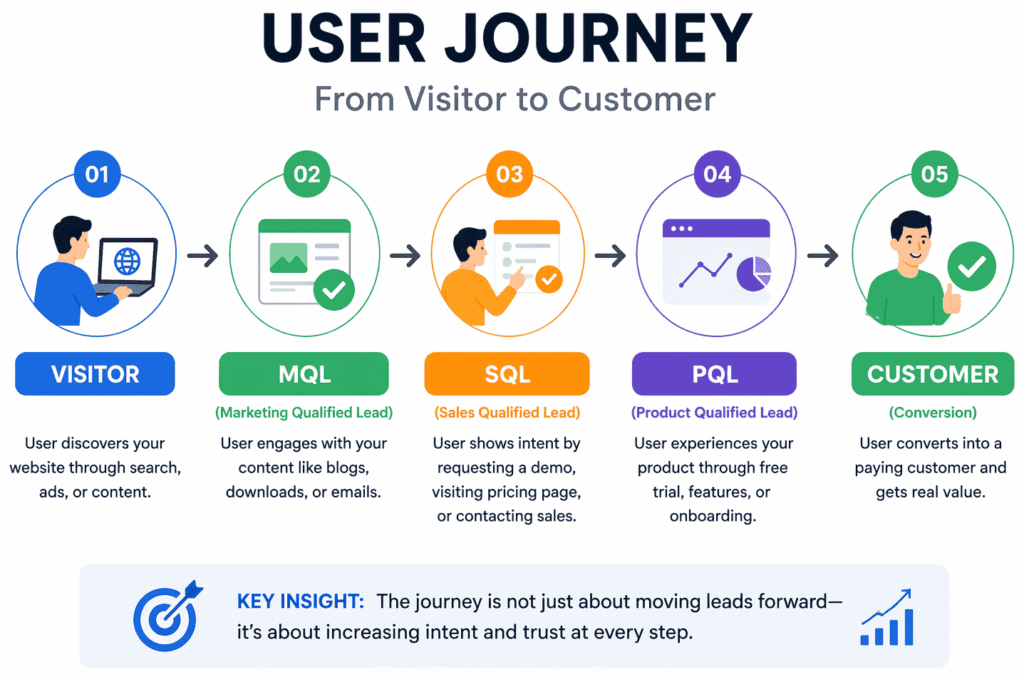
Step 1: Discovery Stage → MQL (Marketing Qualified Lead)
A user finds your website through:
- A blog post
- Google search
- Social media
They start exploring:
- Reading multiple articles
- Downloading a guide
- Subscribing to your email list
👉 At this stage, they are interested but not ready to buy.
Your role:
- Educate them
- Build trust
- Provide value through content
➡️ This is where a visitor becomes an MQL
Step 2: Consideration Stage → SQL (Sales Qualified Lead)
After engaging with your content, the user becomes more serious.
They take stronger actions like:
- Visiting your pricing page
- Comparing your solution with others
- Booking a demo or consultation
👉 Now, they are actively evaluating your product.
Your role:
- Respond quickly
- Personalize your communication
- Address their specific needs
➡️ This is where an MQL becomes an SQL
Step 3: Product Experience Stage → PQL (Product Qualified Lead)
The user decides to try your product:
- Signs up for a free trial
- Starts using key features
- Invites team members
- Hits usage limits
👉 At this point, they have experienced your product’s value firsthand.
Your role:
- Highlight results and outcomes
- Show upgrade benefits
- Remove friction in the buying process
➡️ This is where an SQL becomes a PQL
Step 4: Conversion Stage → Customer
After experiencing the product and seeing value:
- The user upgrades to a paid plan
- Becomes a customer
👉 This is the final outcome of a well-structured funnel.
What This Journey Teaches You
This simple flow highlights a powerful truth:
- Leads don’t convert instantly—they progress through stages
- Each stage requires a different strategy
- Timing and messaging are critical at every step
Key Takeaway
👉 A successful sales system doesn’t just generate leads—it guides them step-by-step toward conversion.
When you:
- Nurture MQLs
- Act fast on SQLs
- Convert PQLs effectively
➡️ You build a predictable and scalable growth engine.
How to Implement MQL, SQL & PQL in Your Business (Step-by-Step Guide)
Understanding definitions is not enough—the real impact comes when you turn MQL, SQL, and PQL into a working system inside your business. Below is a practical implementation framework used by high-performing SaaS and B2B teams.
Step 1: Clearly Define What Counts as MQL, SQL, and PQL (Foundation Layer)
Before anything else, your teams must agree on one definition system. Without this, lead qualification becomes subjective and inconsistent.
🔹 MQL (Marketing Qualified Lead)
A lead becomes MQL when they show interest but not buying intent yet.
Example qualification rules:
- Downloaded an ebook or guide
- Signed up for newsletter
- Visited pricing page 2+ times
- Filled a “contact us” or demo interest form (non-sales intent)
👉 Goal: Identify curious but not ready users.
🔹 SQL (Sales Qualified Lead)
A lead becomes SQL when they show clear buying intent and are ready for sales conversation.
Example qualification rules:
- Requested a demo or pricing directly
- Responded to sales email or outreach
- Has budget, authority, and need (BANT signals)
- Engaged multiple times with high-intent pages (pricing, features, comparisons)
👉 Goal: Identify ready-to-buy leads.
🔹 PQL (Product Qualified Lead)
A lead becomes PQL when they experience value inside the product itself.
Example qualification rules:
- Completed onboarding setup
- Used core feature multiple times
- Hit usage threshold (e.g., 3 campaigns created, 50 contacts added)
- Invited teammates or upgraded trial usage
👉 Goal: Identify users already experiencing product value.
Step 2: Build a Lead Scoring System (Automate Qualification)
Instead of manually guessing lead quality, assign points to actions.
Example Lead Scoring Model:
| Action | Points |
|---|---|
| Email signup | +5 |
| Ebook download | +10 |
| Pricing page visit | +15 |
| Webinar attendance | +20 |
| Demo request | +30 |
| Product sign-up | +25 |
| Feature usage (core action) | +40 |
Qualification Rules Example:
- 0–30 points → Lead
- 31–60 points → MQL
- 61–90 points → SQL
- Product usage milestone → PQL
👉 This removes guesswork and standardizes qualification across teams.
Step 3: Align Marketing, Sales & Product Teams (Critical for Conversion)
Most companies fail here—not because of tools, but because of misalignment between teams.
🔹 Marketing Team Responsibility → MQL
Marketing should focus on:
- Generating traffic
- Capturing leads
- Nurturing through email workflows
- Delivering “ready-for-sales” leads
📌 Key KPI: MQL volume & MQL quality
🔹 Sales Team Responsibility → SQL
Sales should focus on:
- Contacting high-intent leads quickly (within 5–15 minutes ideally)
- Personalizing outreach based on behavior
- Closing deals, not educating from scratch
📌 Key KPI: SQL-to-close conversion rate
🔹 Product Team Responsibility → PQL
Product team should focus on:
- Improving onboarding experience
- Increasing activation rate
- Tracking user behavior inside product
- Identifying “aha moment”
📌 Key KPI: Activation rate → Paid conversion
Step 4: Use the Right Tools to Automate the System
A good system is not manual—it runs on automation.
CRM (Customer Relationship Management)
Use tools like:
- HubSpot
- Salesforce
- Zoho CRM
👉 Purpose:
- Store all leads
- Track lifecycle stage (Lead → MQL → SQL → Customer)
Outreach Tools (Sales Activation)
Examples:
- Apollo
- Reply.io
- Lemlist
👉 Purpose:
- Automated follow-ups
- Cold email sequences
- Sales engagement tracking
Product Analytics Tools (For PQL)
Examples:
- Mixpanel
- Amplitude
- Hotjar
👉 Purpose:
- Track product usage behavior
- Define activation milestones
- Identify PQL signals
Step 5: Build a Full Lead Flow (Real-World Funnel Example)
Here’s how everything connects in practice:
- User downloads an ebook (Marketing)
↓ - Becomes MQL (scoring + engagement)
↓ - Nurtured via email sequence
↓ - Visits pricing page + requests demo
↓ - Becomes SQL (Sales takes over)
↓ - Signs up for product trial
↓ - Uses core feature → becomes PQL
↓ - Converts to paid customer
Pro Insight (What Most Businesses Miss)
The biggest mistake companies make is treating MQL, SQL, and PQL as separate systems.
👉 High-performing companies treat them as a single continuous journey, not separate departments.
When aligned properly:
- Marketing delivers better leads
- Sales closes faster
- Product increases retention
- Revenue grows predictably
How AI Improves Lead Qualification (Real-World Implementation & Insights)
AI is no longer just a “nice-to-have” in lead generation—it’s becoming the core engine behind how modern businesses qualify, prioritize, and convert leads efficiently.
Instead of relying on guesswork or manual scoring, AI uses data, behavior patterns, and predictive models to identify which leads are most likely to convert.
1. AI Tracks User Behavior in Real Time (Beyond Basic Analytics)
Traditional systems track basic actions like form submissions. AI goes much deeper.
What AI actually tracks:
- Pages visited (pricing, features, comparison pages)
- Time spent on each page
- Scroll depth and engagement patterns
- Click behavior (CTAs, buttons, links)
- Email opens and link clicks
- Product usage (for SaaS businesses)
Real Example:
If a user:
- Visits your pricing page 3 times
- Reads a comparison blog
- Clicks “Book Demo” but doesn’t submit
👉 AI flags this as high intent behavior, even without a conversion.
2. AI Predicts Buying Intent (From Data, Not Assumptions)
This is where AI becomes powerful.
Instead of static rules, AI identifies patterns across thousands of users to predict:
- Who is likely to buy soon
- Who needs nurturing
- Who is unlikely to convert
How it works:
AI models analyze:
- Past conversion data
- Behavioral similarities
- Engagement frequency
- Demographics (if available)
Real Example:
Two leads download the same ebook:
- Lead A: No further action
- Lead B: Visits pricing + checks integrations
👉 AI ranks Lead B as higher priority automatically
Many businesses automate lead qualification and outreach using tools like Apollo—learn more in our guide on How Apollo.io helps with lead generation and automation.
3. AI Automates Lead Scoring (Dynamic & Self-Improving)
Manual lead scoring is static and often inaccurate.
AI introduces dynamic lead scoring, which adjusts in real time.
Traditional scoring:
- Ebook = +10
- Demo = +30
(Fixed rules)
AI-based scoring:
- Adjusts scores based on:
- Conversion patterns
- Industry behavior
- Engagement trends
What changes:
- Scores update automatically
- High-quality leads surface faster
- Low-quality leads are filtered out
👉 This directly improves MQL → SQL conversion rates
To implement this effectively, read our complete guide on Lead scoring models and how to prioritize high-intent leads.
4. AI Personalizes Communication at Scale
Generic follow-ups don’t work anymore. AI helps tailor messaging based on behavior and intent.
What AI personalizes:
- Email content (based on user actions)
- Product recommendations
- Follow-up timing
- Sales messaging tone
Real Example:
Instead of sending:
“Check out our product features”
AI sends:
“Since you explored our pricing and integrations, here’s how our tool fits your business needs”
👉 This increases:
- Open rates
- Response rates
- Conversion probability
AI makes follow-ups more efficient—explore how to Automate personalized email campaigns at scale using AI tools.
5. AI Connects MQL, SQL & PQL Seamlessly
One of the biggest advantages of AI is that it removes gaps between teams.
Without AI:
- Marketing qualifies MQL
- Sales re-qualifies again
- Product works separately
With AI:
- Shared data across all stages
- Unified scoring system
- Smooth transition from:
- MQL → SQL → PQL → Customer
👉 Result: No lead is lost due to miscommunication
6. AI Improves Decision-Making Speed (Critical for Sales)
Speed is a major factor in conversions.
AI enables:
- Instant lead qualification
- Real-time alerts for hot leads
- Automated routing to sales reps
Example:
When a lead:
- Visits pricing page
- Uses product trial heavily
👉 AI instantly:
- Notifies sales team
- Triggers follow-up sequence
Final Result: What AI Actually Improves
When implemented correctly, AI delivers:
✔️ Higher-quality MQLs
✔️ Faster SQL conversion
✔️ Better PQL identification
✔️ Reduced manual effort
✔️ Improved sales efficiency
👉 End Result:
More revenue with fewer wasted leads
Pro Insight
The biggest shift AI brings is this:
“Lead qualification moves from rule-based systems to behavior-driven intelligence.”
Businesses that adopt AI don’t just generate more leads—they focus only on leads that matter, which is the real driver of growth.
You can explore practical tools in our review of AI tools for sales and marketing automation.
Tools to Manage MQL, SQL & PQL (Complete Funnel Control Guide)
Managing MQL, SQL, and PQL effectively is not just about definitions—it requires a connected tool ecosystem that tracks, qualifies, and converts leads automatically.
The goal is simple:
👉 Capture → Track → Score → Engage → Convert
1. CRM Tools → Manage & Track the Entire Pipeline
CRM (Customer Relationship Management) tools act as the central hub of your lead system.
Popular CRM tools:
- HubSpot CRM
- Salesforce
- Zoho CRM
What CRM actually does:
✔ Stores all leads in one place
✔ Tracks lifecycle stages (Lead → MQL → SQL → Customer)
✔ Records interactions (emails, calls, meetings)
✔ Assigns leads to sales reps automatically
✔ Tracks deal progress and revenue
Real Workflow Example:
- A user downloads your ebook → enters CRM
- CRM tags them as MQL
- Sales team gets notified when score increases
- Lead moves to SQL after demo request
👉 Why it matters:
Without a CRM, leads get lost, duplicated, or ignored—reducing conversion rates significantly.
If you’re evaluating tools for managing these lead types, check our comparison of Best CRM and sales engagement tools for lead management.
2. Outreach Tools → Automate Follow-Ups & Engagement
Outreach tools help you convert MQLs into SQLs by automating communication.
Popular outreach tools:
- Apollo.io
- Reply.io
- Lemlist
What outreach tools actually do:
✔ Send automated email sequences
✔ Personalize messages at scale
✔ Track opens, clicks, replies
✔ Trigger follow-ups based on behavior
✔ Integrate with CRM for real-time updates
Real Workflow Example:
- MQL downloads a guide
- Enters automated email sequence
- Opens 3 emails + clicks pricing link
👉 Tool flags as high-intent lead → SQL
👉 Why it matters:
Manual follow-ups are slow and inconsistent. Automation ensures no high-intent lead is missed.
To choose the right tool for engaging and converting sales-qualified leads, read our detailed comparison of Apollo.io vs Reply.io for lead generation and outreach.
3. Product Analytics Tools → Identify & Convert PQLs
For SaaS and product-led businesses, this is where the real magic happens.
Popular product analytics tools:
- Mixpanel
- Amplitude
- Hotjar
What these tools track:
✔ User onboarding progress
✔ Feature usage frequency
✔ Engagement depth
✔ Drop-off points
✔ Activation events (key actions)
Real Workflow Example:
- User signs up for free trial
- Uses core feature 3 times
- Invites team members
👉 System marks them as PQL (Product Qualified Lead)
👉 Sales team reaches out with targeted offer
👉 Why it matters:
PQLs are often highest-converting leads because they’ve already experienced value.
4. Integration: The Real Power (Most Businesses Miss This)
Using tools separately is not enough—the real performance comes from integration.
Ideal Connected Workflow:
- CRM captures lead → assigns MQL
- Outreach tool nurtures → tracks engagement
- Product tool tracks usage → identifies PQL
- CRM updates status → notifies sales
👉 This creates a closed-loop system where:
- No lead is ignored
- High-intent leads are prioritized
- Teams work with shared data
If you’re new to managing leads and pipelines, this beginner-friendly guide to How to use HubSpot for lead management and automation will help you get started.
5. Advanced Setup (High-Performance Businesses)
Top-performing companies go one step further:
✔ AI-powered scoring inside CRM
✔ Behavioral triggers (real-time alerts)
✔ Automated lead routing
✔ Personalized outreach sequences
✔ Product usage-based upsell targeting
💡 Key Insight:
The difference between average and high-performing businesses is not the number of leads—but how efficiently they manage and convert them using the right tools.
Final Result: What These Tools Achieve
When implemented correctly, this system delivers:
✔ Higher MQL to SQL conversion
✔ Faster sales cycles
✔ Better PQL identification
✔ Improved customer experience
✔ Increased revenue predictability
👉 End Result:
A fully optimized funnel where every lead is tracked, nurtured, and converted at the right time
Common Mistakes in MQL, SQL & PQL (And How to Fix Them)
Even with the right strategy and tools, many businesses fail to convert leads effectively because of basic but critical mistakes in lead qualification and handling.
Avoiding these mistakes can instantly improve conversion rates without increasing traffic.
1. Treating All Leads Equally
This is one of the biggest conversion killers.
❌ What goes wrong:
- Every lead gets the same emails
- Same follow-up timing
- Same sales pitch
👉 Result:
High-intent leads feel ignored, while low-quality leads waste your time.
Real Example:
- Lead A downloads an ebook (low intent)
- Lead B visits pricing page 3 times (high intent)
If both get the same treatment → you lose Lead B
✅ How to fix:
- Segment leads based on behavior
- Separate MQL, SQL, and PQL clearly
- Prioritize high-intent actions (pricing visits, demos, product usage)
Key Insight:
Not all leads deserve equal attention—they deserve the right attention based on intent.
2. Ignoring Lead Scoring
Without scoring, your funnel becomes guesswork.
❌ What goes wrong:
- Sales teams chase random leads
- Marketing sends unqualified leads
- No clear priority system
👉 Result:
Low conversion rates + wasted effort
Real Example:
A lead who opened 5 emails but never visited pricing is treated the same as someone who requested a demo.
✅ How to fix:
- Implement a scoring system (manual or AI-based)
- Assign points for:
- Page visits
- Email engagement
- Product activity
- Define clear thresholds:
- MQL → SQL → PQL
Pro Insight:
Lead scoring doesn’t just prioritize leads—it aligns your entire funnel around data instead of assumptions.
3. Delaying Follow-Ups (Critical Revenue Leak)
Speed is everything in lead conversion.
❌ What goes wrong:
- Leads are contacted after hours or days
- No real-time alerts
- Manual follow-up process
👉 Result:
Leads lose interest or choose competitors
Reality:
- Leads contacted within 5–15 minutes convert significantly higher
- After 24 hours → conversion chances drop sharply
Real Example:
A user requests a demo but receives a reply after 1 day → they’ve already moved on.
✅ How to fix:
- Use automated follow-ups
- Set instant alerts for high-intent actions
- Trigger outreach based on behavior (pricing visit, demo click)
Key Insight:
In modern sales, speed beats perfection—the fastest responder often wins the deal.
4. Misalignment Between Teams (Silent Growth Killer)
This is a hidden but extremely damaging issue.
❌ What goes wrong:
- Marketing sends low-quality MQLs
- Sales rejects leads without feedback
- Product team works separately from sales insights
👉 Result:
Broken funnel, poor conversions, internal friction
Real Example:
Marketing considers ebook download as MQL
Sales expects demo-ready leads
👉 Result: frustration + lost opportunities
✅ How to fix:
- Define shared MQL, SQL, PQL criteria
- Create feedback loop between teams
- Use a unified CRM system
- Align KPIs across departments
💡 Expert Insight:
High-performing companies don’t just generate leads—they align teams around a shared definition of lead quality.
5. Bonus Mistake : Focusing Only on Lead Quantity, Not Quality
Many businesses chase more leads instead of better leads.
Reality:
- 100 low-quality leads < 10 high-intent leads
✅ Fix:
- Optimize for intent, not volume
- Focus on:
- PQL signals
- High-engagement users
- Decision-stage content
Final Takeaway
Most businesses don’t fail because of lack of leads—they fail because of poor lead management and qualification.
✔ When you fix these mistakes, you get:
- Higher MQL → SQL conversion
- Faster deal closures
- Better use of sales resources
- Increased revenue without increasing traffic
👉 End Result:
A smarter, more efficient funnel where every lead is handled based on its true value
Before setting up scoring and automation, it’s important to understand the basics—this guide on How to build an effective lead qualification framework can help.
Mini Case Study: How Focusing on SQL & PQL Doubled Conversions
A mid-sized SaaS company noticed a common problem:
they were generating a high volume of leads, but sales conversions were inconsistent and resource-heavy.
The Challenge
- Marketing was generating a large number of MQLs
- Sales team was overwhelmed with low-intent leads
- Demo bookings were high, but close rates were low
- Product trials were underutilized
👉 The funnel looked healthy on the surface—but efficiency was poor
Strategic Shift (What They Changed)
Instead of increasing traffic or lead volume, the company made a bold decision:
✔ Reduced MQL dependency
- Tightened qualification criteria
- Filtered out low-engagement leads early
✔ Prioritized high-intent signals
- Focused on demo requests, pricing visits, and repeat engagement
- Created a fast-track process for SQL-level leads
✔ Leveraged product behavior (PQL focus)
- Identified users who reached key activation milestones
- Triggered sales outreach only after meaningful product usage
✔ Optimized sales effort
- Sales team stopped chasing cold leads
- Focus shifted to fewer but higher-quality conversations
The Results (What Actually Improved)
- MQL volume decreased by 30%
- Sales workload reduced significantly
- Lead-to-customer conversion rate doubled (2x)
- Sales cycle became faster and more predictable
Key Insight
The biggest improvement didn’t come from generating more leads—but from:
Eliminating friction between intent and action
By focusing only on leads that showed clear buying or usage intent, the company aligned its entire funnel around conversion readiness instead of lead volume.
What This Means for Your Business
If your funnel feels busy but conversions are low:
- You may not have a traffic problem
- You may have a qualification problem
Practical Takeaway
Instead of asking:
“How can we get more leads?”
Ask:
“How can we identify and prioritize the right leads faster?”
👉 Final Lesson:
When your system is optimized for intent, not volume,
every stage of the funnel becomes more efficient and profitable
✅ Actionable Checklist to Optimize MQL, SQL & PQL Performance
Use this quick checklist to evaluate whether your lead qualification system is actually driving results—or holding you back:
Lead Qualification Clarity
- Do you have clear, documented criteria for MQL, SQL, and PQL?
- Is your entire team aligned on what qualifies a lead at each stage?
Behavior Tracking System
- Are you actively tracking user actions like page visits, email engagement, and product usage?
- Do you use this data to identify high-intent signals?
Lead Prioritization
- Are you focusing more on high-intent leads (demo requests, pricing visits, active users)?
- Or are you treating all leads the same and losing valuable opportunities?
Follow-Up Speed & Automation
- Are you responding to high-intent leads within minutes, not hours?
- Do you have automated systems in place to ensure no lead is missed?
Quick Reality Check:
If you answered “no” to even one of these, your funnel likely has conversion leaks that can be fixed quickly.
👉 Goal:
Build a system where every lead is clearly defined, intelligently tracked, and acted on at the right time—that’s what drives consistent sales growth.
Key Takeaway
Not all leads deserve the same attention—the real growth comes from focusing on the ones that are most likely to convert.
When you prioritize intent, readiness, and behavior, your entire funnel becomes more efficient and results-driven.
That’s how businesses move from chasing leads to closing the right ones consistently.
Final Thought
The real goal isn’t to generate more leads—it’s to build a system that identifies and converts high-quality, sales-ready leads.
When your strategy is aligned with qualification instead of volume, conversions improve naturally and sustainably.
FAQs
-
What is the difference between MQL, SQL, and PQL?
MQL (Marketing Qualified Lead) is a lead that has shown initial interest through marketing activities like downloads or website visits.
SQL (Sales Qualified Lead) is a lead that shows strong buying intent and is ready for direct sales engagement.
PQL (Product Qualified Lead) is a user who has experienced value through product usage, making them the most conversion-ready. -
Which is better: MQL, SQL, or PQL?
None is “better” in isolation—they serve different stages of the funnel.
However, PQLs often convert at higher rates because they are based on real product usage, while MQLs and SQLs rely more on intent signals. -
What is a good MQL to SQL conversion rate?
A typical MQL to SQL conversion rate ranges between 10% and 30%, depending on industry and targeting quality.
Higher conversion rates usually indicate better lead qualification and alignment between marketing and sales. -
Why are PQLs considered high-quality leads?
PQLs are considered high-quality because users have already interacted with the product and experienced its value.
This reduces uncertainty and increases the likelihood of conversion compared to leads based only on interest or intent. -
How do you convert MQL to SQL effectively?
To convert MQLs into SQLs:
Use lead scoring to identify high-intent behavior
Nurture leads with targeted content
Monitor actions like pricing page visits or demo requests
Follow up quickly with personalized outreach -
When should a lead be passed from marketing to sales?
A lead should be passed to sales when it meets predefined SQL criteria, such as:
Requesting a demo
Showing repeated high-intent behavior
Engaging with sales communication
Clear qualification rules ensure only sales-ready leads are passed. -
Can a lead be both SQL and PQL?
Yes. A lead can qualify as both SQL and PQL if they:
Show strong buying intent
Actively use the product
These leads are extremely valuable because they combine intent + product experience. -
What tools help manage MQL, SQL, and PQL?
Businesses typically use:
CRM tools to track lead stages
Outreach tools to automate follow-ups
Product analytics tools to track user behavior
These tools help create a connected and efficient lead qualification system. -
Is PQL replacing MQL in modern marketing?
PQL is not replacing MQL but complementing it.
Many SaaS companies now use a hybrid approach where MQLs generate awareness and PQLs identify high-converting users based on product usage. -
How can I improve lead qualification in my business?
To improve lead qualification:
Define clear MQL, SQL, and PQL criteria
Implement lead scoring
Track user behavior across channels
Align marketing, sales, and product teams
Focus on high-intent leads instead of volume