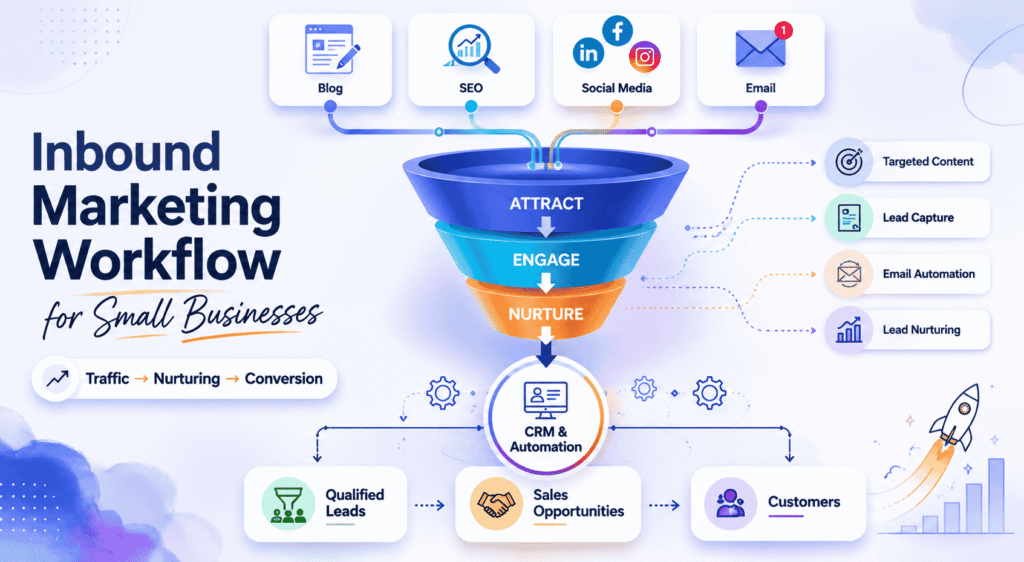
Inbound Marketing Workflow for Small Businesses
Table of Contents
Small businesses today face a difficult marketing challenge: generating consistent leads without building a large marketing team or spending heavily on paid acquisition.
That’s where inbound marketing workflows become powerful.
Instead of relying on disconnected campaigns, manual follow-ups, or unpredictable outreach efforts, inbound workflows help businesses create a structured system for attracting, nurturing, and converting potential customers over time. From SEO-driven blog content and lead magnets to CRM automation and personalized email nurturing, modern inbound marketing is built around creating scalable customer journeys rather than isolated marketing activities.
The biggest shift is that inbound marketing is no longer just about publishing content. Successful businesses now combine content, automation, CRM systems, lead scoring, and AI-powered workflows to build predictable lead generation engines that continue working long after the initial setup.
For small businesses, this creates a major advantage. A well-structured inbound workflow can help reduce manual work, improve lead quality, increase follow-up consistency, and create a more organized path from first website visit to paying customer.
In this guide, we’ll break down how inbound marketing workflows work, the core stages involved, the tools businesses use to automate them, and how small teams can build scalable systems for long-term growth without overwhelming complexity.
Inbound marketing is one of the most effective ways for small businesses to generate consistent leads without relying entirely on paid advertising. To understand how inbound and outbound strategies work together, explore our complete guide to lead generation workflows.
1. What Is an Inbound Marketing Workflow?
An inbound marketing workflow is a structured system businesses use to attract potential customers, guide them through the buying journey, and convert them into qualified leads or paying customers over time.
Instead of relying on random campaigns or manual follow-ups, inbound workflows create a connected process where marketing activities work together as part of a larger customer journey. The goal is not just to generate traffic, but to build a repeatable system that consistently turns visitors into leads and leads into customers.
At its core, an inbound marketing workflow combines multiple components such as content marketing, SEO, lead capture forms, CRM systems, email nurturing, automation tools, and customer engagement strategies. Each stage is designed to move potential customers closer to a purchasing decision while delivering relevant information based on their interests and behavior.
For small businesses, this creates a more organized and scalable approach to marketing. Instead of manually tracking every interaction, workflows automate repetitive tasks while improving lead management and follow-up consistency.
A modern inbound marketing workflow often includes:
- Content Creation To Attract Organic Traffic
- Lead Capture Systems To Collect Visitor Information
- CRM Management To Organize And Track Leads
- Email Nurturing To Build Trust Over Time
- Automation Workflows To Reduce Manual Tasks
- Lead Scoring To Identify Sales-Ready Prospects
- Analytics Tracking To Measure Performance And Conversions
The biggest advantage of inbound marketing workflows is that they create a connected customer experience. Every interaction — from reading a blog post to opening an email or booking a consultation — becomes part of a larger conversion journey rather than isolated marketing activities.
For example, imagine a small AI automation agency publishing an SEO blog about improving lead generation workflows. A business owner discovers the article through Google search and downloads a free checklist from the website. Once the form is submitted, the lead automatically enters the CRM and receives a personalized email sequence explaining automation strategies, implementation examples, and case studies.
As the lead engages with the emails and visits additional service pages, the workflow tracks those behaviors and updates the lead score inside the CRM. When the engagement level reaches a predefined threshold, the sales team is notified to schedule a consultation.
In this process, the business is not manually managing every step. The workflow handles lead capture, nurturing, segmentation, and follow-up automatically while creating a smoother experience for the potential customer.
That is what makes inbound marketing workflows so valuable for modern small businesses. They transform marketing from a collection of disconnected activities into a scalable system designed to generate, nurture, and convert leads more efficiently.
2. Why Small Businesses Need an Inbound Marketing Workflow
Many small businesses struggle with marketing not because they lack effort, but because their processes are disconnected. Leads come from different channels, follow-ups happen inconsistently, customer data gets scattered across tools, and marketing activities often depend heavily on manual execution.
As businesses grow, these inefficiencies become even more difficult to manage. Without a structured workflow, lead generation can quickly become unpredictable, making it harder to scale revenue consistently.
One of the most common challenges is inconsistent lead flow. Many businesses experience periods of strong inquiries followed by long gaps with little engagement. This usually happens when marketing depends entirely on short-term campaigns, referrals, or manual outreach rather than a repeatable inbound system.
At the same time, manual follow-ups create operational bottlenecks. Small teams often spend significant time responding to leads, sending repetitive emails, tracking conversations, and updating spreadsheets instead of focusing on higher-value sales activities. As lead volume increases, maintaining consistency becomes difficult.
Another major issue is lost leads. Potential customers may download resources, submit forms, or engage with content but never receive proper nurturing afterward. Without CRM tracking or automated workflows, businesses frequently miss opportunities simply because no structured follow-up process exists.
Poor lead nurturing also impacts conversion rates. Most inbound leads are not ready to purchase immediately. They often require education, trust-building, and multiple touchpoints before making a decision. Businesses that fail to nurture these relationships typically experience lower engagement and reduced conversion performance.
Over time, these problems create a fragmented customer journey where marketing efforts generate traffic but fail to consistently convert that attention into revenue.
An inbound marketing workflow helps solve these challenges by creating a more organized and scalable system for attracting, nurturing, and converting leads.
Some of the biggest advantages include:
- Scalable Lead Generation Through SEO, Content, And Automated Funnels
- Automated Follow-Ups That Reduce Manual Workloads
- Centralized CRM Tracking For Better Lead Visibility
- Personalized Lead Nurturing Based On User Behavior
- Lower Customer Acquisition Costs Over Time
- Improved Customer Relationships Through Consistent Communication
- Better Alignment Between Marketing And Sales Activities
- Predictable Pipeline Growth With Structured Conversion Processes
Perhaps the biggest benefit is predictability.
Instead of relying on isolated campaigns or inconsistent outreach efforts, businesses create a repeatable marketing engine that continuously attracts visitors, captures leads, nurtures prospects, and identifies sales-ready opportunities. This creates stronger operational efficiency while improving the overall customer experience.
For small businesses with limited time, budget, or staffing, inbound marketing workflows provide a practical way to scale marketing activities without proportionally increasing manual effort. Automation handles repetitive tasks, CRM systems improve organization, and content-driven workflows continue generating value long after they are published.
The result is a more sustainable growth model where lead generation becomes a structured business process rather than a constant struggle for new opportunities.
3. Inbound Marketing vs Outbound Marketing
Inbound and outbound marketing both aim to generate leads and customers, but they use very different approaches.
Inbound marketing focuses on attracting potential customers through educational content, SEO, nurturing, and long-term relationship building. Outbound marketing, on the other hand, relies more heavily on direct outreach methods designed to proactively contact prospects.
Modern small businesses increasingly invest in inbound systems because they support scalable lead generation, automation, and long-term organic growth.
Here’s a simplified comparison between the two approaches:
| Inbound Marketing | Outbound Marketing |
|---|---|
| SEO And Organic Search | Cold Calls |
| Educational Content | Cold Emails |
| Organic Traffic Generation | Paid Ads |
| Lead Nurturing Workflows | Direct Outreach Campaigns |
| Long-Term Brand Authority | Immediate Prospecting |
| Automated Customer Journeys | Manual Sales Effort |
Many businesses today use a combination of both strategies. However, inbound marketing workflows are often more sustainable for long-term growth because they continuously attract, nurture, and convert leads through scalable systems rather than relying entirely on repetitive outbound efforts.
While inbound marketing focuses on attracting prospects through valuable content and organic engagement, many businesses combine it with outbound tactics to accelerate growth. Explore our comparison of inbound vs outbound marketing for lead generation to understand which approach works best in 2026.
4. How Small Businesses Can Start Building an Inbound Marketing Workflow
Building an inbound marketing workflow may seem overwhelming at first, especially for small businesses managing limited time, resources, or marketing experience. However, successful inbound systems are usually built step by step rather than all at once.
The goal is not to create a perfect enterprise-level workflow immediately. Instead, businesses should focus on building a connected system that gradually improves lead generation, nurturing, automation, and customer management over time.
A phased implementation approach makes the process far more manageable and scalable.
Here’s a practical roadmap small businesses can follow when building an inbound marketing workflow.
Phase 1 — Audience Research
The first step is understanding who the business wants to attract and serve.
Without clear audience research, inbound marketing efforts often generate low-quality traffic and weak conversions.
This phase typically includes:
- Identifying Ideal Customer Profiles (ICP)
- Defining Buyer Personas
- Researching Customer Pain Points
- Understanding Search Intent
- Mapping Customer Journey Stages
- Segmenting Audiences By Industry Or Need
Strong audience research creates the strategic foundation for every future workflow stage.
Phase 2 — SEO Content Setup
Once the audience is defined, businesses can begin building content designed to attract relevant organic traffic.
The focus during this stage is creating educational and search-optimized content aligned with customer intent.
This phase may include:
- Keyword Research
- Topic Cluster Planning
- SEO Blog Creation
- Lead Magnet Development
- Internal Linking Setup
- Content Distribution Planning
The goal is to create consistent inbound traffic sources that support long-term lead generation.
Phase 3 — Lead Capture System
After traffic generation begins, businesses need systems that convert visitors into leads.
This phase focuses on creating conversion opportunities throughout the customer journey.
Typical lead capture elements include:
- Landing Pages
- Lead Capture Forms
- CTA Optimization
- Popups
- Chatbots
- Consultation Booking Pages
At this stage, businesses begin transforming anonymous traffic into trackable prospects.
Phase 4 — CRM Integration
Once leads are captured, businesses need centralized systems for organization and follow-up management.
CRM integration helps businesses:
- Store Lead Information
- Track Customer Interactions
- Segment Audiences
- Monitor Pipeline Stages
- Organize Sales Activities
- Improve Workflow Visibility
This phase creates the operational backbone of the inbound marketing system.
As leads enter your marketing funnel, managing interactions and follow-ups becomes increasingly important. Explore our CRM workflow automation guide to learn how small businesses can organize contacts, automate tasks, and streamline customer relationship management.
Phase 5 — Email Automation
With CRM systems in place, businesses can begin automating communication and nurturing workflows.
Email automation helps maintain engagement while reducing manual workload.
This phase often includes:
- Welcome Sequences
- Educational Nurturing Campaigns
- Lead Magnet Delivery
- Behavioral Email Triggers
- Follow-Up Sequences
- Retargeting Support
Automation allows businesses to scale communication more consistently and efficiently.
While email automation helps nurture and engage existing leads, cold email campaigns can help businesses proactively reach new prospects. Learn how to build an effective outreach process in our Cold Email Workflow for Beginners guide.
Phase 6 — Lead Qualification
As lead volume grows, businesses need systems for prioritizing high-intent opportunities.
Lead qualification workflows help identify which prospects are becoming sales-ready.
This stage may involve:
- Lead Scoring
- MQL And SQL Segmentation
- Buyer Intent Tracking
- CRM Qualification Rules
- Sales Team Notifications
- Consultation Qualification Processes
This improves sales efficiency while helping teams focus on the most valuable opportunities.
Generating leads is only the first step. Businesses must also identify which prospects are most likely to become customers. Learn how lead qualification helps sales and marketing teams prioritize high-value opportunities and improve conversion rates.
Phase 7 — Workflow Optimization
Inbound marketing workflows should continuously evolve based on performance data and customer behavior.
Optimization helps businesses improve conversion efficiency, lead quality, and operational performance over time.
This phase often includes:
- Conversion Rate Optimization
- CTA Testing
- Funnel Analysis
- Content Updates
- CRM Cleanup
- Automation Refinement
- Email Performance Optimization
The most successful inbound marketing systems are built through ongoing testing and improvement rather than static setup alone.
For small businesses, the key is starting with manageable systems and gradually expanding workflow sophistication over time. Even simple inbound workflows can create significant long-term improvements in lead generation, customer engagement, and scalable business growth when implemented consistently.
5. Core Stages of an Inbound Marketing Workflow
An effective inbound marketing workflow is built around a series of connected stages that guide potential customers from initial discovery to conversion. Instead of treating marketing as isolated campaigns, businesses create a structured system where content, lead capture, CRM management, nurturing, and automation work together as part of a unified customer journey.
Each stage plays a specific role in attracting the right audience, understanding buyer intent, building trust, and moving leads closer to a purchasing decision. For small businesses, this structure creates a more scalable and organized approach to marketing while reducing manual effort and improving conversion consistency.
5.1. Audience & ICP Research
Every successful inbound marketing workflow starts with understanding the audience. Without clear customer research, businesses often create content that attracts irrelevant traffic, generates low-quality leads, or fails to address real customer problems.
The goal of this stage is to identify who the ideal customers are, what challenges they face, how they search for solutions, and what motivates their purchasing decisions.
A strong audience research process typically includes:
- Identifying Ideal Customer Profiles (ICP) Based On Industry, Company Size, Budget, And Business Goals
- Defining Buyer Personas To Understand Customer Behaviors, Pain Points, And Decision-Making Patterns
- Researching Customer Pain Points That Influence Buying Decisions
- Understanding Buyer Intent Across Different Search And Engagement Stages
- Mapping The Customer Journey From Awareness To Conversion
- Segmenting Audiences Based On Industry, Use Cases, Or Service Needs
This stage is especially important because inbound marketing depends heavily on relevance. Businesses that deeply understand their audience can create more targeted messaging, personalized workflows, and higher-converting content strategies.
For example, a small AI automation agency may serve multiple industries, but the workflow requirements of a SaaS company will differ significantly from those of a recruitment agency or local service business. Industry segmentation helps businesses create more relevant content, lead magnets, and nurturing sequences for each audience segment.
Understanding buyer intent is equally important. Some visitors may only be researching general information, while others are actively comparing solutions or looking for implementation support. Identifying these intent levels helps businesses create workflows that align with where prospects are in the buying journey.
Over time, strong audience and ICP research improves nearly every stage of the inbound workflow, including SEO targeting, lead qualification, email personalization, CRM segmentation, and conversion optimization.
A successful inbound marketing strategy begins with understanding who you want to attract. Learn how to create an Ideal Customer Profile (ICP) to identify your most valuable prospects and tailor your marketing efforts accordingly.
5.2. Content Creation Workflow
Once the target audience is clearly defined, the next stage is building a content creation workflow designed to attract, educate, and nurture potential customers throughout the inbound journey.
Content acts as the foundation of inbound marketing because it helps businesses generate organic traffic, answer customer questions, establish authority, and create opportunities for lead capture.
Rather than publishing random blog posts, successful inbound strategies use structured content workflows aligned with different stages of the customer journey.
A modern inbound content workflow often includes:
- SEO Blog Content To Attract Organic Search Traffic
- Educational Guides That Explain Industry Concepts And Workflows
- Lead Magnets Such As Checklists, Templates, And Case Studies
- Video Content For Product Education And Engagement
- Comparison Articles To Support Buyer Decision-Making
- Email Content Designed For Lead Nurturing Sequences
- Resource Libraries That Build Topical Authority And Trust
Most inbound workflows organize content using funnel-based stages:
- TOFU (Top Of Funnel) Content Focused On Awareness And Education
- MOFU (Middle Of Funnel) Content Focused On Evaluation And Problem-Solving
- BOFU (Bottom Of Funnel) Content Focused On Conversion And Purchase Intent
For example, a TOFU article may explain what inbound marketing workflows are, while a MOFU guide could compare different CRM automation strategies. A BOFU resource may focus on implementation services, software comparisons, or consultation offers.
This structured approach helps businesses create content that supports users throughout the entire buying journey instead of targeting only high-intent conversion keywords.
Consistency also becomes much easier when businesses create repeatable content workflows. Instead of producing isolated pieces of content, they build interconnected topic clusters that strengthen SEO performance, improve internal linking opportunities, and support long-term lead generation.
Over time, content workflows become one of the most valuable assets within an inbound marketing system because they continue attracting and nurturing leads long after publication.
5.3. Lead Capture System
Generating traffic is only one part of an inbound marketing workflow. The next critical stage is converting visitors into identifiable leads through a structured lead capture system.
Without proper lead capture mechanisms, businesses may attract website traffic but lose valuable opportunities because visitors leave without taking action or sharing their information. A strong inbound workflow creates multiple conversion points that guide users toward engagement while making the process simple and frictionless.
The primary goal of a lead capture system is to transform anonymous visitors into trackable prospects that can enter the CRM and nurturing workflow.
Modern inbound marketing workflows typically use several lead capture components, including:
- Landing Pages Designed Around Specific Offers Or Campaign Goals
- Lead Capture Forms To Collect Contact Information
- CTA Buttons That Encourage Users To Take Action
- Chatbots That Engage Visitors In Real Time
- Popups Used For Offers, Newsletters, Or Exit Intent Campaigns
- Resource Download Pages For Lead Magnets And Educational Content
Each component plays a different role within the customer journey.
Landing pages are especially important because they focus visitor attention on a single conversion goal. Instead of overwhelming users with multiple navigation options, effective landing pages are designed around clear messaging, strong value propositions, and focused calls-to-action.
Forms then capture important lead information such as names, email addresses, business details, or specific service interests. For small businesses, the key is balancing data collection with user experience. Asking for too much information too early can reduce conversion rates.
CTAs also have a major influence on inbound performance. Strong calls-to-action guide users toward the next step in the journey, whether that involves downloading a guide, booking a consultation, joining a webinar, or requesting a demo.
Many businesses now integrate chatbots into their workflows to improve engagement and qualification. Chatbots can answer common questions, route inquiries, recommend resources, or collect lead details automatically without requiring immediate manual support.
Popups, when used strategically, can further improve lead generation by promoting relevant offers based on visitor behavior. Exit-intent popups, newsletter prompts, and content upgrade offers are commonly used to increase conversions without disrupting the overall browsing experience.
An effective lead capture system also depends heavily on conversion optimization. Businesses must continuously improve page performance, messaging clarity, CTA placement, form simplicity, and user experience to maximize conversion rates over time.
Some common conversion optimization strategies include:
- Simplifying Form Fields To Reduce Friction
- Improving CTA Copy And Placement
- Aligning Offers With Search Intent
- Optimizing Landing Pages For Mobile Devices
- Using Trust Signals Such As Testimonials And Reviews
- Testing Different Headlines, Layouts, And Conversion Elements
The most successful inbound workflows treat lead capture as an ongoing optimization process rather than a one-time setup. Small improvements in conversion rates can significantly increase lead generation performance without requiring additional traffic.
5.4. CRM & Lead Management Workflow
Once leads are captured, businesses need a structured system to organize, track, and manage every interaction throughout the customer journey. This is where CRM and lead management workflows become essential.
Without centralized lead management, businesses often struggle with scattered contact data, inconsistent follow-ups, poor visibility into pipeline activity, and missed sales opportunities. As lead volume grows, manual tracking quickly becomes inefficient.
A CRM workflow creates a centralized environment where businesses can store lead information, monitor engagement, automate actions, and improve coordination between marketing and sales activities.
A typical CRM and lead management workflow includes:
- Storing Lead Information In A Centralized Database
- Segmenting Contacts Based On Industry, Behavior, Or Intent
- Tracking Website, Email, And Engagement Activities
- Assigning Lead Scores Based On Qualification Signals
- Triggering Automated Follow-Up Actions
- Assigning Sales Tasks To Team Members
- Monitoring Pipeline Stages And Conversion Progress
One of the biggest advantages of CRM systems is visibility. Businesses can track where leads originated, which content they engaged with, how often they interacted with emails, and whether they are becoming sales-ready prospects.
Segmentation is another important part of inbound lead management. Instead of treating every lead the same way, businesses can organize contacts into specific groups based on characteristics such as:
- Industry Type
- Company Size
- Buyer Intent
- Engagement Level
- Service Interest
- Funnel Stage
This allows for more personalized communication and better nurturing workflows.
Lead scoring further improves prioritization by assigning values to user behaviors and qualification signals. For example, a visitor downloading a resource may receive a lower score than someone requesting a demo or visiting pricing pages multiple times.
As lead scores increase, businesses can automatically trigger sales actions such as:
- Scheduling Follow-Up Emails
- Creating Sales Tasks
- Notifying Sales Representatives
- Moving Leads Into Qualified Pipeline Stages
- Launching Personalized Nurturing Sequences
Modern CRM platforms also integrate closely with inbound marketing workflows, making automation and reporting significantly easier.
Popular CRM platforms used by small businesses include:
- HubSpot For CRM, Marketing Automation, And Inbound Workflows
- Pipedrive For Sales Pipeline Management And Lead Tracking
- Zoho CRM For Affordable CRM And Workflow Automation
For small businesses, CRM workflows are not just organizational tools. They become the operational foundation that connects lead generation, nurturing, sales activities, and customer relationship management into a unified growth system.
6. Customer Journey Mapping in Inbound Marketing
An effective inbound marketing workflow is not built around generic campaigns or one-size-fits-all communication. Modern inbound systems are designed around the customer journey — the process potential buyers move through from initial awareness to long-term customer relationships.
Understanding this journey is essential because customer intent changes significantly at each stage. A visitor discovering a problem for the first time requires a very different experience than someone actively comparing solutions or preparing to make a purchasing decision.
This is where customer journey mapping becomes a critical part of inbound marketing strategy.
Customer journey mapping helps businesses understand:
- What Information Buyers Need At Different Stages
- How User Intent Changes Throughout The Funnel
- Which Content Formats Support Decision-Making
- When Automation Should Trigger Specific Actions
- How Leads Progress Toward Conversion
Instead of delivering the same messaging to every visitor, inbound workflows adapt content, communication, and automation based on where users are in the buying journey.
Most inbound customer journeys are divided into four primary stages:
6.1. Awareness Stage
The awareness stage begins when potential customers first recognize a challenge, inefficiency, or opportunity within their business.
At this stage, users are typically researching educational information rather than searching for vendors or services directly. Their goal is to better understand the problem and explore possible solutions.
Content during the awareness stage focuses heavily on education and discovery.
Common awareness-stage content includes:
- Educational Blog Articles
- Beginner Guides
- Industry Trend Content
- Workflow Explanations
- SEO-Focused Informational Resources
- Introductory Videos And Tutorials
Automation workflows at this stage are generally lightweight and engagement-focused.
Businesses often use:
- Newsletter Signup Workflows
- Lead Magnet Delivery Emails
- Educational Drip Campaigns
- Basic Retargeting Campaigns
The primary objective is to attract attention, build trust, and encourage continued engagement.
6.2. Consideration Stage
During the consideration stage, prospects move beyond basic awareness and begin actively evaluating different approaches, tools, or service providers.
At this point, buyer intent becomes more solution-oriented. Users are comparing options, researching implementation strategies, and assessing potential outcomes.
Content becomes more strategic and evaluation-focused.
Common consideration-stage content includes:
- Comparison Articles
- Workflow Frameworks
- Case Studies
- Product Demonstrations
- Webinar Sessions
- Detailed Strategy Guides
Automation workflows also become more personalized.
Businesses may use:
- Segmented Email Sequences
- Behavior-Based Content Recommendations
- CRM Lead Scoring
- Consultation Invitations
- Personalized Follow-Up Workflows
The goal during this stage is to strengthen credibility while helping prospects evaluate possible solutions more confidently.
6.3. Decision Stage
The decision stage occurs when leads demonstrate strong purchase intent and begin preparing to take action.
At this point, prospects are often comparing providers, evaluating pricing, reviewing implementation details, and seeking confidence before making a final decision.
Content at the decision stage becomes conversion-focused.
Typical decision-stage assets include:
- Free Consultations
- Product Demos
- Pricing Pages
- Service Breakdowns
- ROI Examples
- Customer Testimonials
- Proposal Discussions
Automation workflows become more sales-oriented and qualification-driven.
Businesses commonly implement:
- Sales Team Notifications
- High-Intent Lead Scoring Triggers
- Automated Meeting Scheduling
- Proposal Follow-Up Sequences
- CRM Pipeline Movement Automation
The focus is no longer only education. The workflow now supports conversion readiness and sales engagement.
6.4. Retention Stage
Many inbound marketing workflows end at conversion, but long-term growth depends heavily on retention and customer relationship development.
The retention stage focuses on improving customer satisfaction, encouraging repeat engagement, and building long-term loyalty.
This stage is especially important because retained customers often generate referrals, testimonials, upsell opportunities, and recurring revenue.
Content during retention may include:
- Customer Education Resources
- Product Training Guides
- Workflow Optimization Tips
- Advanced Tutorials
- Customer Newsletters
- Community Engagement Content
Automation workflows at this stage often involve:
- Onboarding Sequences
- Customer Success Check-Ins
- Renewal Reminders
- Upsell Recommendations
- Satisfaction Surveys
- Re-Engagement Campaigns
The most effective inbound marketing systems are designed around intent-based workflows rather than static marketing campaigns. As customer intent evolves, the workflow adapts communication, content, and automation accordingly.
This approach creates a more personalized customer experience while improving engagement, nurturing efficiency, and long-term conversion performance.
From an SEO perspective, customer journey mapping also helps businesses create more strategically connected content ecosystems. Instead of targeting isolated keywords, companies build topic clusters aligned with awareness, evaluation, decision-making, and retention stages throughout the buyer journey.
This strengthens topical authority while improving both user experience and inbound conversion performance over time.
Understanding how prospects move through the buying journey is essential for improving conversions. Learn how lead conversion strategies help transform engaged visitors into paying customers.
7. Understanding the Inbound Marketing Funnel
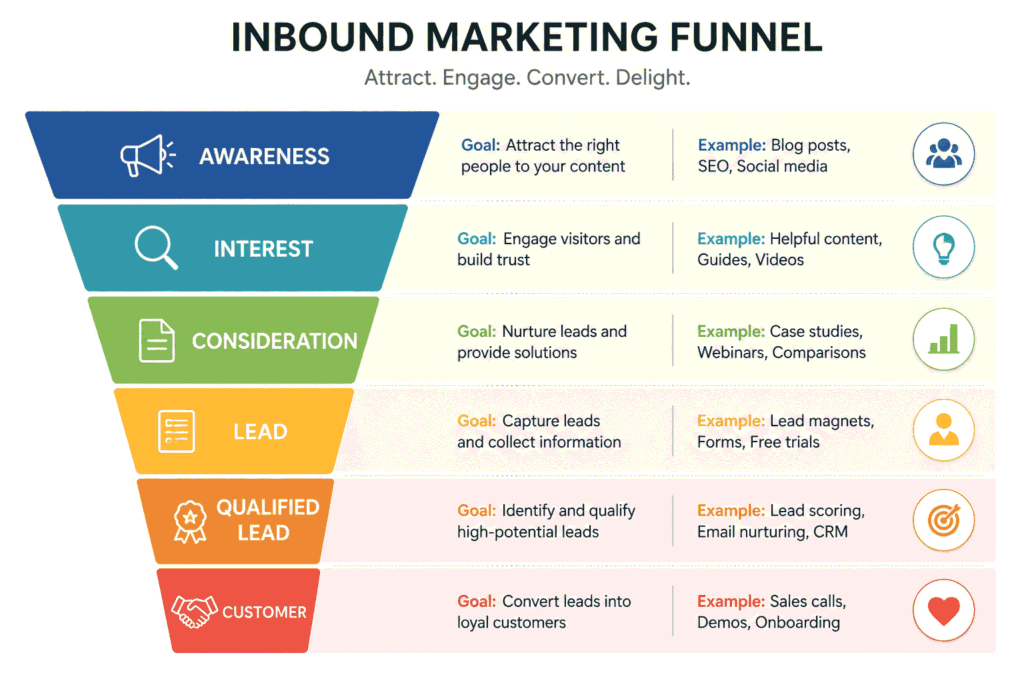
Inbound marketing workflows are typically structured around funnel stages that reflect how buyer intent evolves throughout the customer journey.
As prospects move through the funnel, their goals, questions, and decision-making behavior change. This is why businesses use different content types, CTAs, and nurturing strategies at each stage.
The inbound funnel is commonly divided into three core stages:
- TOFU (Top Of Funnel)
- MOFU (Middle Of Funnel)
- BOFU (Bottom Of Funnel)
Each stage supports a different level of customer intent.
| Funnel Stage | User Intent | Content Examples | CTA Types | Nurturing Goal |
|---|---|---|---|---|
| TOFU (Top Of Funnel) | Learning And Problem Awareness | SEO Blogs, Educational Guides, Videos, Social Content | Newsletter Signup, Free Guide Download | Build Awareness And Trust |
| MOFU (Middle Of Funnel) | Evaluating Solutions | Case Studies, Webinars, Comparison Content, Workflow Guides | Lead Magnets, Webinar Registration, Email Signup | Educate And Qualify Leads |
| BOFU (Bottom Of Funnel) | Purchase Decision | Demos, Pricing Pages, Consultations, Testimonials | Book Demo, Consultation Request, Proposal Inquiry | Drive Conversion And Sales |
For example, a business owner searching for “how to automate lead generation” may initially enter the funnel through an educational SEO article at the TOFU stage. After consuming additional workflow guides and case studies, they may move into the MOFU stage where they begin evaluating possible solutions.
Eventually, after engaging with consultations, pricing pages, or demos, the lead progresses into the BOFU stage where direct sales conversations and conversion opportunities become more likely.
Understanding funnel stages helps businesses create more targeted inbound workflows, improve personalization, and deliver content that aligns more effectively with buyer intent throughout the customer journey.
8. Lead Nurturing Workflow
One of the biggest misconceptions in inbound marketing is assuming that every lead is ready to buy immediately after discovering a business. In reality, most potential customers require multiple interactions before making a purchasing decision.
This is where lead nurturing becomes a critical part of an inbound marketing workflow.
Lead nurturing is the process of building relationships with prospects over time through relevant communication, educational content, and personalized engagement. Instead of pushing for immediate conversions, businesses gradually guide leads through the decision-making journey while building trust and credibility.
For small businesses, nurturing workflows are especially valuable because they help maximize the value of every captured lead. Rather than losing prospects after the first interaction, businesses can continue engaging them through automated workflows that maintain visibility and encourage future conversions.
A modern lead nurturing workflow typically combines several components:
- Email Sequences Designed Around Customer Journey Stages
- Educational Content That Solves Customer Problems
- Personalized Communication Based On User Behavior And Interests
- Retargeting Campaigns That Re-Engage Website Visitors
- CRM-Based Automation For Triggered Follow-Ups
- Lead Scoring Systems That Identify Sales-Ready Prospects
Email nurturing remains one of the most effective inbound marketing channels because it allows businesses to communicate consistently without depending entirely on paid advertising or manual outreach.
Instead of sending generic promotional emails, effective nurturing sequences focus on delivering value first. Businesses educate leads, answer common questions, provide implementation insights, and gradually introduce solutions that align with customer needs.
Educational nurturing is particularly important during longer buying cycles. A prospect researching CRM automation or inbound marketing workflows may spend days or even weeks evaluating options before making a decision. During this period, helpful educational content keeps the business relevant while strengthening trust.
This nurturing process often includes:
- Industry Guides And Educational Articles
- Workflow Tutorials And Implementation Tips
- Case Studies And Success Examples
- Product Comparisons And Strategic Insights
- Webinars, Templates, And Downloadable Resources
Personalization also plays a major role in improving engagement. Modern inbound workflows use CRM data, website behavior, and lead segmentation to tailor communication based on user interests and intent levels.
For example, a lead interested in email automation workflows may receive different nurturing content than a lead researching CRM setup strategies. This creates a more relevant customer experience while improving conversion potential.
Retargeting further strengthens nurturing workflows by reconnecting with visitors who previously interacted with the website but did not convert. Businesses often use retargeting ads to promote relevant resources, reminders, demos, or consultation offers across platforms such as Google, LinkedIn, and Meta.
A simple inbound email nurturing sequence may look like this:
- Day 1 → Welcome Email With Resource Delivery And Brand Introduction
- Day 3 → Educational Content Explaining Key Industry Challenges
- Day 5 → Case Study Demonstrating Real-World Results Or Workflow Improvements
- Day 7 → Consultation Offer, Demo Invitation, Or Service Introduction
This gradual approach feels more natural than immediate hard-selling while giving prospects enough time to evaluate solutions and build confidence.
The most effective nurturing workflows are designed around customer intent rather than aggressive promotion. Businesses that consistently educate, engage, and personalize communication often experience stronger relationships, higher trust levels, and better long-term conversion performance.
Over time, lead nurturing becomes one of the most valuable components of an inbound marketing system because it bridges the gap between initial interest and sales readiness.
As leads engage with your content and campaigns, a CRM system helps organize interactions and automate follow-ups. Discover how CRM workflow automation supports more efficient lead nurturing.
9. Marketing Automation in Inbound Workflows
As inbound marketing systems grow, manually managing every lead interaction becomes increasingly difficult. Businesses often struggle with repetitive tasks such as sending follow-up emails, assigning leads, updating CRM records, scheduling meetings, and monitoring engagement across multiple channels.
Marketing automation solves this problem by creating structured workflows that automatically respond to user behavior and predefined conditions.
Instead of handling every action manually, businesses can build automated systems that guide leads through the customer journey with minimal operational effort. This allows small teams to scale marketing activities more efficiently while maintaining consistent communication and lead management.
At its core, marketing automation is designed to streamline repetitive processes while improving personalization, response speed, and workflow efficiency.
Modern inbound workflows commonly use automation for:
- Automated Email Sequences Based On User Actions
- CRM Triggers That Update Lead Stages Automatically
- Chatbot Routing For Instant Lead Qualification
- Lead Scoring Based On Engagement And Intent Signals
- Meeting Scheduling And Follow-Up Coordination
- Behavior Tracking Across Websites, Emails, And Campaigns
- Personalized Content Delivery Based On User Interests
One of the biggest advantages of automation is trigger-based workflow execution.
Instead of running static campaigns, inbound systems can respond dynamically to customer behavior. For example, if a visitor downloads a lead magnet, the workflow can automatically add the lead to the CRM, assign a lead score, trigger a nurturing sequence, and notify the sales team if engagement levels increase.
This creates a more responsive and scalable customer journey without requiring continuous manual oversight.
Behavior tracking further strengthens automation workflows by monitoring how leads interact with content, emails, landing pages, and website resources. Businesses can use this data to better understand buyer intent and personalize future communication.
Some common behavioral signals tracked inside inbound workflows include:
- Email Opens And Link Clicks
- Landing Page Visits
- Resource Downloads
- Webinar Registrations
- Pricing Page Engagement
- Form Submissions
- Demo Requests
As engagement levels increase, automation systems can trigger additional actions such as:
- Moving Leads Into Qualified CRM Stages
- Launching Advanced Nurturing Sequences
- Assigning Sales Follow-Up Tasks
- Sending Personalized Recommendations
- Scheduling Consultations Automatically
AI tools are also becoming an increasingly important part of inbound marketing automation. Businesses now use AI-powered systems for content recommendations, predictive lead scoring, chatbot interactions, email optimization, and workflow personalization.
For small businesses, this creates significant operational advantages because automation reduces manual workload while improving consistency and scalability.
A simple inbound automation workflow may look like this:
- Visitor Downloads A Lead Magnet
- CRM Automatically Captures Lead Information
- Welcome Email Sequence Starts Immediately
- Lead Score Updates Based On Engagement Activity
- Chatbot Offers Consultation Or Resource Recommendations
- Sales Team Receives Notification When Intent Threshold Is Reached
This type of automation helps businesses maintain continuous engagement without manually managing every customer interaction.
Several marketing automation platforms support these workflows for small businesses and growing teams.
Popular tools include:
- HubSpot For CRM Automation, Lead Management, And Inbound Marketing Workflows
- Mailchimp For Email Automation And Audience Nurturing
- ActiveCampaign For Advanced Customer Automation And Behavioral Targeting
- Zapier For Connecting Apps And Automating Cross-Platform Workflows
The most effective inbound marketing systems are no longer built around isolated marketing tasks. They rely on connected automation workflows that combine CRM management, communication, AI-driven personalization, and behavioral intelligence into a scalable lead generation engine.
Modern businesses increasingly use AI-powered workflows to automate repetitive marketing, sales, and operational tasks. Explore real-world AI workflow examples for small businesses.
10. SEO Workflow in Inbound Marketing
SEO plays a foundational role in inbound marketing because it helps businesses attract qualified traffic consistently without depending entirely on paid advertising. A strong inbound workflow is not built around publishing random blog posts. Instead, it relies on a structured SEO system designed to align content with user intent, customer problems, and long-term topical relevance.
For small businesses, this creates a more sustainable lead generation strategy where content continues attracting visitors long after publication. Over time, SEO-driven inbound workflows can become one of the most cost-effective acquisition channels because they compound traffic, authority, and lead generation potential.
An effective SEO workflow starts with understanding how potential customers search for information during different stages of the buying journey. This is where keyword research becomes critical.
Rather than targeting only high-volume keywords, businesses should identify search queries connected to customer pain points, workflow challenges, implementation needs, and buying intent. This helps create content that aligns more naturally with real user behavior.
A structured keyword research process often includes:
- Identifying Primary Commercial And Informational Keywords
- Researching Long-Tail Search Queries With Clear User Intent
- Analyzing Competitor Content And Keyword Gaps
- Mapping Keywords To Funnel Stages And Customer Journeys
- Grouping Related Topics Into Strategic Content Clusters
- Prioritizing Topics Based On Relevance, Intent, And Business Goals
Once keyword opportunities are identified, the next stage involves blog optimization.
Inbound marketing content should be optimized not only for search engines but also for readability, engagement, and conversion potential. Modern SEO performance depends heavily on content quality, topical depth, structure, and user experience rather than keyword stuffing.
A strong blog optimization workflow typically includes:
- Writing Clear SEO Titles And Meta Descriptions
- Structuring Content With Logical Headings And Subsections
- Optimizing Introduction Sections For Search Intent Alignment
- Adding Relevant Internal Links Across Related Articles
- Improving Content Readability And Scanability
- Including Visuals, Workflow Diagrams, And Supporting Media
- Optimizing CTAs And Lead Capture Opportunities
Internal linking is another essential part of inbound SEO workflows because it helps connect related topics across the website. Instead of treating articles as isolated pages, businesses build interconnected content ecosystems that improve navigation, authority distribution, and topical relevance.
For example, an article about inbound marketing workflows may internally link to related topics such as:
- CRM Automation
- Lead Nurturing
- Sales-Ready Leads
- Email Marketing Workflows
- AI Marketing Tools
- Lead Scoring Strategies
This interconnected structure strengthens both user experience and search engine understanding of the website’s expertise.
Over time, these internal linking systems contribute to topical authority.
Topical authority refers to how comprehensively a website covers a subject area. Search engines increasingly reward websites that demonstrate deep expertise across connected topics rather than publishing scattered, unrelated content.
This is why many modern SaaS and inbound marketing brands focus heavily on content clusters.
Content clusters organize articles around a central pillar topic supported by multiple related subtopics. Instead of targeting isolated keywords, businesses build complete topic ecosystems that strengthen relevance and authority over time.
A simple inbound marketing content cluster may include:
- Pillar Page About Inbound Marketing Workflows
- Supporting Content About CRM Automation
- Articles About Lead Nurturing Strategies
- Guides On Sales Funnels And Lead Qualification
- SEO Workflow Tutorials
- AI Marketing Automation Content
- Email Workflow Optimization Articles
This structured SEO workflow creates several long-term advantages:
- Improved Organic Visibility Across Multiple Keywords
- Stronger Internal Linking Opportunities
- Better User Engagement And Session Duration
- Increased Lead Generation Potential
- Higher Topical Relevance In Search Engines
- More Sustainable Long-Term Traffic Growth
For small businesses, SEO workflows are not simply about ranking individual blog posts. They become part of a larger inbound marketing engine designed to attract, educate, nurture, and convert potential customers through strategically connected content systems.
11. Social Media & Distribution Workflow
Creating high-quality inbound content is only part of the process. Without a proper distribution workflow, even valuable content may struggle to generate consistent visibility, engagement, or lead generation results.
This is why modern inbound marketing strategies focus heavily on content distribution and repurposing. Instead of publishing a blog post once and moving on, businesses extend the reach of their content across multiple channels to maximize visibility and engagement.
A structured distribution workflow helps businesses continuously drive traffic back into the inbound funnel while improving content lifespan and audience reach.
One of the most effective approaches is content repurposing.
Rather than creating entirely new content for every platform, businesses can transform a single long-form article into multiple content formats tailored for different audiences and channels. This improves content efficiency while maintaining consistent messaging across the marketing ecosystem.
A single inbound marketing article can often be repurposed into:
- LinkedIn Thought Leadership Posts
- Educational Social Media Carousels
- Email Newsletter Content
- Short Video Clips Or Explainer Videos
- Community Discussion Posts
- Infographics And Workflow Visuals
- Downloadable Lead Magnets
- Webinar Or Presentation Topics
This approach allows businesses to generate significantly more value from each piece of content while reinforcing topical authority across multiple platforms.
LinkedIn is especially valuable for B2B inbound marketing workflows because it supports professional networking, educational content distribution, and audience engagement. Many SaaS companies and service businesses use LinkedIn to share strategic insights, workflow tips, case studies, and industry commentary that drive traffic back to their websites.
Effective LinkedIn distribution strategies often include:
- Educational Posts Based On Blog Content
- Workflow Breakdowns And Implementation Insights
- Industry Trend Commentary
- Customer Success Stories
- Carousel Posts Summarizing Key Concepts
- Short-Form Thought Leadership Content
Email newsletters also play an important role in distribution workflows. Instead of relying only on search traffic or social media algorithms, newsletters allow businesses to maintain direct communication with subscribers and existing leads.
Many inbound marketing teams use newsletters to distribute:
- Newly Published Blog Content
- Educational Guides And Resources
- Product Updates And Announcements
- Industry Insights And Trends
- Webinar Invitations And Events
- Curated Content Recommendations
Communities further strengthen inbound distribution strategies by creating opportunities for engagement and relationship building. Businesses often share educational content within professional groups, niche forums, Slack communities, LinkedIn groups, Discord servers, or industry-specific communities where their target audience actively participates.
However, effective community distribution should focus on value and contribution rather than aggressive promotion. Educational insights, practical workflows, and implementation discussions generally perform better than direct sales messaging.
Automation publishing tools help streamline this entire process by reducing repetitive manual work.
Instead of manually sharing every content piece across platforms, businesses can automate parts of the distribution workflow such as:
- Scheduling Social Media Posts
- Republishing Evergreen Content
- Triggering Email Campaigns
- Cross-Posting Across Multiple Platforms
- Sending Newsletter Updates Automatically
- Coordinating Multi-Channel Publishing Workflows
This creates a more consistent publishing cadence while helping small teams manage distribution more efficiently.
Over time, strong social media and content distribution workflows become an essential part of inbound marketing because they continuously expand audience reach, reinforce brand visibility, and drive recurring traffic back into the lead generation funnel.
Without distribution, even high-quality content can remain underutilized. With a structured workflow, businesses transform content into a scalable inbound growth asset that continues generating awareness, engagement, and leads across multiple channels.
12. Lead Qualification Workflow
Not every inbound lead is ready to become a customer immediately. Some visitors may only be researching general information, while others may already be comparing solutions, evaluating vendors, or preparing to make a purchasing decision.
This is why lead qualification workflows are essential in inbound marketing.
A structured qualification process helps businesses identify which leads require additional nurturing, which prospects are becoming high-intent opportunities, and which contacts are ready for direct sales engagement. Without qualification systems, businesses often waste time pursuing low-intent leads while missing genuinely valuable opportunities.
Lead qualification workflows create a more organized approach to prioritization by combining engagement tracking, buyer intent analysis, CRM segmentation, and lead scoring systems.
One of the core concepts in inbound qualification is understanding the difference between MQLs and SQLs.
An MQL (Marketing Qualified Lead) is a prospect who has shown meaningful engagement with marketing activities but may not yet be fully ready for direct sales conversations. These leads often interact with educational content, download resources, subscribe to newsletters, or repeatedly engage with inbound campaigns.
Typical MQL signals may include:
- Downloading Lead Magnets Or Educational Resources
- Visiting Multiple Blog Articles
- Opening And Clicking Email Campaigns
- Registering For Webinars Or Events
- Returning To The Website Repeatedly
- Engaging With Social Content Or Newsletters
At this stage, leads usually require continued nurturing and education before becoming high-intent opportunities.
An SQL (Sales Qualified Lead), on the other hand, demonstrates stronger purchase intent and is considered more ready for direct sales engagement. These leads often show behavior indicating active evaluation or decision-making.
Common SQL signals include:
- Requesting A Demo Or Consultation
- Visiting Pricing Or Service Pages Frequently
- Asking Product Or Implementation Questions
- Responding Directly To Outreach
- Comparing Solutions Or Vendors
- Showing Clear Budget Or Timeline Interest
Once leads reach this stage, they are typically moved into sales pipelines for follow-up conversations, consultations, or proposals.
Sales-ready leads represent the highest-intent segment within the qualification workflow. These are prospects who not only fit the ideal customer profile but also demonstrate strong engagement, urgency, and buying intent.
A sales-ready lead often combines several qualification factors such as:
- Strong ICP Alignment
- High Engagement Levels
- Clear Business Need
- Decision-Making Authority
- Budget Potential
- Active Solution Research
- Near-Term Purchase Intent
Identifying these leads accurately is one of the biggest goals of inbound marketing workflows because it improves conversion efficiency and sales prioritization.
Lead scoring systems help automate much of this process.
Lead scoring assigns values to different user actions and qualification signals so businesses can measure lead quality more consistently. Instead of manually reviewing every interaction, inbound systems automatically evaluate engagement and intent levels.
Typical lead scoring criteria may include:
- Email Opens And Link Clicks
- Resource Downloads
- Website Visit Frequency
- Pricing Page Engagement
- Webinar Attendance
- Demo Requests
- CRM Interaction History
- Company Size Or Industry Fit
As scores increase, workflows can trigger automated actions such as:
- Moving Leads Into Advanced Nurturing Sequences
- Alerting Sales Teams About High-Intent Prospects
- Assigning Follow-Up Tasks Automatically
- Scheduling Consultations
- Updating CRM Qualification Stages
Many businesses also use qualification frameworks to standardize lead evaluation processes.
Popular qualification frameworks include:
- BANT (Budget, Authority, Need, Timeline)
- CHAMP (Challenges, Authority, Money, Prioritization)
- MEDDIC (Metrics, Economic Buyer, Decision Criteria, Decision Process, Identify Pain, Champion)
These frameworks help sales and marketing teams evaluate whether prospects align with business goals and purchasing readiness.
A well-structured lead qualification workflow improves far more than sales efficiency. It also enhances customer experience by ensuring leads receive communication appropriate to their stage in the buying journey.
Rather than treating every prospect the same way, inbound systems create more personalized, timely, and relevant interactions that improve both nurturing performance and long-term conversion potential.
Not every lead is ready for a sales conversation. Learn how lead qualification helps businesses identify high-intent prospects and prioritize the best opportunities.
13. Aligning Marketing and Sales in Inbound Workflows
In high-performing inbound marketing systems, marketing and sales are not separate functions. They operate as a connected revenue system powered by shared data, unified workflows, and continuous feedback loops.
Without alignment between these two teams, even well-structured inbound systems can lose efficiency due to miscommunication, inconsistent lead qualification, and poor handoff processes.
Effective inbound workflows ensure that marketing and sales work from the same data source, follow the same qualification standards, and collaborate on improving overall conversion performance.
Several key components enable this alignment.
13.1. Shared CRM System
A shared CRM acts as the central system of record for both marketing and sales teams.
It ensures that all lead data, engagement history, and customer interactions are stored in one unified platform.
This helps teams:
- Maintain A Single Source Of Truth
- Track Full Customer Journey History
- Avoid Duplicate Or Lost Leads
- Improve Cross-Team Visibility
- Coordinate Lead Follow-Ups Effectively
When both teams operate from the same CRM system, collaboration becomes more structured and transparent.
13.2. SQL Handoff Process
The SQL (Sales Qualified Lead) handoff is the transition point where marketing-qualified leads are passed to the sales team.
A clear handoff process ensures that only high-intent, well-qualified leads reach sales teams.
This typically involves:
- Defined Qualification Criteria
- Lead Scoring Thresholds
- Automated CRM Status Updates
- Sales Notification Triggers
- Context Sharing (Behavior + Intent Data)
A structured handoff process improves conversion efficiency and reduces wasted sales effort on low-quality leads.
13.3. Lead Qualification Alignment
Marketing and sales teams must agree on what defines a qualified lead.
Without alignment, marketing may generate leads that sales consider low quality, creating friction and inefficiency.
Alignment typically includes agreement on:
- Ideal Customer Profile (ICP)
- MQL Criteria
- SQL Definition
- Lead Scoring Rules
- Buying Intent Signals
This ensures both teams are evaluating leads using the same framework.
13.4. Sales Feedback Loops
Sales feedback loops help marketing teams continuously improve lead quality and campaign performance.
Sales teams provide insights such as:
- Which Leads Convert Most Often
- Common Objections From Prospects
- High-Quality Lead Sources
- Content Gaps In The Funnel
- Missing Qualification Signals
This feedback allows marketing teams to refine targeting, content strategy, and lead scoring models over time.
13.5. Attribution And Performance Tracking
Attribution helps businesses understand which marketing channels, campaigns, and content pieces are driving revenue outcomes.
This includes tracking:
- First Touch Attribution
- Multi-Touch Attribution
- Content Influence On Conversions
- Channel Performance Contribution
- Campaign ROI Impact
Strong attribution systems ensure that marketing efforts are measured not just by traffic or leads, but by actual revenue impact.
When marketing and sales alignment is implemented correctly, inbound marketing workflows become significantly more efficient. Leads move through the funnel more smoothly, qualification becomes more accurate, and revenue generation becomes more predictable.
This alignment transforms inbound marketing from a lead generation system into a fully connected revenue engine.
14. Real-World Example of an Inbound Marketing Workflow
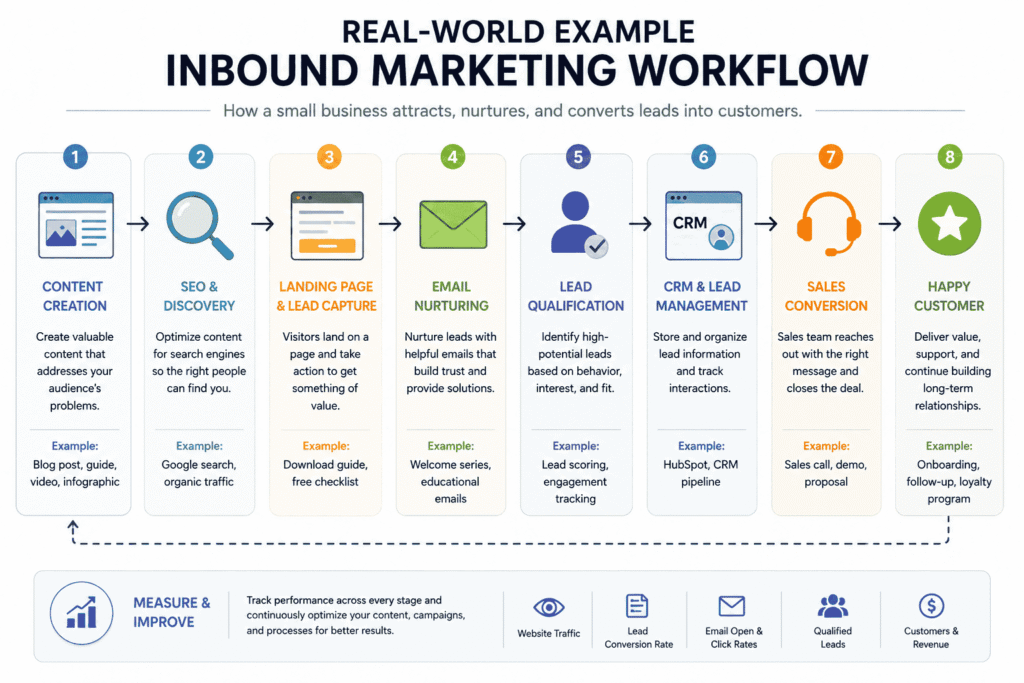
Understanding inbound marketing concepts is important, but seeing how the entire system works together in a real business scenario makes the workflow much easier to understand.
To illustrate this, let’s look at a practical example of how a small AI automation agency might build an inbound marketing workflow to generate and convert leads consistently.
Instead of relying entirely on cold outreach or referrals, the agency creates a structured inbound system designed to attract potential customers, nurture them automatically, and move qualified prospects into the sales pipeline.
Here’s how the workflow operates from start to finish.
Step 1: SEO Blog Attracts Organic Traffic
The process begins with SEO-driven content designed to target specific customer pain points and search intent.
The agency publishes educational blog articles focused on topics such as:
- AI Automation For Small Businesses
- CRM Workflow Automation
- Lead Generation Systems
- Sales Follow-Up Automation
- Marketing Workflow Optimization
These articles are optimized for search engines and designed to attract business owners actively researching workflow improvements and automation solutions.
Instead of directly selling services immediately, the content focuses on education, practical insights, and implementation guidance. This helps build trust while generating qualified inbound traffic from search engines and social distribution channels.
Step 2: CTA Encourages User Action
Once visitors engage with the article, strategically placed calls-to-action guide them toward the next step in the customer journey.
The blog may include CTAs such as:
- Download The Automation Workflow Checklist
- Get A Free CRM Audit
- Access The Lead Nurturing Template
- Book A Workflow Consultation
These CTAs are aligned with the visitor’s intent and positioned naturally within the content experience.
The goal at this stage is not immediate conversion. Instead, the business aims to capture lead information and continue nurturing the relationship.
Step 3: Lead Magnet Captures Contact Information
After clicking the CTA, visitors are directed to a dedicated landing page offering a valuable lead magnet.
Examples may include:
- Workflow Templates
- Automation Checklists
- CRM Setup Guides
- Lead Generation Playbooks
- Email Sequence Frameworks
To access the resource, users submit a lead capture form containing details such as:
- Name
- Business Email
- Company Name
- Team Size
- Primary Workflow Challenges
This transforms anonymous website visitors into identifiable leads within the inbound system.
Step 4: CRM Automatically Captures And Segments The Lead
Once the form is submitted, the CRM automatically stores and organizes the lead information.
At this stage, the workflow may:
- Assign The Lead To A Specific Audience Segment
- Apply Lead Scores Based On User Actions
- Track Source Attribution
- Trigger Follow-Up Automations
- Categorize Leads By Industry Or Service Interest
For example, a SaaS founder researching outbound automation may enter a different nurturing path than a local service business exploring CRM organization.
This segmentation improves personalization and future communication relevance.
Step 5: Automated Nurturing Sequence Begins
After entering the CRM, the lead automatically receives a nurturing sequence designed to educate and build trust gradually.
The workflow may include:
- Welcome Emails With Resource Delivery
- Educational Guides And Workflow Tutorials
- Case Studies Demonstrating Client Results
- Implementation Tips And Best Practices
- Comparison Content About Automation Strategies
Rather than aggressively pushing sales, the nurturing sequence focuses on helping the lead better understand workflow challenges and potential solutions.
At the same time, the system tracks engagement signals such as:
- Email Opens
- Link Clicks
- Resource Downloads
- Website Revisit Activity
- Pricing Page Visits
These behaviors help identify increasing buyer intent.
Step 6: Consultation Booking Trigger Activates
As the lead engages more deeply with the content and reaches higher intent thresholds, the workflow introduces consultation opportunities.
For example, after multiple interactions, the lead may receive:
- A Free Strategy Session Invitation
- A Personalized Workflow Audit Offer
- A CRM Automation Consultation
- A Demo Request Opportunity
Scheduling tools then allow leads to book consultations automatically without manual coordination.
This creates a smoother transition from marketing engagement into direct sales conversations.
Step 7: Sales Follow-Up And Qualification
Once the consultation is booked, the sales workflow begins.
During this stage, the agency evaluates:
- Business Goals
- Existing Workflow Challenges
- Team Structure
- Current Marketing Processes
- CRM Usage
- Automation Readiness
- Budget And Implementation Needs
Lead qualification frameworks and CRM notes help the sales team determine whether the prospect is sales-ready and aligned with the agency’s ideal customer profile.
The sales process may also include:
- Personalized Recommendations
- Workflow Strategy Discussions
- Technical Requirement Analysis
- ROI Opportunity Evaluation
This stage bridges the gap between inbound nurturing and actual solution planning.
Step 8: Proposal And Solution Presentation
After qualification, the agency prepares a customized proposal outlining:
- Recommended Automation Workflows
- CRM Setup Plans
- Lead Nurturing Systems
- Integration Requirements
- Implementation Timeline
- Pricing Structure
- Expected Business Outcomes
Because the lead has already consumed educational content and interacted with the nurturing workflow, the proposal process often becomes more efficient and conversion-focused.
The prospect already understands many of the underlying concepts before entering the sales discussion.
Step 9: Client Onboarding And Workflow Implementation
Once the proposal is accepted, the onboarding workflow begins.
This stage may include:
- Client Discovery Sessions
- Workflow Mapping
- CRM Configuration
- Automation Setup
- Email Sequence Creation
- Team Training
- Performance Tracking Setup
The business then transitions from lead generation into long-term customer relationship management and optimization.
This complete workflow demonstrates how inbound marketing creates a connected customer journey rather than isolated marketing activities. Every stage — from SEO traffic and lead capture to nurturing, sales qualification, and onboarding — works together as part of a scalable growth system.
For small businesses, this type of structured inbound workflow can significantly improve consistency, operational efficiency, lead quality, and long-term revenue generation.
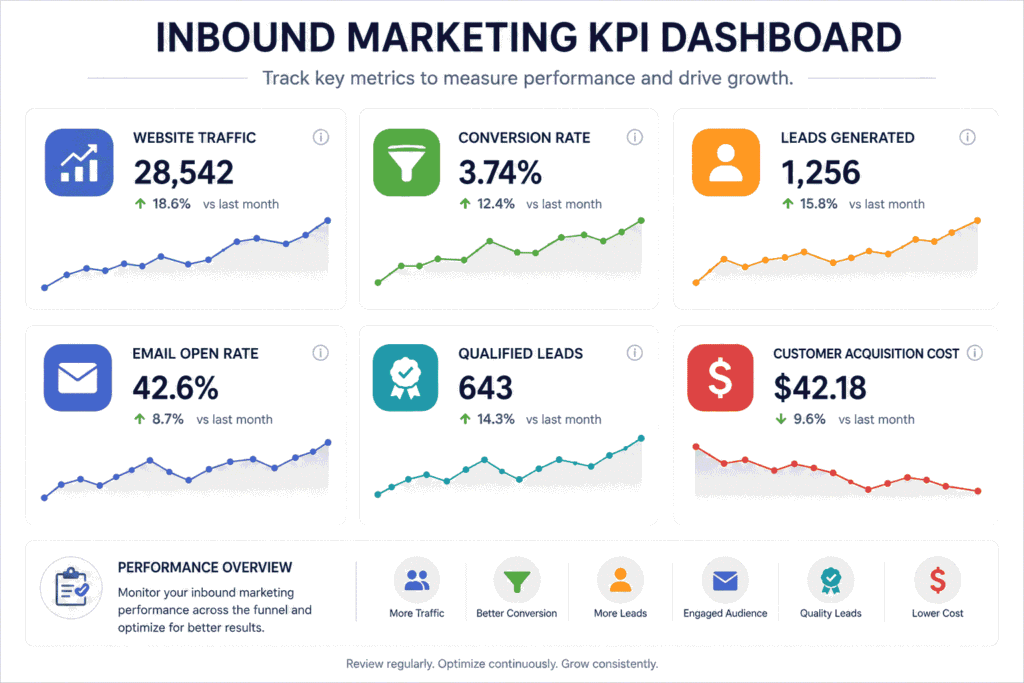
15. Key Metrics to Measure Inbound Marketing Performance
Building an inbound marketing workflow is only the first step. To improve long-term performance, businesses must continuously measure how effectively their workflows generate traffic, nurture leads, and convert prospects into customers.
Without performance tracking, businesses often struggle to identify workflow bottlenecks, conversion issues, content gaps, or inefficient marketing activities. Metrics provide visibility into what is working, what needs optimization, and where growth opportunities exist.
Modern inbound marketing strategies rely heavily on data-driven decision-making. Instead of relying on assumptions, businesses use performance metrics to optimize customer journeys, improve lead quality, and increase marketing ROI over time.
Several key metrics play an important role in evaluating inbound marketing performance.
15.1. Traffic Growth
Traffic growth measures how effectively inbound strategies attract visitors through channels such as:
- Organic Search
- Social Media
- Email Marketing
- Referral Sources
- Content Distribution
Consistent traffic growth often indicates improving SEO visibility, stronger content performance, and expanding brand awareness.
However, traffic quality is just as important as traffic volume. Businesses should focus on attracting relevant visitors aligned with their ideal customer profile rather than pursuing vanity metrics alone.
15.2. Conversion Rate
Conversion rate measures how effectively website visitors complete desired actions within the inbound workflow.
These actions may include:
- Submitting Lead Forms
- Downloading Resources
- Booking Consultations
- Signing Up For Newsletters
- Requesting Demos
Strong conversion rates typically reflect effective landing pages, compelling CTAs, relevant offers, and well-optimized customer journeys.
Even small improvements in conversion rates can significantly increase lead generation performance without requiring additional traffic acquisition.
15.3. Lead-To-Customer Rate
This metric measures how many captured leads eventually become paying customers.
Lead-to-customer rate helps businesses evaluate:
- Lead Quality
- Nurturing Effectiveness
- Sales Alignment
- Qualification Accuracy
- Workflow Efficiency
High traffic alone does not guarantee business growth. Strong inbound systems focus on attracting qualified leads that convert into long-term customers.
15.4. Email Open Rate
Email open rate measures how effectively email campaigns capture subscriber attention.
This metric is influenced by factors such as:
- Subject Line Quality
- Audience Segmentation
- Send Timing
- Brand Familiarity
- Personalization
While open rates alone do not measure overall campaign success, they help businesses evaluate engagement trends and email communication effectiveness.
15.5. MQL To SQL Conversion Rate
This metric tracks how many marketing-qualified leads become sales-qualified leads.
It helps businesses evaluate whether:
- Lead Nurturing Workflows Are Effective
- Qualification Criteria Are Accurate
- Marketing And Sales Teams Are Aligned
- Lead Scoring Models Reflect Buyer Intent Properly
Low MQL-to-SQL conversion rates may indicate weak targeting, poor nurturing, or misaligned qualification processes.
15.6. Customer Acquisition Cost (CAC)
Customer acquisition cost measures how much a business spends to acquire a new customer.
CAC calculations often include:
- Advertising Costs
- Content Production Expenses
- Software Costs
- Marketing Team Resources
- Sales Expenses
Inbound marketing is often valued because strong SEO, automation, and nurturing systems can reduce acquisition costs over time compared to heavily outbound-dependent strategies.
15.7. Return On Investment (ROI)
ROI measures the overall profitability of inbound marketing activities relative to total investment.
This metric helps businesses determine whether their workflows generate sustainable business value and revenue growth.
ROI analysis often considers:
- Revenue Generated From Inbound Leads
- Marketing Spend
- Sales Performance
- Retention Value
- Operational Efficiency Gains
Long-term inbound marketing success is typically measured not only by traffic or leads, but by sustainable revenue contribution.
15.8. Pipeline Velocity
Pipeline velocity measures how quickly leads move through the sales pipeline from initial engagement to conversion.
This metric helps businesses identify:
- Workflow Delays
- Slow Follow-Up Processes
- Qualification Bottlenecks
- Sales Inefficiencies
- Customer Journey Friction
Faster pipeline movement often indicates stronger nurturing systems, better lead qualification, and more effective workflow automation.
The most successful inbound marketing systems are continuously optimized using performance data rather than static assumptions. Businesses that consistently monitor metrics, analyze workflow behavior, and refine customer journeys are far more likely to build scalable and predictable growth systems over time.
For small businesses, tracking the right inbound metrics creates a stronger foundation for smarter decision-making, better marketing efficiency, and long-term revenue growth.
16. How to Optimize an Inbound Marketing Workflow
Building an inbound marketing workflow is not a one-time process. Even well-structured workflows require continuous optimization to improve lead quality, conversion rates, customer engagement, and overall marketing efficiency.
As businesses grow, customer behavior changes, search intent evolves, and marketing channels become more competitive. Without ongoing refinement, workflows can gradually lose effectiveness over time.
This is why high-performing inbound marketing systems rely heavily on testing, analysis, and continuous improvement.
Optimization helps businesses identify workflow bottlenecks, eliminate friction points, improve customer journeys, and maximize the value of existing traffic and leads.
Several optimization areas play a major role in improving inbound marketing performance.
16.1. A/B Testing
A/B testing helps businesses compare different versions of marketing assets to determine which variations perform better.
Businesses commonly test:
- Landing Page Headlines
- CTA Placement And Copy
- Email Subject Lines
- Form Designs
- Button Text
- Page Layouts
- Offer Messaging
Even small improvements from testing can significantly increase engagement and conversion rates over time.
Successful inbound workflows are typically built through continuous experimentation rather than assumptions.
16.2. CTA Optimization
Calls-to-action play a critical role in moving visitors through the inbound funnel.
Weak CTAs often reduce conversion opportunities even when content quality is strong. Businesses should regularly optimize CTA strategy to improve clarity, relevance, and user engagement.
CTA optimization may involve:
- Improving Value Proposition Messaging
- Aligning CTAs With User Intent
- Testing CTA Placement
- Simplifying Conversion Paths
- Matching Offers To Funnel Stages
The most effective CTAs feel contextually relevant rather than overly promotional.
16.3. Improving Lead Quality
Generating large volumes of leads is not enough if the leads are poorly qualified.
Inbound optimization should focus not only on lead quantity but also on attracting prospects aligned with the ideal customer profile.
Businesses often improve lead quality by:
- Refining SEO Targeting
- Improving Audience Segmentation
- Adjusting Lead Capture Forms
- Updating Qualification Criteria
- Enhancing Content Relevance
- Improving Funnel Alignment
Higher-quality leads typically improve both conversion rates and sales efficiency.
16.4. Email Optimization
Email workflows should be continuously refined to improve engagement and nurturing performance.
Optimization areas often include:
- Subject Line Testing
- Personalization Improvements
- Send-Time Optimization
- Audience Segmentation
- CTA Performance
- Email Sequence Timing
- Content Relevance
Strong email optimization helps businesses maintain consistent communication while improving open rates, click-through rates, and customer engagement.
16.5. Funnel Drop-Off Analysis
One of the most valuable optimization strategies is identifying where users leave the inbound workflow.
Drop-off analysis helps businesses uncover friction points within:
- Landing Pages
- Lead Forms
- Email Sequences
- Consultation Booking Flows
- Checkout Or Proposal Processes
For example, high landing page traffic with low conversions may indicate weak messaging or poor CTA placement. Similarly, low consultation booking rates may reveal friction within scheduling workflows.
Understanding these gaps helps businesses improve customer journey continuity.
16.6. Automation Refinement
Automation workflows should evolve as businesses gather more customer behavior data and operational insights.
Businesses often optimize automation by:
- Updating Trigger Conditions
- Improving Workflow Logic
- Refining Lead Scoring Rules
- Reducing Unnecessary Automation Complexity
- Personalizing Customer Journeys
- Improving Sales Notifications
The goal is to create workflows that feel responsive and relevant rather than robotic or repetitive.
16.7. CRM Cleanup And Data Organization
As inbound systems scale, CRM databases can become cluttered with outdated contacts, duplicate entries, and inaccurate information.
Poor CRM organization often creates:
- Inefficient Lead Management
- Weak Segmentation
- Inaccurate Reporting
- Poor Personalization
- Reduced Sales Productivity
Regular CRM cleanup helps maintain workflow accuracy and operational efficiency.
Common CRM optimization tasks include:
- Removing Duplicate Contacts
- Updating Lead Statuses
- Refining Audience Segments
- Standardizing Data Fields
- Archiving Inactive Leads
16.8. Content Updates And SEO Refreshes
Inbound marketing content should be treated as a long-term growth asset rather than a one-time publication.
Search behavior, industry trends, and SEO competition change continuously. Businesses that regularly update content often maintain stronger search visibility and engagement performance.
Content optimization may include:
- Updating Statistics And Examples
- Improving Internal Linking
- Expanding Topic Coverage
- Refreshing SEO Keywords
- Enhancing Readability
- Adding New Visuals Or Workflow Examples
Many high-performing inbound articles generate traffic for years because they are continuously improved and updated over time.
The most successful inbound marketing systems are not static. They evolve through ongoing testing, refinement, and performance analysis.
Businesses that consistently optimize workflows, improve customer experiences, and refine operational systems are far more likely to achieve scalable and predictable long-term growth.
17. Common Mistakes Small Businesses Should Avoid
Many small businesses invest time and effort into inbound marketing but still struggle to generate consistent results. In most cases, the problem is not the idea of inbound marketing itself — it is the lack of structure, consistency, and workflow optimization behind the strategy.
Inbound marketing performs best when every stage of the customer journey is connected through clear systems, automation, lead management, and nurturing processes. Without these foundations, businesses often generate traffic but fail to convert that attention into qualified opportunities.
Understanding the most common inbound workflow mistakes can help businesses avoid operational inefficiencies and improve long-term performance.
17.1. No Lead Nurturing
One of the biggest mistakes businesses make is assuming that leads will convert immediately after the first interaction.
In reality, many prospects require multiple touchpoints before making a decision. Without nurturing workflows, businesses often lose leads that may have converted later with proper follow-up and education.
Common nurturing gaps include:
- No Follow-Up Email Sequences
- Lack Of Educational Content
- No Retargeting Campaigns
- Generic Communication Without Personalization
- Inconsistent Customer Engagement
Businesses that continuously educate and engage leads typically achieve stronger long-term conversion performance.
17.2. Weak CTAs
Even high-quality content may fail to generate leads if the calls-to-action are unclear or poorly positioned.
Many businesses publish informative blog posts but never guide visitors toward meaningful next steps. As a result, users consume content and leave the website without entering the inbound workflow.
Weak CTAs often involve:
- Generic “Contact Us” Messaging
- No Clear Value Proposition
- Poor CTA Placement
- Too Many Competing Actions
- Lack Of Lead Magnet Offers
Strong inbound workflows use contextual CTAs aligned with user intent and customer journey stages.
17.3. No CRM Tracking
Without CRM tracking, businesses lose visibility into how leads interact with content, emails, and sales processes.
This creates operational problems such as:
- Scattered Lead Information
- Missed Follow-Ups
- Duplicate Outreach
- Poor Pipeline Visibility
- Lack Of Performance Tracking
CRM systems help centralize customer data while improving organization, automation, and lead management efficiency.
17.4. Publishing Random Content
Another common mistake is creating disconnected content without a structured SEO or inbound strategy.
Many businesses publish articles based only on trends or isolated keyword ideas without considering topical relevance, buyer intent, or funnel alignment.
This often leads to:
- Weak Topical Authority
- Poor Internal Linking
- Inconsistent Search Visibility
- Low Conversion Intent Traffic
- Fragmented User Journeys
Successful inbound workflows focus on connected content ecosystems built around customer pain points, search intent, and strategic topic clusters.
17.5. No Automation
Manual workflows quickly become difficult to manage as businesses grow.
Without automation, teams often spend excessive time on repetitive tasks such as:
- Sending Follow-Up Emails
- Updating CRM Records
- Scheduling Meetings
- Assigning Leads
- Tracking Engagement Activity
Automation improves scalability by reducing manual workload while maintaining consistent customer communication and workflow execution.
17.6. No Lead Scoring
Treating every lead the same way is another major inbound marketing mistake.
Some prospects may only be casually researching information, while others are actively evaluating solutions and preparing to purchase. Without lead scoring systems, businesses struggle to prioritize high-intent opportunities effectively.
Lead scoring helps businesses:
- Identify Sales-Ready Leads
- Prioritize High-Intent Prospects
- Improve Sales Efficiency
- Trigger Better Follow-Up Timing
- Personalize Nurturing Workflows
This creates a more organized and conversion-focused sales process.
17.7. Poor Follow-Up Timing
Timing plays a critical role in inbound marketing performance.
Businesses that delay responses or fail to follow up consistently often lose leads to competitors with faster and more organized workflows.
Poor timing issues may include:
- Delayed Email Responses
- Missed Consultation Requests
- Irregular Sales Outreach
- Long Gaps Between Touchpoints
- Lack Of Follow-Up Automation
Modern inbound workflows use automated triggers, CRM notifications, and scheduling systems to maintain faster and more consistent engagement.
Ultimately, most inbound marketing problems stem from disconnected systems rather than lack of effort. Businesses that build structured workflows around nurturing, automation, CRM management, SEO strategy, and lead qualification create a much stronger foundation for long-term growth.
The goal of inbound marketing is not simply generating traffic. It is creating a scalable system that consistently transforms audience attention into qualified leads, customer relationships, and revenue opportunities.
18. Best Tools for Inbound Marketing Workflows
Building an effective inbound marketing workflow becomes significantly easier when businesses use the right combination of tools for lead management, automation, communication, SEO, and customer engagement.
Modern inbound systems rely on connected platforms rather than isolated software. Instead of manually managing every stage of the customer journey, businesses use integrated tools to streamline workflows, automate repetitive tasks, and improve lead conversion efficiency.
The ideal tool stack often depends on business size, workflow complexity, and growth goals. However, most inbound marketing systems are built around a few core categories.
CRM & Lead Management Tools
CRM platforms act as the operational foundation of inbound marketing workflows. They help businesses organize lead data, track customer interactions, manage pipeline stages, and automate follow-up processes.
Popular CRM platforms include:
- HubSpot For Inbound Marketing, CRM Automation, Lead Tracking, And Sales Pipelines
- Zoho CRM For Affordable CRM Management And Workflow Automation
These platforms help businesses centralize customer information while improving visibility across marketing and sales activities.
Managing leads effectively requires more than spreadsheets and manual follow-ups. Explore our HubSpot CRM Guide to learn how businesses can organize contacts, automate workflows, track interactions, and improve customer relationship management.
Email Marketing & Nurturing Tools
Email platforms are essential for lead nurturing, automated follow-ups, newsletters, and customer communication workflows.
Common email marketing tools include:
- Mailchimp For Email Campaigns, Audience Segmentation, And Automated Nurturing Sequences
Businesses use these tools to maintain consistent communication with leads while delivering educational content, promotional campaigns, and personalized engagement workflows.
Marketing Automation Tools
Automation platforms connect different systems and reduce repetitive manual tasks across the inbound workflow.
Popular automation solutions include:
- Zapier For Connecting Apps, Automating Tasks, And Building Cross-Platform Workflows
Automation tools are commonly used for:
- CRM Updates
- Lead Routing
- Email Triggers
- Task Assignment
- Form Integrations
- Notification Workflows
This improves operational efficiency while helping small teams scale inbound systems more effectively.
SEO & Content Optimization Tools
SEO tools help businesses research keywords, analyze competitors, optimize content, and monitor organic visibility.
Widely used SEO platforms include:
- Ahrefs For Keyword Research, Backlink Analysis, And Content Strategy
- Semrush For SEO Research, Competitive Analysis, And Content Optimization
These tools support inbound marketing by helping businesses identify search opportunities and build stronger topical authority over time.
Scheduling & Meeting Tools
Scheduling platforms simplify consultation booking and reduce manual coordination during lead qualification and sales processes.
A commonly used scheduling tool is:
- Calendly For Automated Meeting Scheduling And Consultation Booking
These systems help create smoother transitions from inbound nurturing into sales conversations.
Chatbot & Customer Engagement Tools
Chatbots improve website engagement by providing instant communication, lead qualification, and visitor assistance.
Popular chatbot platforms include:
- Intercom For Customer Messaging, Chatbot Automation, And Lead Engagement
Businesses often use chatbot workflows to:
- Answer Common Questions
- Route Leads Automatically
- Recommend Resources
- Capture Contact Information
- Schedule Consultations
The most effective inbound marketing systems are not built around individual tools alone. They rely on how well these platforms work together as part of a connected workflow ecosystem.
For small businesses, the goal is not to adopt every available platform. Instead, it is to build a practical and scalable tool stack that supports lead generation, automation, nurturing, CRM management, and customer engagement without creating unnecessary operational complexity.
Many businesses use prospecting and engagement platforms to support their marketing and sales efforts. Learn how Apollo.io helps teams find prospects, manage outreach, and streamline workflows.
19. How AI Is Transforming Inbound Marketing Workflows
Artificial intelligence is rapidly reshaping how businesses manage inbound marketing workflows. What once required significant manual effort can now be automated, optimized, and personalized at scale through AI-powered systems.
For small businesses, this shift is especially important because AI helps reduce operational complexity while improving efficiency across lead generation, nurturing, customer engagement, and conversion workflows.
Modern inbound marketing is no longer limited to basic automation. Businesses are increasingly using AI to analyze customer behavior, optimize content performance, predict buyer intent, personalize communication, and improve decision-making across the entire customer journey.
One of the biggest areas of transformation is AI content optimization.
AI-powered tools now help businesses streamline content creation and SEO workflows by identifying keyword opportunities, improving readability, generating content briefs, optimizing headlines, and analyzing search intent patterns.
Businesses commonly use AI for:
- Content Research And Topic Ideation
- SEO Optimization Recommendations
- Content Structuring And Readability Improvements
- Search Intent Analysis
- Content Repurposing Across Multiple Channels
- Workflow Documentation And Draft Generation
This helps marketing teams produce more consistent and search-optimized content while reducing production bottlenecks.
Predictive lead scoring is another major advancement within inbound marketing workflows.
Traditional lead scoring systems rely on manually assigned rules and engagement points. AI-driven scoring models go further by analyzing behavioral patterns, historical conversion data, engagement signals, and customer attributes to predict which leads are most likely to convert.
This allows businesses to:
- Prioritize High-Intent Leads More Accurately
- Improve Sales Team Efficiency
- Reduce Time Spent On Low-Quality Leads
- Trigger Smarter Automation Sequences
- Improve Conversion Forecasting
As inbound systems collect more customer data, AI models become increasingly effective at identifying sales-ready opportunities.
AI chatbots are also transforming customer engagement workflows.
Unlike traditional rule-based chat systems, modern AI chatbots can understand context, answer complex questions, recommend resources, qualify leads, and guide users through personalized customer journeys in real time.
Businesses now use AI chatbots to:
- Handle Initial Customer Conversations
- Recommend Relevant Content Or Services
- Capture Lead Information Automatically
- Route Leads To Appropriate Teams
- Schedule Meetings And Consultations
- Provide Instant Website Support
This improves responsiveness while reducing dependency on manual support processes.
AI email personalization is another powerful development within inbound workflows.
Instead of sending identical campaigns to every subscriber, AI systems can personalize subject lines, messaging, timing, recommendations, and content delivery based on user behavior and engagement history.
AI-driven email workflows often improve:
- Open Rates
- Click-Through Rates
- User Engagement
- Lead Nurturing Efficiency
- Conversion Performance
Personalized communication creates a more relevant customer experience while helping businesses maintain stronger long-term engagement.
AI analytics further enhances inbound marketing by helping businesses interpret large volumes of performance data more efficiently.
Rather than manually reviewing dashboards and reports, AI-powered analytics tools can identify trends, detect workflow inefficiencies, predict campaign performance, and surface actionable insights automatically.
Businesses use AI analytics for:
- Conversion Pattern Analysis
- Funnel Performance Monitoring
- Customer Behavior Insights
- Campaign Optimization Recommendations
- Attribution Tracking
- Revenue Forecasting
This enables faster decision-making while improving optimization strategies across the inbound workflow.
As AI technology continues evolving, inbound marketing workflows are becoming more intelligent, adaptive, and scalable. Businesses that integrate AI strategically can improve efficiency, personalize customer experiences, and create more data-driven growth systems without dramatically increasing operational workload.
For small businesses, AI is no longer just an advanced enterprise feature. It is becoming a practical competitive advantage that helps teams automate repetitive tasks, improve lead quality, and scale inbound marketing operations more effectively.
Many businesses complement inbound marketing with outbound email campaigns to accelerate lead generation. Explore our Cold Email Workflow for Beginners guide to learn a practical outreach process.
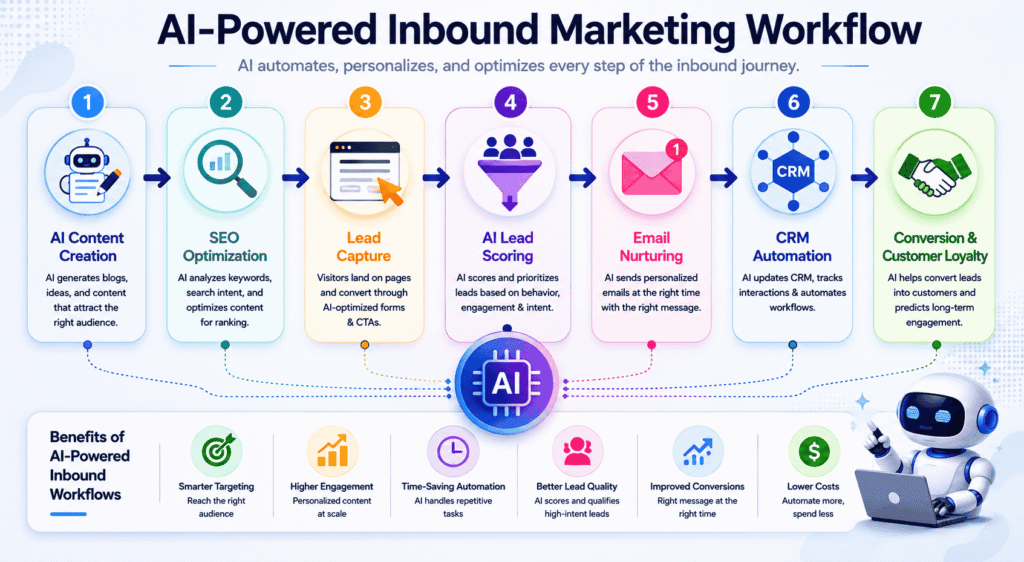
20. Final Thoughts
Inbound marketing is no longer just about publishing content or running isolated campaigns. Modern inbound strategies are built around connected systems that guide potential customers through structured journeys — from initial discovery and lead capture to nurturing, qualification, and long-term customer relationships.
For small businesses, this system-based approach creates significant advantages. Instead of relying entirely on unpredictable outreach or manual marketing activities, businesses can build scalable workflows that continuously generate, organize, and nurture leads over time.
Throughout this guide, we explored how inbound marketing workflows combine multiple components such as:
- SEO And Content Marketing
- Lead Capture Systems
- CRM Management
- Email Nurturing
- Marketing Automation
- Lead Qualification
- AI-Powered Optimization
When these systems work together, businesses create a more efficient and predictable growth engine.
One of the biggest benefits of inbound workflows is scalability. Automation reduces repetitive manual tasks, CRM systems improve lead organization, and nurturing sequences maintain consistent communication without requiring constant oversight.
At the same time, structured workflows help businesses improve customer experience by delivering more relevant content, personalized engagement, and timely follow-ups throughout the buying journey.
Consistency is another major advantage.
Businesses that publish strategic content regularly, nurture leads effectively, optimize workflows continuously, and maintain organized customer journeys are far more likely to build predictable pipelines and sustainable long-term growth.
As AI and automation technologies continue evolving, inbound marketing workflows will become even more intelligent and data-driven. Businesses that invest early in scalable systems, workflow optimization, and customer-focused marketing strategies will be better positioned to compete in increasingly digital and automated markets.
Ultimately, successful inbound marketing is not built around isolated tactics. It is built around connected workflows that attract the right audience, nurture trust over time, and create scalable systems for long-term business growth.
21. Frequently Asked Questions (FAQs)
-
What Is An Inbound Marketing Workflow?
An inbound marketing workflow is a structured system businesses use to attract, capture, nurture, and convert leads through content marketing, CRM management, automation, email sequences, and customer engagement processes.
-
Why Is An Inbound Marketing Workflow Important For Small Businesses?
Inbound workflows help small businesses create scalable lead generation systems, reduce manual work, improve follow-up consistency, organize customer data, and build more predictable sales pipelines.
-
What Are The Main Stages Of An Inbound Marketing Workflow?
Most inbound workflows include:
Audience Research
Content Creation
Lead Capture
CRM Management
Lead Nurturing
Marketing Automation
Lead Qualification
Sales Conversion
Customer Retention -
What Is The Difference Between Inbound And Outbound Marketing?
Inbound marketing focuses on attracting customers through content, SEO, education, and engagement, while outbound marketing relies on direct outreach methods such as cold calls, cold emails, and advertisements.
-
How Does SEO Support Inbound Marketing Workflows?
SEO helps businesses attract qualified organic traffic by targeting relevant search queries, optimizing content for search intent, building topical authority, and improving long-term visibility across search engines.
-
What Is Lead Nurturing In Inbound Marketing?
Lead nurturing is the process of building relationships with potential customers through educational content, automated email sequences, personalized communication, and ongoing engagement until they become sales-ready.
-
What Is A CRM In Inbound Marketing?
A CRM (Customer Relationship Management) system helps businesses store lead information, track customer interactions, automate follow-ups, manage sales pipelines, and organize inbound marketing activities more efficiently.
-
What Is The Role Of Automation In Inbound Marketing?
Automation helps businesses streamline repetitive tasks such as email follow-ups, lead assignment, CRM updates, chatbot routing, scheduling, and nurturing workflows while improving operational efficiency.
-
What Are MQLs And SQLs?
MQLs (Marketing Qualified Leads) are leads that show engagement with marketing content but may still require nurturing. SQLs (Sales Qualified Leads) demonstrate stronger buying intent and are considered more ready for direct sales conversations.
-
How Does Lead Scoring Work?
Lead scoring assigns values to user behaviors and engagement signals such as email clicks, website visits, content downloads, and demo requests to help businesses identify high-intent and sales-ready leads.
-
What Are Content Clusters In SEO?
Content clusters are groups of related articles connected around a central topic. They help businesses improve topical authority, strengthen internal linking, and increase organic search visibility.
-
Which Tools Are Best For Inbound Marketing Workflows?
Popular inbound marketing tools include:
HubSpot For CRM And Marketing Automation
Mailchimp For Email Marketing
Zapier For Workflow Automation
Ahrefs And Semrush For SEO
Calendly For Scheduling
Intercom For Chatbots And Customer Messaging -
How Is AI Transforming Inbound Marketing?
AI is improving inbound marketing through content optimization, predictive lead scoring, AI chatbots, automated personalization, customer behavior analysis, and workflow automation.
-
How Long Does Inbound Marketing Take To Generate Results?
Inbound marketing is a long-term strategy. While some businesses may see early engagement within a few months, sustainable traffic, lead generation, and authority growth often require consistent execution over time.
-
Can Small Businesses Use Inbound Marketing Without Large Teams?
Yes. Modern automation tools, CRM systems, AI platforms, and workflow software allow small businesses to build scalable inbound marketing systems without requiring large marketing departments.
-
What Are Common Mistakes In Inbound Marketing Workflows?
Some of the most common mistakes include:
Publishing Random Content
Weak Lead Nurturing
No CRM Tracking
Poor CTA Strategy
Lack Of Automation
No Lead Qualification Process
Inconsistent Follow-Ups -
What Makes A Lead Sales-Ready?
A sales-ready lead typically shows strong engagement, clear buying intent, relevant business needs, and alignment with the company’s ideal customer profile.