
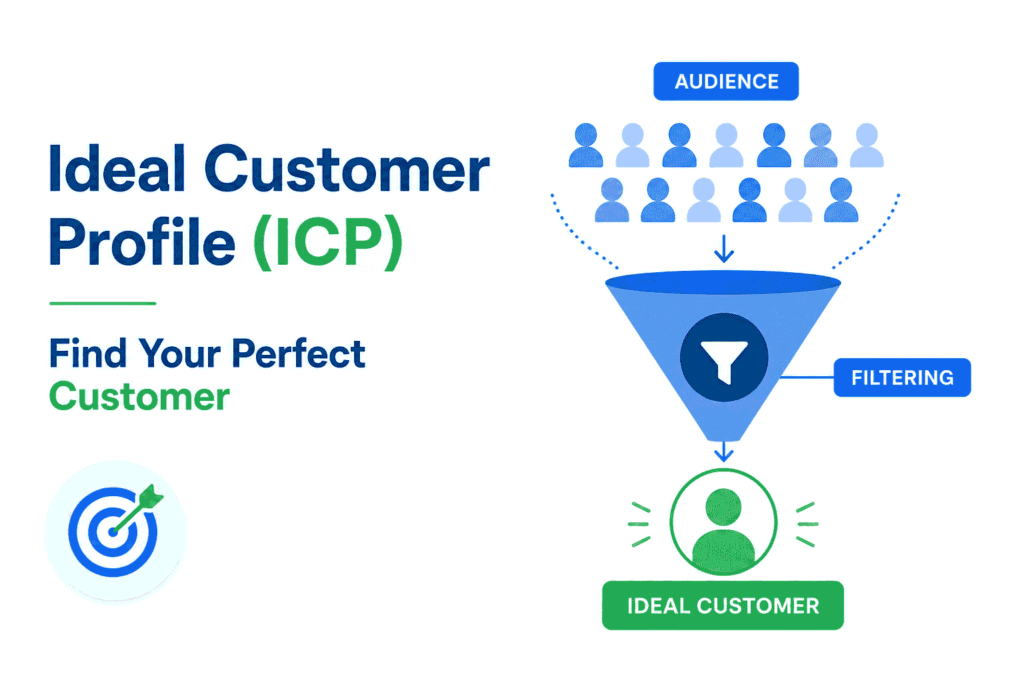
Ideal Customer Profile (ICP) Explained for Beginners
Table of Contents
ICP Fundamentals
Modern B2B growth has changed significantly in the last few years. Businesses today have access to powerful tools for automation, outreach, and lead generation — yet many still struggle to achieve consistent results.
The issue is rarely the tools themselves. It is the lack of clarity around who those tools are actually being used for.
Before scaling campaigns, building outbound systems, or automating workflows, one critical element determines everything that follows the Ideal Customer Profile (ICP).
In simple terms, ICP defines the type of customer your business is truly built for. It becomes the foundation for targeting, messaging, and conversion efficiency across all marketing and sales activities.
To understand how this impacts growth systems in practice, we first need to clearly define what an Ideal Customer Profile actually is.
1. What Is An Ideal Customer Profile (ICP)
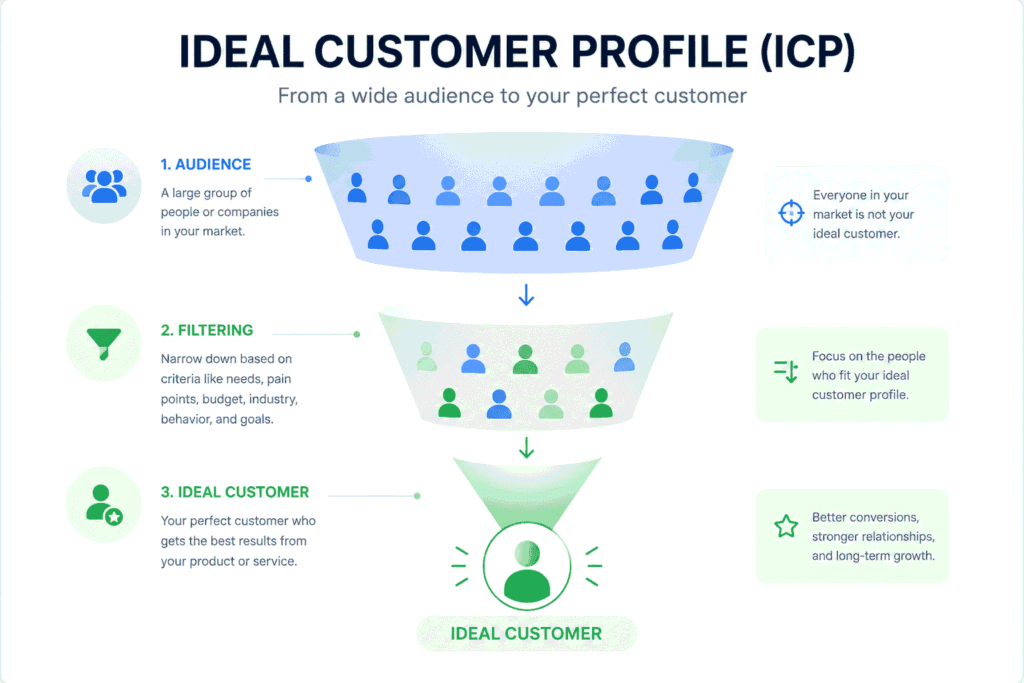
An Ideal Customer Profile (ICP) is a clear, structured definition of the type of customer or company that benefits most from your product or service and delivers the highest value in return.
Instead of treating all leads as equal, an ICP helps businesses identify the customers who are naturally aligned with their offering — the ones who are easier to convert, more likely to stay, and more profitable in the long run.
In practice, ICP becomes the foundation of focused growth. It guides decisions across sales, marketing, and outbound strategy by narrowing attention toward high-value opportunities rather than broad, unqualified audiences.
A well-defined ICP is commonly used across modern B2B growth systems, including:
- B2B sales strategy
- SaaS marketing and positioning
- Cold outreach and outbound campaigns
- Lead generation and prospecting workflows
- CRM segmentation and pipeline management
- Account-based marketing (ABM) strategies
1.1. Simple Definition of ICP
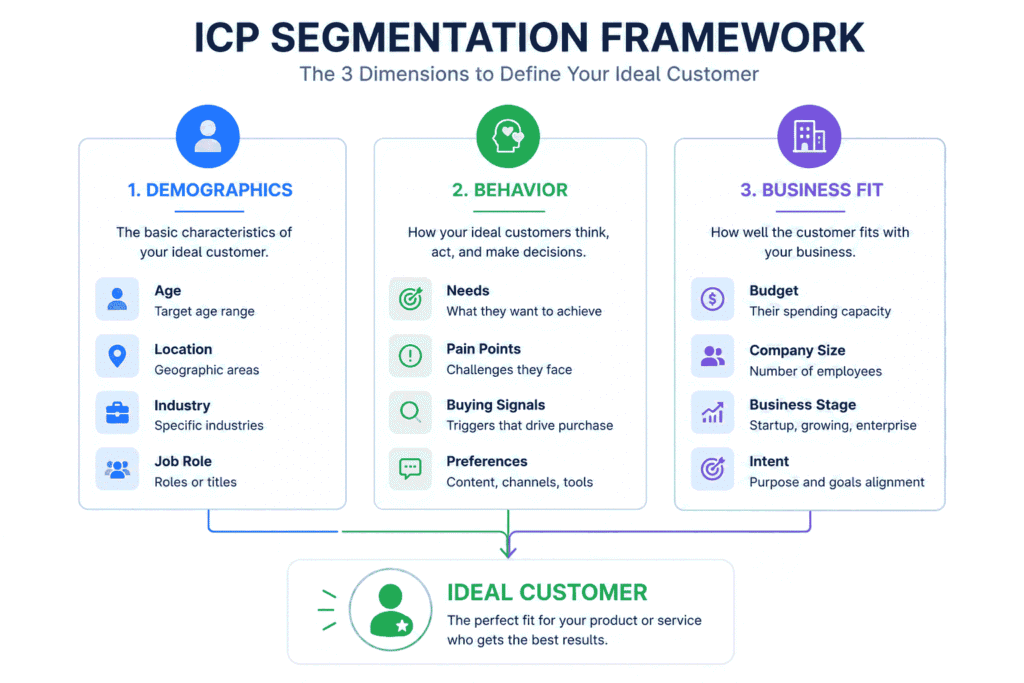
At its core, an Ideal Customer Profile defines the ideal type of customer your business is built to serve. This goes beyond basic demographics and includes deeper structural and behavioral attributes such as:
- Company size and stage
- Industry or niche focus
- Revenue range or budget capacity
- Team structure and decision-making setup
- Geographic location and market focus
- Buying behavior and purchase intent patterns
- Technology stack or tools already in use
- Key operational challenges and pain points
Together, these factors help you move from broad targeting to precise customer alignment.
1.2. Why ICP Matters
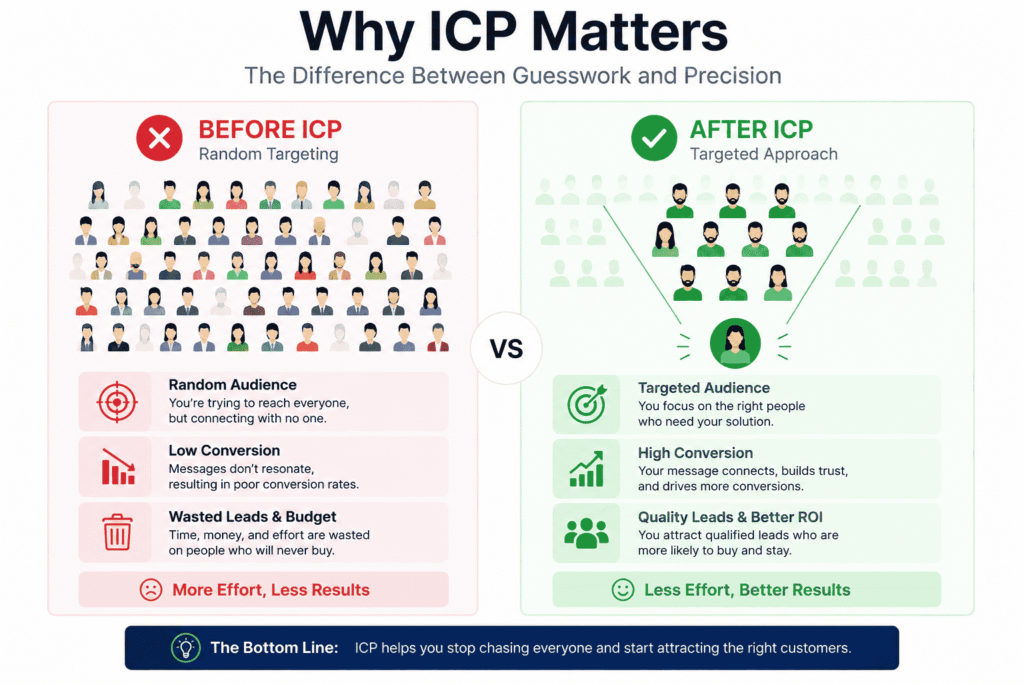
Most growth problems in B2B businesses do not come from lack of traffic or lack of outreach — they come from misaligned targeting.
When an ICP is not clearly defined, businesses often end up:
- Targeting random or irrelevant leads
- Spending outreach credits on low-quality prospects
- Attracting customers who are not a good fit
- Struggling with personalization in messaging
- Facing inconsistent sales performance
The result is not just lower conversion rates — it is inefficiency across the entire system.
A well-defined ICP, on the other hand, brings structure and clarity to acquisition efforts. It improves targeting precision, increases lead quality, strengthens outbound performance, and helps maintain a clean and predictable CRM pipeline.
Most importantly, it allows marketing and sales teams to operate with the same understanding of what a “good customer” actually looks like — which directly improves conversion potential and long-term revenue quality.
If you want to understand how ICP connects with full outbound execution, read our guide on lead generation strategy and modern outbound systems, where we break down how businesses build scalable pipeline systems step by step.
2. Why ICP Matters In B2B Sales & Lead Generation
An Ideal Customer Profile is one of the most foundational elements in modern B2B sales and outbound marketing. It quietly determines how efficiently a business can generate leads, how relevant its outreach feels, and ultimately how consistently it can convert prospects into customers.
When ICP is clearly defined, every stage of the sales process becomes more focused. Outreach becomes more relevant, messaging becomes more precise, and sales teams spend less time filtering unqualified prospects.
At its core, ICP improves four critical areas of outbound performance: sales efficiency, personalization, outreach quality, and conversion rates. Each of these directly impacts how predictable and scalable a revenue system becomes.
2.1. The Problem With Poor Targeting
When businesses operate without a clearly defined ICP, the entire outbound system starts to lose direction.
Sales teams often end up targeting companies that do not align with the product’s value. Cold emails feel generic because they are written for too broad an audience. CRM systems become cluttered with low-quality leads that never convert. And even advanced automation tools struggle to produce meaningful results because they are built on weak targeting logic.
Over time, this creates a compounding set of problems — lower reply rates, inconsistent pipelines, higher churn, and wasted prospecting effort across teams.
The issue is rarely execution. It is alignment.
Without ICP clarity, even the most sophisticated outreach systems begin to amplify inefficiency instead of fixing it.
2.2. How Strong ICPs Improve Outbound Performance
A well-defined ICP changes the structure of outbound execution in a meaningful way. Instead of chasing volume, teams shift toward precision.
It allows businesses to focus on high-quality prospects who are more likely to respond, engage, and convert. Messaging becomes easier to personalize because the audience is clearly understood. And sales teams can prioritize accounts based on actual fit rather than guesswork.
This shift has a direct impact on system performance. Pipeline quality improves, CRM data becomes cleaner and more usable, and overall sales efficiency increases without requiring additional outreach volume.
In many cases, simply refining ICP clarity leads to better results than adding more tools or increasing automation.
Because in B2B sales and lead generation, targeting is not just a step in the process — it is the foundation that determines how well every other step performs.
3. ICP vs Buyer Persona
One of the most common points of confusion in B2B marketing and sales is the difference between an Ideal Customer Profile (ICP) and a Buyer Persona.
Although they are closely related and often used together, they serve fundamentally different purposes in a growth strategy.
Understanding this distinction is important because it directly affects how businesses target accounts, personalize outreach, and structure their sales messaging.
3.1. Ideal Customer Profile (ICP)
An Ideal Customer Profile defines the type of company or organization that is the best fit for your product or service.
It focuses on business-level characteristics rather than individuals, helping teams identify which accounts are worth pursuing in the first place.
An ICP typically includes attributes such as:
- Industry or business category
- Company size and employee range
- Revenue level or growth stage
- Geographic focus or market region
- Operational structure and team setup
- Technology stack and tools already in use
- Overall fit with the product’s value proposition
For example, an ICP might look like:
A B2B SaaS company with 50–200 employees, based in the US, using HubSpot CRM, and actively running outbound sales campaigns.
This level of definition helps businesses narrow their focus to accounts that are structurally aligned with their offering.
3.2. Buyer Persona
A Buyer Persona, on the other hand, focuses on the individual decision-maker inside the company. Instead of describing the organization, it defines the people who influence or make purchasing decisions.
A buyer persona typically includes:
- Job role or title
- Professional goals and responsibilities
- Daily challenges and pain points
- Decision-making influence
- Behavioral patterns and preferences
- Motivations and objections
For example, a buyer persona might look like:
An SDR Manager who is struggling with lead quality and is actively looking for better prospecting and automation tools to improve outbound performance.
This helps businesses understand how to communicate value in a way that resonates with real decision-makers.
3.3. The Core Difference
At a simple level, the distinction can be understood like this:
An ICP defines which companies to target, while a Buyer Persona defines who inside those companies to engage with.
In other words:
- ICP = The right accounts
- Buyer Persona = The right people within those accounts
When both are aligned, businesses can build highly focused outbound systems that target the right companies with messaging tailored to the right individuals — significantly improving conversion efficiency and sales performance.
3.4. Real-World Example Of ICP vs Buyer Persona
A simple way to understand the difference between ICP and Buyer Persona is to see how they work together inside a real sales scenario.
3.4.1. Start With the Company (ICP Level)
An Ideal Customer Profile defines the type of company your business should target. For example, a strong ICP in a B2B SaaS context might include companies that fall into the following category:
B2B SaaS businesses with 50–200 employees, based in the US, actively running outbound sales operations, and already using a CRM like HubSpot to manage their pipeline.
At this stage, the focus is not on individuals or job roles. It is purely about identifying the right type of company — the accounts that are structurally and operationally aligned with your product or service.
This step ensures your outbound efforts are directed toward businesses that actually have the potential to become long-term customers.
3.4.2. Then Identify the Decision-Maker (Buyer Persona Level)
Once the right companies are defined, the next step is understanding who inside those companies actually drives the decision.
For the ICP above, a typical Buyer Persona could be an SDR Manager responsible for pipeline generation and outbound performance.
This person is usually dealing with challenges such as:
- Low-quality or unqualified leads entering the pipeline
- Inefficient prospecting workflows
- Pressure to improve outbound conversion rates
- Lack of automation or scalable systems for lead generation
Unlike ICP, which focuses on company attributes, the Buyer Persona focuses on real human context — goals, frustrations, and decision-making behavior.
3.4.3. How They Work Together in Practice
In a real outbound system, ICP and Buyer Persona are not separate activities. They function as two layers of the same targeting strategy.
The ICP defines which companies are worth targeting.
The Buyer Persona defines how to communicate with the people inside those companies.
When only ICP is defined, outreach may reach the right companies but fail to connect with the right individuals.
When only Buyer Personas are defined, messaging may be strong, but it reaches companies that were never a good fit to begin with.
3.5. Why This Matters in Modern B2B Sales
Modern outbound systems are no longer driven by volume alone. They are built on precision.
Successful teams combine ICP definition with Buyer Persona insights to improve:
- Targeting accuracy at the account level
- Message relevance at the individual level
- CRM segmentation quality
- Overall conversion efficiency
This alignment ensures that outreach is not only reaching the right market, but also speaking to the right decision-maker with the right context.
In practical terms, this is what separates average outbound campaigns from high-performing, scalable sales systems.
4. ICP vs Target Audience
One of the most common areas of confusion in early-stage marketing is the difference between a target audience and an Ideal Customer Profile (ICP). While they are related, they operate at very different levels of precision.
Understanding this distinction is important because it directly impacts how businesses structure their messaging, targeting, and lead generation strategy.
4.1. Target Audience Is Broader
A target audience represents a wide and generalized segment of the market. It defines the larger group of people or businesses that might have an interest in your product or service, without going into deep qualification.
For example, a target audience might simply be:
B2B marketers
This definition is useful for positioning at a high level, but it does not provide enough detail to guide precise targeting, personalization, or outbound execution.
4.2. ICP Is More Specific and Action-Oriented
An Ideal Customer Profile takes this broad audience and narrows it down into a highly specific and actionable segment. It defines the exact type of customer that is most likely to convert, stay longer, and generate higher value.
For example, a well-defined ICP might look like:
US-based SaaS companies with 20–100 employees that actively use outbound sales workflows and CRM-based lead management systems.
This level of specificity allows businesses to move from general marketing to focused execution, where targeting becomes intentional and data-driven rather than broad and assumption-based.
As a result, teams see improvements in lead quality, personalization accuracy, and overall conversion performance.
4.3. How They Work Together
The target audience sets the direction of your market focus, while the ICP defines the exact segment worth prioritizing within that market.
In practice, businesses first identify a broad audience and then refine it into a clear ICP to guide sales and marketing execution more effectively.
4.4. Real-World Example of ICP vs Target Audience
A simple way to understand the difference between Target Audience, ICP, and Buyer Persona is through a practical, real-world breakdown.
4.4.1. Target Audience
At the broadest level, a target audience represents a general market direction rather than a precise customer definition.
For example:
- B2B marketers
- SaaS founders
- Sales professionals
This level is useful for positioning and awareness, but it remains too wide to guide targeted outreach or personalized sales execution.
4.4.2. Ideal Customer Profile (ICP)
An Ideal Customer Profile narrows this broad audience into a clearly defined group of companies that are most likely to convert, benefit from the solution, and generate long-term value.
For example:
- US-based SaaS companies
- 20–100 employees
- Outbound sales teams
- Using HubSpot CRM
- Actively scaling lead generation systems
At this stage, targeting becomes significantly more focused. Instead of reaching a broad market, businesses shift toward identifying high-fit accounts that align structurally and operationally with their offering.
This is what transforms general marketing activity into actionable outbound strategy — where every prospect has a higher probability of conversion.
4.5. Why Businesses Confuse These Terms
Target Audience, ICP, and Buyer Persona are often used interchangeably because they all relate to customer targeting. However, they operate at different levels of precision within a sales system.
A target audience defines the broad market category a business wants to operate in.
An ICP refines that audience into the exact type of company worth pursuing.
A Buyer Persona further defines the individual decision-maker inside those companies.
When these layers are not clearly separated, businesses often struggle with misaligned targeting, inconsistent messaging, and inefficient outreach performance.
However, when structured correctly, this hierarchy creates a much clearer system for execution. Marketing efforts become more focused, sales outreach becomes more relevant, and CRM segmentation becomes significantly cleaner and more usable.
This clarity directly improves lead quality, personalization accuracy, and overall conversion performance — especially in modern B2B outbound systems where precision targeting consistently outperforms broad outreach.
5. Core Elements Of A Strong ICP
A strong Ideal Customer Profile is not built from assumptions or surface-level targeting. It is a structured combination of data points that together define which customers are most likely to convert, stay longer, and deliver consistent value.
Instead of relying on a single dimension, effective ICPs combine multiple layers of customer intelligence to create a complete targeting picture.
5.1. Firmographic Data
Firmographic data forms the structural foundation of an ICP. It defines the organization-level attributes that help identify whether a company is a relevant fit at all.
This typically includes:
- Industry or business category
- Company size and employee count
- Revenue range or growth stage
- Geographic location and market focus
These signals help narrow down the broader market into a more relevant set of companies that align with your offering.
5.2. Technographic Data
Technographic insights focus on the tools and systems a company already uses. This helps determine whether there is compatibility between your solution and their existing infrastructure.
Common examples include:
- CRM platforms
- Sales engagement tools
- Marketing automation systems
- Data enrichment or prospecting tools
For example, companies using tools like HubSpot, Salesforce, or Apollo.io often indicate a more mature sales and marketing stack, making them better candidates for advanced outbound workflows.
This layer is especially important in SaaS and automation-driven sales environments where integration and workflow compatibility directly impact adoption.
5.3. Behavioral Signals
Beyond structure and tools, behavioral data helps identify intent and readiness.
These signals often include:
- Active buying intent or research behavior
- Hiring activity in sales or marketing roles
- Funding rounds or recent investment activity
- Expansion into new markets or regions
- Maturity of outbound or sales processes
These indicators help prioritize timing — not just fit. Even a well-matched company may not convert if the timing is not right.
5.4. Pain Points
Pain points define the operational and strategic challenges that make a customer actively seek a solution.
These may include:
- Inefficient sales workflows
- Poor lead quality or inconsistent pipeline generation
- Manual or unscalable outreach processes
- Low conversion rates from existing systems
Understanding pain points is critical because it directly improves how messaging and positioning are crafted.
When ICP is aligned with real problems, outreach becomes more relevant, personalization becomes easier, and conversion rates improve naturally without increasing volume.
These ICP data points also play a key role in lead qualification systems — see how they connect in our guide on MQL vs SQL and B2B lead qualification frameworks.
6. ICP And Lead Qualification Relationship
Understanding the relationship between an Ideal Customer Profile (ICP) and lead qualification is essential for building efficient and scalable outbound sales systems.
Many businesses struggle because they treat these two concepts as the same thing. In reality, they solve two very different problems — one defines who to target, and the other defines who to prioritize right now.
When both are used together correctly, they create a structured flow that improves targeting accuracy, sales efficiency, and overall pipeline quality.
6.1. Why ICP and Lead Qualification Are Different
Although closely connected, ICP and lead qualification operate at different stages of the sales process.
An Ideal Customer Profile focuses on company fit — identifying which types of businesses are most likely to benefit from your product or service.
Lead qualification, on the other hand, focuses on buying readiness — understanding whether a prospect is ready to engage, evaluate, or purchase at the current moment.
This distinction is critical in outbound systems because not every high-fit company is immediately ready to buy, and not every ready buyer is a long-term ideal fit.
6.2. ICP Defines Company Fit
The ICP stage helps businesses filter and prioritize the right types of companies before outreach begins.
This typically includes factors such as:
- Industry and market segment
- Company size and employee count
- Revenue range or growth stage
- Geographic location
- Technology stack and CRM usage
- Operational structure and sales maturity
- Core business challenges and pain points
For example, an ICP might look like:
US-based SaaS companies with 20–100 employees using HubSpot CRM and actively running outbound sales workflows.
This level of clarity ensures that outreach efforts are directed toward companies that actually align with the product’s value proposition.
6.3. Lead Qualification Defines Buying Readiness
Once the right companies are identified, lead qualification determines whether those prospects are ready for immediate engagement.
Even within a strong ICP, timing can vary significantly. A company may be a perfect fit but still not be ready to buy due to:
- Budget constraints
- Lack of urgency
- Internal priorities
- Limited decision-making authority
- Early-stage exploration of solutions
Lead qualification helps sales teams identify prospects who are actively showing intent, such as engaging with outreach, requesting demos, or demonstrating clear buying signals.
This allows teams to prioritize high-intent opportunities instead of treating all leads equally.
6.4. How ICP Improves Lead Quality
A well-defined ICP acts as a filter that prevents low-quality prospects from entering the pipeline in the first place.
Without this filter, sales teams often spend time on:
- Poor-fit companies
- Low-value opportunities
- Misaligned business models
- Unqualified segments
This leads to lower reply rates, weak personalization, and inefficient use of outreach resources.
With a strong ICP in place, prospecting becomes more focused, resulting in higher-quality leads and more consistent outbound performance.
6.5. How Lead Qualification Improves Sales Prioritization
While ICP improves targeting, lead qualification improves execution timing.
It helps sales teams prioritize leads based on real engagement and buying signals, ensuring that attention is focused on the most promising opportunities.
This improves:
- SDR productivity and focus
- Pipeline management efficiency
- Sales follow-up accuracy
- Conversion speed and consistency
Instead of treating every lead equally, teams can allocate effort based on actual readiness to buy.
6.6. How Both Work Together in Modern Outbound Systems
In modern B2B sales, ICP and lead qualification are not separate activities — they are sequential layers of the same system.
First, ICP ensures that the right companies are being targeted.
Then, lead qualification ensures that the right opportunities within those companies are being prioritized.
When combined effectively, this creates a structured outbound system where targeting and timing work together instead of in isolation.
This alignment significantly improves lead quality, sales efficiency, CRM organization, and overall conversion performance — especially in outbound-heavy environments like SaaS, agencies, and B2B service businesses.
ICP and lead qualification directly impact every stage of the funnel — see how this connects in our sales funnel optimization and conversion strategy breakdown.
7. How To Create An Ideal Customer Profile (ICP)
Building an Ideal Customer Profile is not a theoretical exercise — it is a structured process based on real customer data, behavior patterns, and buying signals. The goal is to move from assumptions to evidence-driven targeting.
A strong ICP is built by analyzing your existing customers, identifying patterns, and translating those insights into a clear framework for future targeting.
Step 1: Analyze Your Best Existing Customers
The foundation of any strong ICP comes from understanding your current high-value customers.
Start by reviewing your most important accounts, especially those that show:
- Highest revenue contribution
- Longest retention periods
- Smoothest onboarding experience
- Strong product adoption
- Minimal support requirements
The goal here is not just to list customers, but to identify patterns across your best-fit accounts. These patterns form the base of your ICP logic.
Step 2: Identify Common Customer Characteristics
Once your top customers are identified, the next step is to look for shared attributes across those accounts.
This typically includes:
- Industry or niche focus
- Company size and employee range
- Team structure and decision-making setup
- Technology stack and existing tools
- Growth stage and market maturity
When these characteristics start repeating across multiple customers, they reveal the structural profile of your ideal market segment.
Step 3: Identify Core Customer Pain Points
Beyond structure, ICP definition requires understanding why these customers buy.
This step focuses on identifying recurring challenges such as:
- Inefficient or broken workflows
- Lack of scalable systems
- Poor lead quality or inconsistent pipeline
- Operational bottlenecks in sales or marketing
Strong ICPs are not only based on who the customer is, but also on what problems they are actively trying to solve.
Step 4: Define Buying Signals
Once patterns and pain points are clear, the next layer is identifying signals that indicate buying intent.
These signals often include:
- Hiring SDRs or sales roles
- Expanding sales or marketing teams
- Recent funding or rapid growth
- Adoption of CRM or automation tools
These indicators help prioritize accounts that are not only a good fit but also at the right stage of readiness.
Step 5: Build Your ICP Framework
After gathering all insights, the final step is to structure them into a clear ICP document that can guide sales and marketing execution.
A complete ICP framework typically includes:
- Industry and market segment
- Revenue range and company size
- Geographic focus
- Technology stack and tools used
- Key operational challenges
- Core buying triggers and intent signals
This structured document becomes the foundation for targeting, outreach, segmentation, and qualification across all outbound systems.
Once your ICP is defined, the next step is applying it in real outreach workflows — learn how this works in our cold email and outbound lead generation system guide.
8. Negative ICP (Who You Should NOT Target)
Most businesses spend significant time defining who their ideal customers are. However, high-performing sales and marketing teams take the process one step further by defining who they should not target.
This concept is often referred to as a Negative ICP.
A Negative ICP identifies customer segments that are unlikely to generate positive outcomes, regardless of how much outreach effort, advertising budget, or sales resources are invested. While these prospects may appear relevant at first glance, they often create inefficiencies that reduce overall pipeline quality and conversion performance.
Defining a Negative ICP helps businesses focus their resources on opportunities with the highest probability of success rather than pursuing every potential lead that enters the funnel.
8.1. Why a Negative ICP Matters
Without clear exclusion criteria, sales teams often spend time engaging prospects that were never a strong fit for the business.
Common examples include:
- Companies that are too small to justify the solution
- Prospects with limited budgets or purchasing authority
- Industries that historically show low conversion rates
- Organizations with workflows that do not align with the product
- Businesses that require excessive support relative to their value
Although these accounts may occasionally convert, they rarely become ideal long-term customers.
Over time, targeting poor-fit prospects can lead to lower sales efficiency, weaker personalization, longer sales cycles, and reduced return on outreach efforts.
8.2. Common Negative ICP Characteristics
While every business is different, Negative ICPs often include patterns such as:
- Companies below a specific employee count or revenue threshold
- Businesses operating in industries outside the product’s core use case
- Organizations without the budget to support implementation
- Teams lacking the operational maturity needed to adopt the solution
- Prospects with no clear need or urgency for change
These characteristics help sales and marketing teams establish boundaries around targeting rather than relying solely on broad market assumptions.
8.3. How Negative ICPs Improve Outbound Performance
A well-defined Negative ICP creates the same type of clarity that a traditional ICP provides—but from the opposite direction.
Instead of asking:
“Who should we target?”
Businesses also begin asking:
“Who should we intentionally avoid targeting?”
This simple shift improves prospecting precision, lead quality, and resource allocation across the entire sales process. It also helps keep CRM databases cleaner, reduces wasted outreach efforts, and allows teams to focus on accounts with stronger conversion potential.
The most effective outbound systems are not built solely on finding the right customers. They are also built on consistently eliminating the wrong ones.
9. Best Data Sources For ICP Research
A strong Ideal Customer Profile is only as effective as the data behind it. Without accurate and diverse data inputs, ICPs become assumptions rather than actionable targeting frameworks.
Modern B2B teams rely on multiple data sources to build a reliable understanding of their ideal customers, combining both internal insights and external market intelligence.
9.1. Core Sources for ICP Research
Effective ICP development typically draws from a mix of sales, marketing, and customer success data, including:
- CRM systems such as HubSpot for structured customer history and lifecycle data
- Sales call recordings and discovery conversations for real-world insights
- Customer interviews to understand motivations and decision drivers
- Prospecting platforms like Apollo.io for market and contact intelligence
- LinkedIn for professional and company-level insights
- Website analytics to study behavior patterns and engagement trends
- Support tickets to identify recurring operational issues
- Survey responses for direct customer feedback
Each of these sources contributes a different layer of understanding, helping teams move beyond surface-level demographics into deeper behavioral and operational insights.
9.2. Why Data Quality Matters in ICP Building
The effectiveness of any ICP framework depends heavily on the quality and reliability of the data used to build it. Inaccurate or incomplete data can significantly distort targeting decisions and reduce outbound performance.
When data quality is poor, businesses often experience:
- Misaligned targeting and irrelevant prospecting
- Weak segmentation across CRM and marketing systems
- Limited personalization in outreach campaigns
On the other hand, high-quality and well-structured data leads to more accurate ICP definitions, which directly improves:
- Outreach performance and response rates
- Lead qualification accuracy
- Overall sales efficiency and pipeline quality
In modern B2B systems, ICP is not just a strategic document — it is a data-driven framework. The stronger the underlying data, the more predictable and scalable the outbound results become.
10. ICP Examples For SaaS & Lead Generation
Understanding ICP becomes much easier when it is applied to real-world scenarios. Below are practical examples that show how different businesses define their Ideal Customer Profile based on industry, size, pain points, and operational needs.
These examples are not rigid templates, but structured representations of how ICPs are used in real sales and marketing systems.
10.1. SaaS Company ICP Example
In a SaaS environment, ICPs are usually built around companies that already have some level of sales or marketing maturity and can benefit from automation or optimization tools.
A typical SaaS ICP may look like:
Industry:
B2B SaaS companies
Company Size:
20–100 employees
Core Pain Points:
- Inconsistent lead generation
- Weak or unstructured outbound workflows
- Difficulty scaling sales processes
Technology Stack:
- HubSpot CRM
- Apollo.io for prospecting and outreach
This type of ICP represents companies that already understand outbound sales but need better systems to improve efficiency and scalability.
10.2. Lead Generation Agency ICP Example
For lead generation agencies, ICPs are often broader in industry but highly specific in intent and pain points. The focus is less on tools and more on revenue growth challenges.
A typical ICP for this category may include:
Target Audience:
- Small businesses
- Startup founders
- Sales-driven teams or agencies
Core Pain Points:
- Low-quality or inconsistent leads
- Difficulty booking qualified appointments
- Inefficient or manual prospecting processes
This ICP is centered around businesses that are actively looking for ways to improve their pipeline generation and are more likely to invest in done-for-you or outsourced solutions.
These examples show how ICPs shift based on business models, but the underlying principle remains the same — identifying the most relevant customers based on fit, pain points, and readiness for the solution.
When applied correctly, ICPs move from being theoretical definitions to practical tools that guide targeting, messaging, and conversion strategy across the entire sales funnel.
11. Common ICP Mistakes
Many businesses struggle with ICP development not because the concept is complex, but because they approach it too broadly. Instead of narrowing their focus, they attempt to target entire markets, which leads to unclear positioning and inefficient outbound execution.
A weak ICP is usually the result of missing structure, outdated assumptions, or lack of real customer data.
11.1. Most Common ICP Errors
Some of the most frequent mistakes include:
- Defining ICPs that are too broad and unfocused
- Relying on poor or incomplete data sources
- Ignoring customer pain points and focusing only on surface-level attributes
- Failing to segment customers into meaningful groups
- Using outdated ICP definitions that no longer reflect market reality
- Overemphasizing demographics while ignoring behavioral and operational signals
Each of these issues weakens the accuracy of targeting and reduces the effectiveness of outbound and marketing systems.
11.2. Why Broad ICPs Fail
When an ICP is too broad, it creates a ripple effect across the entire sales process. Messaging becomes generic, targeting loses precision, and personalization becomes difficult to execute at scale.
As a result, businesses often see lower engagement, weaker response rates, and reduced conversion performance across outbound campaigns.
A well-defined ICP works in the opposite direction. The more specific and data-driven it is, the more aligned the entire sales system becomes. This leads to stronger messaging relevance, improved lead quality, and higher efficiency in both marketing and sales execution.
Precision in ICP definition is what separates scalable outbound systems from inconsistent lead generation efforts.
12. How Apollo.io Helps Build Better ICPs
Modern ICP building is no longer based on assumptions or static customer profiles. It is increasingly driven by real-time data, segmentation capabilities, and market intelligence platforms that help businesses refine their targeting with precision.
One of the tools widely used for this purpose is Apollo.io, which enables teams to build and refine Ideal Customer Profiles using structured, data-driven filters.
12.1. ICP Building Capabilities in Apollo.io
With Apollo.io, businesses can segment and identify potential customers based on multiple ICP-relevant data points such as:
- Industry and business category
- Employee size and company scale
- Revenue range and growth stage
- Technology stack and tools in use
- Hiring activity and intent signals
- Geographic and regional targeting
These filters help teams move beyond generic prospecting and build highly specific ICP segments that align with real market conditions.
By combining these attributes, sales and marketing teams can improve:
- Lead segmentation accuracy
- Prospect qualification quality
- Outbound targeting precision
This makes ICP execution more structured and data-driven rather than assumption-based.
12.2. Where Apollo.io Fits in Modern ICP Execution
In practical workflows, Apollo.io is most commonly used across several high-intent B2B functions, including:
- Cold email prospecting and outreach campaigns
- SDR and sales development workflows
- B2B lead generation and database building
- Account-based marketing (ABM) strategies
- Sales intelligence and market research
By integrating ICP logic directly into prospecting workflows, teams can ensure that targeting decisions are consistently aligned with real-time data rather than outdated assumptions.
In modern outbound systems, tools like Apollo.io do not replace ICP strategy — they strengthen it by making targeting more precise, scalable, and execution-ready.
Learn how teams use tools like Apollo.io in real outbound workflows in our step-by-step Apollo.io lead generation guide for B2B sales.
13. ICP And Account-Based Marketing (ABM)
Account-Based Marketing (ABM) is one of the most strategic approaches in modern B2B growth, but its effectiveness is directly dependent on how well an Ideal Customer Profile (ICP) is defined.
Without a strong ICP foundation, ABM campaigns often lack focus, leading to diluted targeting and lower engagement across high-value accounts.
In contrast, when ICPs are clearly structured, ABM becomes far more precise, allowing businesses to concentrate their efforts on the most relevant and high-potential accounts.
This is why ICP is considered the backbone of successful ABM execution.
13.1. Why ICP Is Critical for ABM Success
ABM strategies rely on identifying and engaging a defined set of high-value accounts rather than broad market segments. This level of precision is only possible when the Ideal Customer Profile is clearly established.
A strong ICP ensures that ABM efforts are focused on accounts that match:
- Industry relevance and market fit
- Ideal company size and revenue potential
- Technology stack alignment
- Operational needs and business maturity
- Strong likelihood of long-term value generation
When these factors are not clearly defined, ABM campaigns tend to become scattered, reducing both efficiency and return on effort.
13.2. How ICP Strengthens ABM Execution
A well-defined ICP improves every stage of ABM strategy, from account selection to personalized outreach.
It helps businesses identify the right target accounts, build more relevant messaging, and prioritize engagement based on strategic value rather than volume.
This leads to more effective account segmentation, stronger personalization at scale, and improved coordination between sales and marketing teams.
As a result, ABM campaigns become more focused, predictable, and performance-driven.
In modern B2B marketing, ICP and ABM are deeply interconnected. A strong ICP does not just support ABM — it defines its foundation, ensuring that every targeted account is strategically aligned with the business’s ideal customer framework.
14. ICP Scoring Or Tiering
In advanced B2B sales and RevOps systems, not all Ideal Customer Profile (ICP) matches carry the same level of value or priority. Even within a well-defined ICP, some accounts are significantly more likely to convert, generate higher revenue, or move faster through the pipeline than others.
To manage this variation, many high-performing teams implement ICP scoring or tiering systems.
This approach allows businesses to prioritize accounts based on strategic value rather than treating every ICP-fit company equally.
14.1. How ICP Tiering Works
ICP tiering is a structured method of segmenting ideal customers into different priority levels based on their overall fit and potential impact on revenue.
Most outbound and RevOps teams categorize accounts into tiers such as:
- Tier 1 ICP Accounts – High-value, high-fit, and high-intent opportunities that closely match the ideal customer model
- Tier 2 ICP Accounts – Strong fit accounts with good potential but moderate urgency or engagement
- Tier 3 ICP Accounts – Basic ICP alignment with lower priority or longer-term opportunity potential
This structured segmentation helps teams focus their efforts more strategically instead of distributing outreach evenly across all accounts.
14.2. What Determines ICP Tiering
ICP scoring is typically based on a combination of qualitative and quantitative signals, including:
- Revenue potential and deal size
- Overall company fit with the ICP model
- Buying intent and engagement signals
- Growth indicators such as hiring or expansion
- Market activity and operational maturity
By combining these factors, businesses can assign priority levels that reflect both fit and readiness, rather than relying on guesswork.
14.3. Why ICP Tiering Improves Sales Efficiency
ICP scoring adds an extra layer of precision to outbound and account-based strategies. Instead of simply identifying who fits, teams can also determine who matters most right now.
This leads to better pipeline prioritization, more efficient use of SDR time, and improved conversion focus on high-value accounts.
In modern sales systems, ICP tiering acts as a bridge between targeting strategy and execution — ensuring that the strongest opportunities receive the highest level of attention across outbound campaigns.
This connects directly with advanced sales pipeline management — where teams prioritize leads using structured CRM and scoring systems.
15. ICP Best Practices
An Ideal Customer Profile is not a one-time exercise. It is a living framework that should evolve as your product, market, and customer base grow. The most effective B2B teams continuously refine their ICP using real performance data rather than static assumptions.
15.1. Core ICP Best Practices
Strong ICPs are built and maintained through ongoing iteration and alignment across teams. Key practices include:
- Reviewing ICP definitions on a quarterly basis to ensure relevance with market changes
- Updating ICP criteria based on real customer data and deal outcomes
- Aligning sales and marketing teams around a single, shared ICP definition
- Tracking lead-to-customer conversion quality to validate ICP accuracy
- Continuously refining around real customer pain points instead of assumptions
- Keeping the ICP framework simple, practical, and easy to apply in day-to-day workflows
15.2. Why Continuous ICP Optimization Matters
Markets, customer behavior, and buying patterns are constantly evolving. An ICP that remains static quickly becomes outdated and loses effectiveness in guiding targeting decisions.
Businesses that consistently refine their ICP are better positioned to improve:
- Targeting precision across outbound campaigns
- Segmentation quality in CRM and marketing systems
- Personalization relevance in messaging
- Overall sales workflow efficiency
In modern B2B growth systems, ICP optimization is not just a best practice — it is an ongoing requirement for maintaining predictable and scalable lead generation performance.
16. Real-World ICP Workflow Example
One of the most effective ways to understand ICP in action is to see how it fits into a complete outbound workflow. Instead of treating ICP as a theoretical framework, modern sales teams operationalize it across their entire lead generation and outreach process.
This is where ICP becomes directly connected to execution, not just planning.
16.1. End-to-End ICP Execution Flow
A typical real-world workflow looks like this:
ICP definition begins the process by clearly identifying the type of companies worth targeting. Once the criteria are set, teams move into structured lead discovery using platforms like Apollo.io, where they filter prospects based on industry, company size, technology stack, and intent signals.
After building a relevant list, accounts are segmented based on fit level and priority, ensuring that the highest-quality prospects receive focused attention first.
From there, outreach is personalized based on ICP insights, allowing messaging to align with real pain points, business context, and operational challenges.
Once campaigns are launched, responses are monitored and qualified based on engagement level and buying intent. High-quality leads are then moved into the CRM for structured follow-up and pipeline management.
16.2. How This Workflow Connects the System
This flow creates a direct connection between strategy and execution — starting from ICP definition and ending with qualified opportunities inside the CRM.
It helps teams move from random prospecting to structured outbound systems where every step is guided by predefined customer criteria.
16.3. Why This Workflow Matters
This type of ICP-driven execution model improves:
- Practical understanding of ICP application
- Clarity in outbound sales processes
- Time spent in high-value activities instead of manual filtering
- Consistency across SDR and marketing workflows
- Shareability and adoption of ICP frameworks across teams
In modern B2B sales, ICP is most powerful when it is not just defined — but actively used across every stage of the lead generation lifecycle.
17. Final Thoughts
An Ideal Customer Profile (ICP) is not just a marketing exercise — it is the foundation of scalable and predictable growth.
Most businesses invest heavily in tools, automation systems, and outreach platforms, yet still struggle with inconsistent results because one critical element is missing: clear targeting.
Without a defined ICP, even the most advanced sales systems often produce low-quality leads, weak personalization, and inefficient pipelines.
17.1. Why ICP Matters
A strong ICP brings clarity to every stage of outbound execution. It helps teams focus on high-fit prospects, improve personalization quality, and build more predictable sales pipelines.
Instead of chasing volume, businesses shift toward relevance — targeting the right customers with the right message at the right time.
17.2. The Real Impact of Strong ICPs
When ICP is clearly defined, every part of the sales system improves naturally:
- Better lead quality
- Stronger personalization
- Higher conversion rates
- Cleaner CRM structure
- More efficient outbound workflows
It also reduces wasted effort on low-fit prospects and helps sales teams focus on opportunities that actually matter.
17.3. Closing Insight
Modern B2B growth is not driven by more outreach — it is driven by better targeting.
When businesses clearly understand who their ideal customers are, everything else becomes easier: messaging, prospecting, conversion, and scaling.
Strong ICPs don’t just improve sales performance — they define how efficiently a business can grow.
ICP is just one part of a larger system — see how it fits into a complete B2B lead generation and outbound sales blueprint.
Frequently Asked Questions (FAQs)
-
What Is An Ideal Customer Profile (ICP)?
An Ideal Customer Profile (ICP) is a detailed description of the type of company that gets the most value from your product or service and is most likely to convert into a long-term customer. It is commonly used in B2B sales, SaaS marketing, and outbound lead generation to improve targeting accuracy.
-
Why is ICP important in B2B sales and lead generation?
ICP is important because it helps businesses focus only on high-fit prospects instead of targeting broad and irrelevant audiences. A strong ICP improves lead quality, personalization, conversion rates, and overall outbound efficiency while reducing wasted sales effort.
-
What is the difference between ICP and buyer persona?
An ICP defines the ideal company, while a buyer persona defines the individual decision-maker inside that company. ICP focuses on firmographic and business-level data, whereas buyer personas focus on roles, motivations, and behavior patterns.
-
What Is The Difference Between ICP And Target Audience?
An ICP defines the ideal company, while a buyer persona defines the individual decision-maker inside that company. ICP focuses on firmographic and business-level data, whereas buyer personas focus on roles, motivations, and behavior patterns.
-
How do you create an Ideal Customer Profile?
Creating an ICP involves analyzing your best customers, identifying shared characteristics, understanding their pain points, and defining buying signals. These insights are then structured into clear criteria such as industry, company size, revenue range, technology stack, and growth stage.
-
What are common ICP mistakes businesses make?
The most common mistakes include targeting too broadly, ignoring customer pain points, relying on outdated data, focusing only on demographics, and failing to segment customers properly. These issues often lead to weak targeting and low conversion rates.
-
How does ICP improve lead generation performance?
A strong ICP improves lead generation by ensuring outreach is focused on the most relevant accounts. This leads to higher-quality leads, better personalization, stronger engagement rates, and more predictable sales pipelines.
-
How does Apollo.io help with ICP building?
Apollo.io helps businesses build and refine ICPs by offering advanced filters such as industry, company size, revenue, technology stack, hiring signals, and location targeting. This allows teams to create highly segmented lead lists based on real-time data.
-
What is ICP scoring or tiering?
ICP scoring or tiering is a method of ranking ideal customers based on their value and priority. Companies are grouped into Tier 1, Tier 2, and Tier 3 based on factors like revenue potential, buying intent, and overall fit, helping sales teams focus on the highest-value opportunities first.
-
How often should you update your ICP?
An ICP should be reviewed and updated regularly, typically every quarter or whenever there are major changes in customer behavior, market conditions, or product positioning. Continuous optimization ensures better targeting and higher conversion efficiency.
-
What is a negative ICP?
A negative ICP defines the type of customers a business should avoid targeting. These are accounts that are too small, poorly aligned, low-budget, or not a good operational fit. Defining a negative ICP improves sales efficiency and reduces wasted outreach efforts.