Apollo.io vs Hunter.io: Lead Database vs Email Finder (2026 Guide)
Table of Contents
Apollo vs. Hunter: Two Different Approaches to Prospecting
Choosing the right prospecting tool can have a direct impact on the quality, efficiency, and scalability of your outbound sales and marketing efforts. Apollo.io and Hunter.io are often compared because both help businesses find prospect contact information, but they are built around different jobs.
The simplest way to understand the difference is this: Apollo.io is primarily a B2B lead intelligence and prospecting platform, while Hunter.io focuses primarily on finding and verifying professional email addresses. Knowing this distinction helps you avoid paying for features you don’t actually need.
In this guide, we’ll compare the two tools based on their core functions, lead discovery capabilities, email finding and verification, pricing considerations, and practical use cases.
What You’ll Learn
- What Apollo.io and Hunter.io are designed to do
- How a B2B lead database differs from an email finder
- When to use Apollo.io, Hunter.io, or both together
- Which tool makes more sense at different stages of your prospecting workflow
- Key features, pricing considerations, and real-world use cases
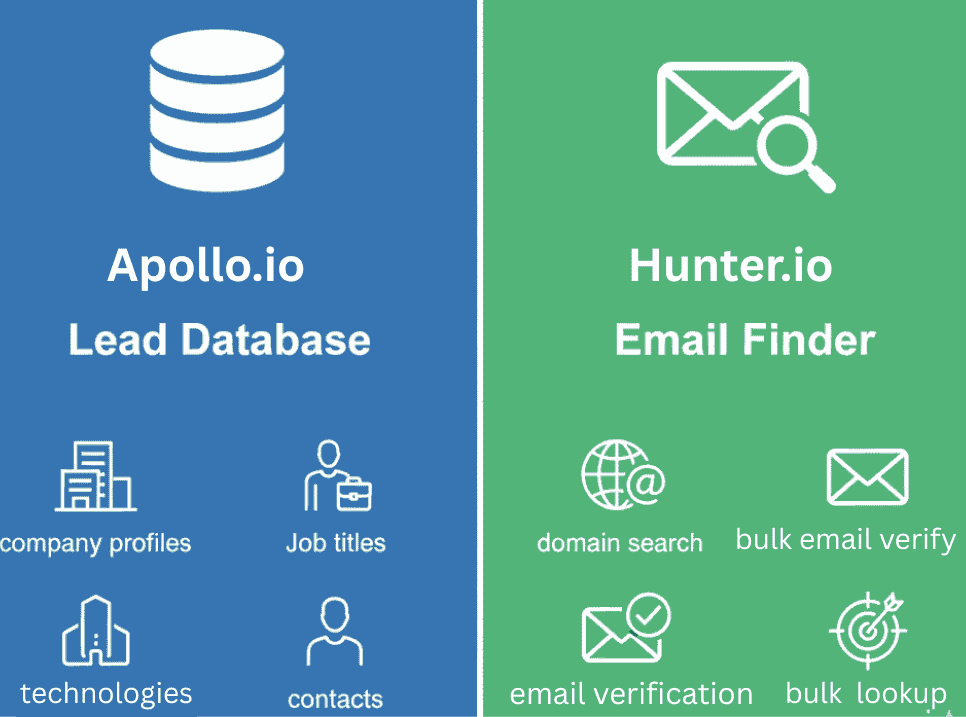
1. Core Difference: Lead Database vs. Email Finder
The biggest difference between Apollo.io and Hunter.io comes down to where you start your prospecting process.
Apollo.io → B2B Lead Intelligence & Prospecting Platform
Hunter.io → Professional Email Finding & Verification Platform
Apollo is designed for situations where you may know only your ideal customer profile (ICP)—for example, marketing agencies in the United States with 11–200 employees—and need to discover relevant companies and decision-makers.
Hunter is more useful when you already know the company, domain, or person you’re researching and need to find or verify a professional email address.
The distinction in one example
Suppose you want to find 50 founders of UK digital marketing agencies.
With Apollo, you can start with criteria such as:
Location → United Kingdom
Industry → Marketing / Advertising
Job title → Founder / Owner / CEO
Company size → Your preferred range
Apollo can then help you build a prospect list from its available company and contact data.
With Hunter, the workflow is different. If you already have:
companyname.co.uk
Hunter can help identify email patterns and available professional email addresses associated with that domain.
So the practical difference is:
- Apollo helps you discover companies and people who fit your targeting criteria.
- Hunter helps you find and verify professional email addresses for prospects you already have.
This is why Apollo is generally the stronger starting point for lead generation, while Hunter becomes particularly useful during the contact-enrichment and email-verification stages.
A simple way to remember it
Apollo: Who should I contact?
Hunter: How can I reach them by email?
The two tools can also complement each other rather than being direct substitutes. A lead-generation workflow might begin with Apollo to identify prospects, move to Hunter when additional email research is required, and then use an email verification step before outreach.
2. What Is Apollo.io?
Apollo.io is a B2B sales intelligence and prospecting platform that combines a large business contact database with tools for finding, organizing, enriching, and engaging prospects.
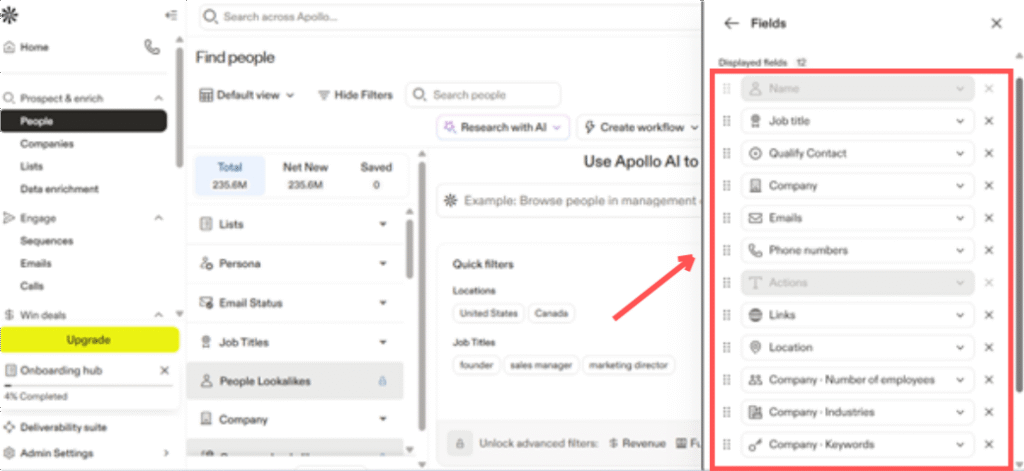
Its main advantage is that you don’t have to begin with a ready-made list of companies or contacts. You can define your ideal customer profile (ICP) and use Apollo’s search filters to discover companies and decision-makers that match your criteria.
For example, if you’re looking for US-based SaaS companies with 11–200 employees that are hiring sales professionals, Apollo can help narrow the prospect pool using company, people, location, industry, and other available data filters. This makes it particularly useful when the main challenge is finding the right prospects at scale, rather than simply finding an email address for a prospect you already know.
2.1. Key Apollo.io Capabilities
Apollo’s prospecting database and sales tools can support several stages of a B2B outreach workflow:
- Prospect Search: Find people and companies using filters such as job title, industry, company size, location, and other available attributes.
- Contact Data: Access available business contact information, including professional email addresses and other prospect details.
- Company Intelligence: Research companies and narrow prospects based on organizational characteristics and available business signals.
- List Building: Save, organize, and segment prospects into targeted lists for different campaigns or ICPs.
- Outreach: Use built-in sales engagement capabilities to manage email and prospecting activities rather than exporting every lead to a separate platform.
- Chrome Extension: Research prospect and company information while browsing supported websites and LinkedIn.
The important point is that Apollo isn’t simply an email finder. Its broader purpose is to help answer:
“Which companies and people should I target, and how can I organize them for outreach?”
2.2. Who Is Apollo.io Best For?
Apollo is particularly useful for businesses that don’t already have a well-developed prospect database and need to build targeted B2B lists efficiently.
Common users include:
- Startups: Build an initial prospect database without creating one entirely from scratch.
- Small Businesses: Find potential customers without investing in multiple separate prospecting tools.
- Sales Teams: Identify decision-makers and segment prospects according to their ICP.
- Lead Generation Professionals: Build client-specific prospect lists based on industry, location, job title, company size, and other criteria.
- Outbound Teams: Combine prospect discovery with sales engagement in one platform.
For a lead-generation workflow, you can think of Apollo as the discovery layer:
ICP → Company Search → Decision-Maker Search → Contact Data → Qualification → Outreach
That is the fundamental reason Apollo and Hunter shouldn’t be treated as identical tools: Apollo can help you discover the prospect in the first place, while Hunter is more focused on finding and verifying the email address once you know who or which company you’re researching.
New to Apollo.io? Read our complete Apollo.io review for beginners to understand its lead database, outreach features, and best use cases.
3. What Is Hunter.io?
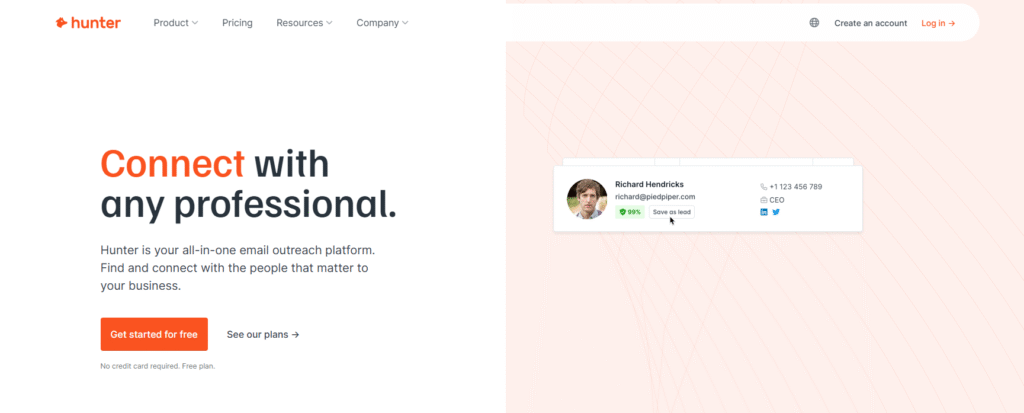
Hunter.io is an email finding and verification platform designed to help you discover professional email addresses associated with a specific company or domain.
Unlike Apollo.io, which starts with a large prospect database and lets you search for people using filters such as job title, company size, industry, and location, Hunter is more domain-focused. You typically start with a known company, website, or domain and then use Hunter to discover the email addresses associated with that organization.
For example, if you already know that a company operates at example.com, Hunter can search the domain for publicly available professional email patterns and addresses. You can then verify an email address before using it for outreach.
This makes Hunter particularly useful when your workflow is “I know the company; now I need the right email address”, rather than “I need to discover companies and decision-makers that match my ICP.”
Hunter.io Key Capabilities
Hunter combines email discovery, verification, and prospecting features into a relatively simple workflow:
- Domain Search: Find professional email addresses associated with a company domain.
- Email Finder: Search for a person’s professional email when you know their name and company or domain.
- Email Verifier: Check whether an email address is likely to be deliverable before sending outreach.
- Bulk Email Search: Process multiple domains or prospects when building a larger prospect list.
- Chrome Extension: Find contact information while researching websites and online prospects.
- API Access: Connect Hunter’s email-finding and verification capabilities with other systems and workflows.
The important distinction is that Hunter is not primarily a replacement for a large B2B lead database. Its strength is extracting value from information you already have—such as a company name, domain, or prospect identity—and turning that information into usable and verified contact data.
3.2. Who Is Hunter.io Best For?
- Hunter is a strong fit for workflows where the company or prospect is already known and email discovery is the next step.
- Bloggers: Find professional contact emails for writers, editors, and website owners.
- PR Professionals: Identify media and publication contacts for outreach campaigns.
- Link Builders: Find relevant website or editorial contacts when pursuing backlinks.
- Recruiters: Find professional email addresses for candidates or hiring contacts.
- Sales Prospecting: Find and verify business email addresses for known companies and prospects.
- Outreach Teams: Build contact lists when company names or domains have already been identified.
Hunter.io in One Sentence :
Hunter helps you find and verify professional email addresses when you already have a company, domain, or prospect to investigate.
To explore Apollo.io in detail, see our complete Hunter.io beginner’s review, covering features, pricing, and real use cases
4. Feature Comparison: Apollo.io vs Hunter.io
Apollo.io and Hunter.io overlap in a few areas—particularly email finding and email verification—but they are designed around different stages of the lead-generation process.
Apollo is primarily a B2B prospecting and sales engagement platform. It helps you discover companies and decision-makers, find contact information, build prospect lists, and run outreach from one platform.
Hunter.io is more focused on professional email discovery and verification. It is particularly useful when you already know the company, website, domain, or prospect you want to research.
| Feature | Apollo.io | Hunter.io |
|---|---|---|
| Lead discovery | ✅ Yes | ⚠️ Limited |
| Company database | ✅ Yes | ❌ No |
| Contact database | ✅ Yes | ⚠️ Limited |
| Email finder | ✅ Yes | ✅ Yes |
| Email verification | ✅ Yes | ✅ Yes |
| Bulk email search | ✅ Yes | ✅ Yes |
| CRM capabilities | ✅ Yes | ❌ No |
| Sales outreach | ✅ Built-in | ❌ No |
| LinkedIn prospecting | ✅ Strong | ⚠️ Limited |
| API access | ✅ Yes | ✅ Yes |
| Best for prospect discovery | ✅ Strong | ❌ No |
| Best for known-domain research | ⚠️ Good | ✅ Strong |
| Best for scaling lead generation | ✅ Yes | ⚠️ More limited |
The Key Difference
The easiest way to understand the difference is to look at where each tool fits in your workflow.
With Apollo.io, you can start with an ideal customer profile and search for companies and people that match your criteria—for example, US-based SaaS companies with 11–200 employees and a Head of Sales or Founder. Apollo can then help you build a prospect list and continue into contact enrichment and outreach.
With Hunter.io, the workflow usually starts with information you already have. For example, you may already have a list of 100 company websites and want to find the relevant professional email addresses for those companies. Hunter is well suited to that type of domain-to-email workflow.
So, while both platforms can help you find and verify email addresses, they solve different problems:
Apollo helps you discover who to contact. Hunter helps you find and verify how to contact them.
That distinction becomes especially important when choosing a tool for lead generation, cold email list building, or sales prospecting at scale.
5. Pricing Comparison
Pricing is an important part of the Apollo.io vs. Hunter.io decision, but the better choice depends on what you actually need the platform to do.
Apollo.io Pricing
Apollo.io offers a free plan with limited access to its prospecting and sales engagement features. Its paid plans expand access to contact data, credits, automation, and outreach capabilities.
The main value of Apollo comes from combining several functions in one platform:
- B2B Lead And Contact Data
- Email And Phone Enrichment
- Prospect Search And Filtering
- Sales Engagement And Outreach
- Sequences And Workflow Features
Because Apollo combines prospect discovery with contact data and outreach, it can be more cost-effective for users who need to build and work through prospect lists at scale, rather than simply find individual email addresses.
Hunter.io Pricing
Hunter.io also offers a free plan, currently providing 50 credits per month. Its paid plans are structured around credits and increasingly include lead discovery, enrichment, email verification, and outreach capabilities.
Hunter’s current paid plans include:
- Starter: $34/month when billed monthly
- Growth: $104/month when billed monthly
- Scale: $209/month when billed monthly
Annual billing offers lower effective monthly pricing.
Hunter credits are used across core data functions such as Email Finder, Email Verifier, and Domain Search. Its higher-tier plans also include features such as lead enrichment, Discover, and email sequences.
Which Offers Better Value?
The answer depends on your workflow.
If your main requirement is discovering companies and decision-makers that match an ICP, Apollo generally offers more value because prospect discovery, contact data, and outreach are integrated into the same platform.
If you already have a list of companies or prospects and your main requirement is finding and verifying professional email addresses, Hunter can be a more focused option.
So the better way to think about the pricing comparison is:
Apollo is better suited to full-scale prospecting and sales workflows, while Hunter is attractive when email discovery, verification, and targeted outreach are the primary requirements.
Neither tool is automatically cheaper for every use case. The right choice depends on whether you are starting with a prospect you need to discover or a company/contact you already know and need to enrich.s.
6. Use-Case Scenarios: When to Use Apollo.io vs. Hunter.io
The easiest way to choose between Apollo.io and Hunter.io is to start with what information you already have.
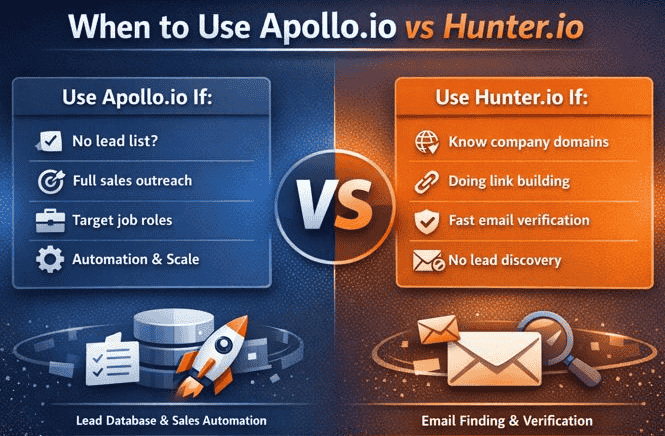
If you need to discover companies, identify decision-makers, build a prospect list, and run outbound campaigns, Apollo.io is generally the better fit. If you already know the companies or prospects and mainly need to find or verify professional email addresses, Hunter.io can be the more focused choice.
✅ Use Apollo.io If:
Apollo.io is a better choice when your workflow starts with prospect discovery rather than a finished contact list.
- You Don’t Have A Lead List: Start with an ICP and use filters such as industry, location, company size, and job title to discover relevant prospects.
- You Want End-To-End Outbound Sales: Manage prospecting, contact data, and sales outreach within one platform.
- You Target Specific Job Roles: Find decision-makers such as founders, CEOs, marketing directors, sales leaders, or other roles within your target companies.
- You Need To Scale Lead Generation: Build larger prospect lists and use automation and outreach features to manage campaigns more efficiently.
- You Want Multiple Data Points: Combine company information, contact details, and prospecting filters instead of relying only on email discovery.
✅ Use Hunter.io If:
Hunter.io is a better fit when you already know who or which companies you want to contact and need reliable email-related data.
- You Already Have Company Domains: Search known websites or domains to discover professional email addresses.
- You’re Doing Link Building Or PR: Find contact emails for website owners, publishers, journalists, editors, and other outreach targets.
- You Need Email Verification: Verify email addresses before sending campaigns to reduce the risk of using invalid or undeliverable addresses.
- You’re Building A Contact List From Known Companies: Enrich an existing list of companies or prospects with professional email information.
- You Don’t Need Broad Lead Discovery: Use Hunter when finding thousands of new prospects based on detailed ICP filters is not your primary requirement.
The Simple Decision Rule
A useful way to remember the difference is:
Start with no prospects → Apollo.io.
Start with known companies or contacts → Hunter.io.
In practice, the two tools can also be used together. For example, you could use Apollo.io to identify target companies and decision-makers, then use Hunter.io when you need additional email discovery or verification for specific domains.
The important point is that Apollo and Hunter are not exact substitutes. They overlap in email finding and verification, but their core workflows are different.
7. Can Apollo.io and Hunter.io Be Used Together?
Yes. Apollo.io and Hunter.io can be used together, particularly when you want to combine broad prospect discovery with additional email research and verification.
The two tools can complement each other because they are strongest at different stages of the lead-generation workflow. Apollo.io can help you identify target companies and decision-makers, while Hunter.io can provide another way to find or verify professional email addresses associated with known companies and domains.
Example Workflow: Apollo.io + Hunter.io
A practical workflow could look like this:
1. Use Apollo.io → Find Target Companies And Decision-Makers
Start with your ICP and use Apollo’s filters to identify companies and the relevant people within them.
For example, you could search for US-based SaaS companies with 11–200 employees and target roles such as Founder, CEO, Head of Sales, or Marketing Director.
2. Build Your Prospect List
Collect the relevant company names, domains, decision-maker names, job titles, LinkedIn profiles, and available contact information.
3. Use Hunter.io → Search Known Domains
For prospects where you need additional email research, enter the company domain into Hunter’s Domain Search or use its Email Finder to look for a professional email address.
4. Verify Email Addresses
If you have an email address that you plan to use for outreach, Hunter’s Email Verifier can provide an additional deliverability check.
5. Compare And Clean Your Final Data
If Apollo and Hunter return different email information, don’t automatically assume that one is correct. Compare the available evidence and use email verification and other data-quality checks before adding the address to your final outreach list.
When Does This Combination Make Sense?
Using both tools makes the most sense when one tool does not fully cover your workflow.
For example, Apollo may be excellent for discovering a large group of prospects, while Hunter can be useful when you need to investigate specific domains or perform an additional email verification step.
However, you don’t necessarily need both. If Apollo already provides the prospect and a usable, verified email address, adding Hunter to every lead may simply increase your cost and workflow complexity.
The best approach is to use Apollo for discovery and Hunter selectively for additional email research or verification—not automatically run every lead through both platforms.
8. Deliverability & Data Accuracy
When comparing Apollo.io and Hunter.io, data accuracy and email deliverability are important considerations—but they should not be treated as a simple case of “Apollo has less accurate data and Hunter has more accurate data.”
Both platforms provide email-related data and verification capabilities. The practical difference is more about how each tool fits into your prospecting workflow.
Apollo.io is built around large-scale B2B prospect discovery, contact data, enrichment, and sales engagement. This makes it useful when you need to identify a large number of potential prospects and gather multiple data points about them.
Hunter.io places a stronger emphasis on email discovery and verification. Its workflow is particularly useful when you already know the company or domain and want to find or check professional email addresses before using them for outreach.
Why Email Verification Matters
An email address appearing in a lead database does not automatically mean that it is safe to send to. Email addresses can become invalid because people change jobs, domains change, mailboxes are disabled, or company information becomes outdated.
Before adding contacts to a cold email campaign, it is good practice to verify questionable or important addresses and remove contacts that are clearly invalid.
This can help reduce:
- Bounced Emails
- Invalid Addresses
- Poor List Quality
- Unnecessary Sending To Risky Addresses
However, email verification alone does not guarantee inbox placement. Sender reputation, domain configuration, authentication, sending volume, engagement, and email content also affect deliverability.
Best-Practice Workflow
For a lead-generation workflow, you can use the tools in stages:
Apollo.io → Prospect Discovery → Contact Data → Hunter.io Verification (Optional) → Final List → Outreach
Use Apollo when you need to find the right companies and decision-makers. Use Hunter selectively when you need additional email discovery or verification for specific prospects.
You don’t need to send every Apollo contact through Hunter. If the available contact data is already sufficient and verified for your workflow, an additional verification step may not provide enough benefit to justify the extra cost.
The goal is not to choose the tool with the “most accurate emails.” The goal is to build a prospect list that is relevant, current, verified where necessary, and suitable for responsible outreach.
9. Which Tool Is Better for Small Businesses?
There is no single winner for every small business. The better choice depends on how you build your prospect list and what you need to do after finding a contact.
If you are starting from scratch and need to discover companies and decision-makers, Apollo.io is usually the stronger starting point. If you already have a list of companies or websites and primarily need professional email discovery and verification, Hunter.io can be the better fit.
Apollo.io vs. Hunter.io for Different Business Types
| Business Type | Best Tool | Why |
|---|---|---|
| New Startup | Apollo.io | Useful for discovering target companies, decision-makers, and building an outbound prospect list. |
| Solo Founder | Apollo.io | Provides prospecting and outreach capabilities in one platform. |
| Link Building Agency | Hunter.io | Useful for finding website, editorial, and outreach contacts from known domains. |
| PR Outreach | Hunter.io | Well suited to researching professional email addresses for known publications, journalists, and media contacts. |
| Sales Agency | Apollo.io | Strong fit for building prospect lists and managing outbound sales workflows at scale. |
| Recruiter | Apollo.io + Hunter.io | Apollo helps with prospect discovery, while Hunter can provide additional email research or verification. |
| Business With An Existing Lead List | Hunter.io | Useful when the main requirement is finding or verifying professional email addresses. |
| Business Starting From An ICP | Apollo.io | Better suited to discovering companies and contacts based on specific targeting criteria. |
10. Final Verdict
For most small businesses that are starting outbound prospecting from scratch, Apollo.io is the better starting point because it combines lead discovery, contact data, and sales engagement in one platform.
But that does not make Apollo the universal winner.
Choose Apollo.io when your main question is:
“Who should I contact?”
Choose Hunter.io when your main question is:
“What professional email address should I use to contact this company or person?”
And if your workflow requires both, you can use Apollo for prospect discovery and Hunter selectively for additional email research or verification.
The key is to choose based on your workflow rather than simply choosing the tool with more features.
FAQs
-
Is Apollo.io better than Hunter.io?
Apollo.io is generally better for B2B prospect discovery, lead database access, contact enrichment, and outbound sales. Hunter.io is more focused on email finding, email verification, and researching known companies or domains. The better tool depends on whether you need to discover prospects or primarily find and verify their email addresses.
-
What is the main difference between Apollo.io and Hunter.io?
The main difference is their starting point. Apollo.io is primarily a prospecting platform, where you can search for companies and decision-makers using targeting criteria. Hunter.io is primarily an email discovery and verification platform, where you can research professional email addresses associated with known people, companies, or domains.
-
Can Hunter.io replace Apollo.io?
Not completely. Hunter.io can handle email discovery, verification, and some prospecting workflows, but Apollo.io is more comprehensive for B2B lead discovery, contact databases, prospect filtering, and sales engagement. If you need to build a targeted prospect list from scratch, Apollo is generally the stronger option.
-
Can Apollo.io replace Hunter.io?
For many users, yes. Apollo includes email finding and verification, so you may not need Hunter if Apollo already provides the contact information you need. However, Hunter can still be useful as an additional email research or verification tool, particularly when working with known domains.
-
Which is better for lead generation, Apollo.io or Hunter.io?
Apollo.io is generally better for lead generation. It allows you to discover companies and contacts based on criteria such as industry, location, company size, and job title. Hunter is more useful when you already have companies or prospects and need to find or verify their professional email addresses.
-
Which is better for email finding, Apollo.io or Hunter.io?
Both can find professional email addresses. Hunter.io has a more focused email-finding workflow, while Apollo combines email finding with a much broader prospecting database. If email discovery is your primary requirement, Hunter may be the simpler choice; if email finding is part of a larger prospecting workflow, Apollo may be more convenient.
-
Which is better for email verification?
Both Apollo.io and Hunter.io provide email verification capabilities. The best choice depends on your workflow, pricing, and the volume of addresses you need to verify. If you already use Apollo for prospecting, its built-in verification can reduce the need for another tool. Hunter can be useful when email verification is a central part of your workflow.
-
Can I use Apollo.io and Hunter.io together?
Yes. A common workflow is to use Apollo.io for prospect discovery and Hunter.io selectively for additional email research or verification. However, you do not necessarily need to run every Apollo contact through Hunter. Use the second tool when it adds useful data or an additional verification step.
-
Which is better for cold email campaigns?
Apollo.io is generally the better choice if you want prospecting plus cold email outreach in one platform. Hunter can also support outreach workflows, but its traditional strength has been email discovery and verification. Whichever tool you use, email verification and proper domain/email authentication are important for responsible cold outreach.
-
Which is better for small businesses?
For a small business starting outbound prospecting from scratch, Apollo.io is usually the better starting point because it combines lead discovery, contact data, and sales engagement. Hunter may be a better fit for a small business that already has a prospect or company list and mainly needs email discovery and verification.
-
Which is better for recruiters: Apollo.io or Hunter.io?
Apollo.io is generally more useful for recruiters who need to discover and research prospects at scale. Hunter can complement the workflow when the recruiter already knows the candidate or company and needs additional professional email research or verification.
-
Which is better for link building and PR outreach?
Hunter.io can be particularly useful for link building and PR workflows when you already know the websites, publications, journalists, or companies you want to contact. Its domain and email-finding capabilities fit naturally into a known-website-to-contact workflow.
-
Is Apollo.io more expensive than Hunter.io?
Not necessarily. The value depends on what features you need and how much prospecting, enrichment, verification, and outreach you perform. Apollo bundles several sales and prospecting functions, while Hunter has historically focused more heavily on email discovery and verification. Compare the plans based on your actual workflow rather than the headline monthly price.
-
Can I find a company’s email address with Apollo.io or Hunter.io?
Yes. Both platforms can help find professional email addresses associated with companies. Apollo is particularly useful when you also need to identify specific decision-makers, while Hunter is useful for searching a known company domain and discovering associated professional email addresses.
-
Which tool should I choose: Apollo.io or Hunter.io?
Use Apollo.io if you need to discover companies and decision-makers, build targeted B2B lead lists, and manage outbound sales.
Use Hunter.io if you already know the companies or prospects you want to contact and primarily need email discovery, domain research, or verification.
Simple rule: Apollo for “Who should I contact?” Hunter for “How can I find or verify their email?”