
Inbound vs Outbound Marketing for Lead Generation: Which Strategy Works Best in 2026?
Table of Contents
Start Here
Choosing between inbound vs outbound marketing for lead generation can be confusing for most businesses.
• Inbound marketing builds long-term traffic through SEO and content
• Outbound marketing generates faster leads through cold email and outreach
👉 The challenge is knowing which strategy works best for your goals—and when to use each
What You’ll Learn
This guide breaks down:
• How inbound and outbound marketing actually work
• When to use each for lead generation
• How to combine both into a scalable, high-performing system
If you want a step-by-step system instead of just strategy, this complete lead generation workflow shows exactly how to generate leads using modern tools.
Inbound vs Outbound Marketing: Quick Summary
• Inbound marketing → drives long-term traffic through SEO, content marketing, and organic growth
• Outbound marketing → generates fast leads using cold email outreach, LinkedIn prospecting, and direct campaigns
• Best strategy → combine inbound + outbound marketing to build a scalable lead generation system
👉 If you want quick results, start with outbound marketing
👉 If you want sustainable growth, invest in inbound marketing—and combine both for maximum ROI
This outbound lead generation workflow explains how cold email systems actually work in practice
Inbound vs Outbound Marketing
Understanding the difference between inbound vs outbound marketing for lead generation helps you choose the right strategy based on speed, scalability, and long-term ROI.
Inbound Marketing (Pull Strategy)
Inbound marketing focuses on attracting potential customers through valuable content and organic channels.
• Channels: SEO, blogs, social media, content marketing
• Approach: Pull strategy (customers find you)
• Speed: Slow to start, but compounds over time
• Trust: High (builds authority and credibility)
• Cost Structure: Lower cost over time (content-driven)
Best for:
• Long-term organic traffic and brand authority
• Businesses investing in content marketing and SEO
If you’re building content for inbound traffic, this guide on AI tools for content marketing can help you scale faster.
Outbound Marketing (Push Strategy)
Outbound marketing focuses on reaching prospects directly through targeted outreach.
• Channels: Cold email, LinkedIn outreach, direct messaging
• Approach: Push strategy (you reach out first)
• Speed: Fast results and immediate lead generation
• Trust: Lower initially (depends on messaging quality)
• Cost Structure: Tool + infrastructure dependent
Best for:
• Fast lead generation and pipeline building
• Testing offers and scaling outreach campaigns
Side-by-Side Comparison
| Factor | Inbound Marketing | Outbound Marketing |
|---|---|---|
| Strategy Type | Pull (attract leads) | Push (reach out to prospects) |
| Lead Generation Speed | Slow (long-term growth) | Fast (immediate results) |
| Channels | SEO, blogs, social | Cold email, LinkedIn, direct outreach |
| Trust Building | High (content-driven) | Medium (improves with personalization) |
| Scalability | Compounds over time | Scales with tools and systems |
| Cost Efficiency | Better long-term ROI | Higher short-term cost, faster returns |
Key Insight
➜ Inbound marketing builds demand over time, while outbound marketing captures demand immediately
➜ The highest-performing businesses use both strategies together to create a predictable and scalable lead generation system
What Is Inbound Marketing?
Inbound marketing is a lead generation strategy that attracts potential customers through valuable content, SEO, and organic channels—instead of reaching out directly.
👉 Instead of chasing leads, inbound marketing brings qualified prospects to you
How Inbound Marketing Works
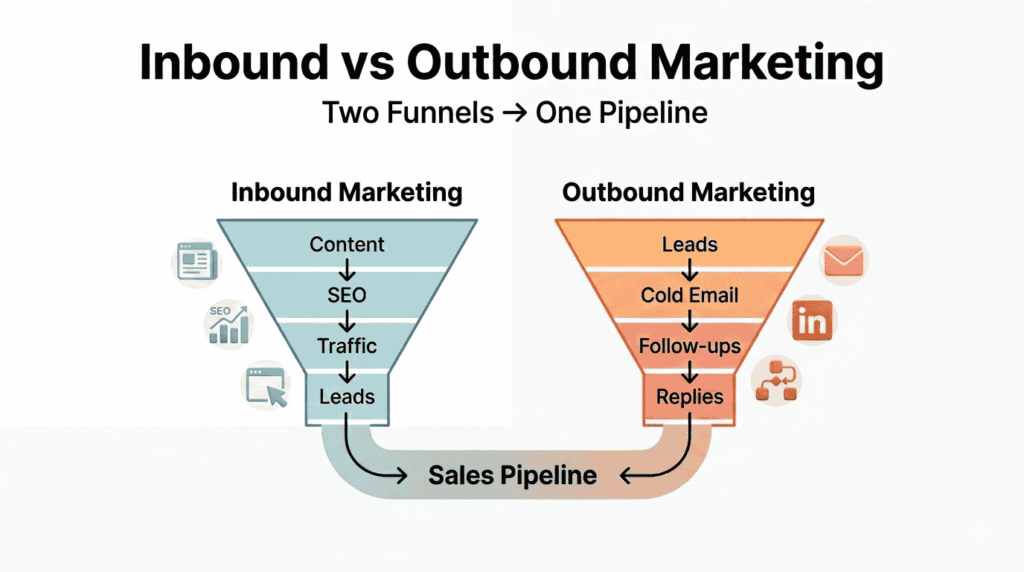
Inbound marketing typically follows a simple funnel:
• Content creation → blogs, guides, videos
• SEO optimization → rank on search engines
• Traffic generation → users discover your content
• Lead capture → email signup, forms, downloads
• Nurturing → email sequences, retargeting
Core Inbound Marketing Channels
• Content marketing (blog posts, guides, tutorials)
• SEO (Search Engine Optimization)
• Social media content
• Lead magnets (ebooks, checklists, templates)
👉 These channels work together to build a consistent inbound lead generation system
Real Example (Simple Funnel)
Blog post → ranks on Google → gets traffic → user signs up → email follow-up → becomes a lead
Why Inbound Marketing Matters
• Builds long-term organic traffic
• Increases trust and authority
• Generates high-quality, intent-driven leads
• Reduces dependency on paid ads over time
Limitations to Know
• Takes time to see results (SEO delay)
• Requires consistent content creation
• Needs optimization for conversions
Key Insight
Inbound marketing is a long-term asset—once your content ranks, it can generate leads continuously without ongoing outreach.
If you’re starting with outbound, this beginner-friendly cold email workflow explains the full setup step by step.
What Is Outbound Marketing?
Outbound marketing is a lead generation strategy where you proactively reach out to potential customers using targeted channels like cold email outreach, LinkedIn prospecting, and direct messaging.
👉 Instead of waiting for traffic, you initiate conversations with qualified prospects
How Outbound Marketing Works
Outbound marketing follows a direct, action-driven workflow:
• Lead sourcing → build a targeted prospect list
• Data filtering → verify emails and refine targeting
• Outreach campaign → send cold emails or LinkedIn messages
• Follow-ups → automated sequences to increase replies
• Conversion → replies → meetings → deals
Core Outbound Marketing Channels
• Cold email outreach (scalable B2B lead generation)
• LinkedIn automation & prospecting
• Direct messaging campaigns
• Cold calling (optional for some teams)
👉 These channels are designed for fast, controlled lead generation
Real Example (Simple Funnel)
Lead list → cold email campaign → follow-up → reply → booked call → conversion
Why Outbound Marketing Matters
• Generates immediate leads and pipeline
• Allows precise targeting by role, company, industry
• Highly scalable with automation tools
• Ideal for testing offers and messaging quickly
Limitations to Know
• Requires proper email deliverability setup
• Lower initial trust compared to inbound
• Needs tools for automation and scaling
Key Insight
Outbound marketing gives you speed and control—when done right, it can create a predictable lead generation system within days, not months.
This guide shows how to use Apollo.io for lead generation and build targeted prospect lists.
Inbound vs Outbound Marketing: Pros & Cons
Understanding the pros and cons of inbound vs outbound marketing helps you choose the right lead generation strategy based on your goals, timeline, and resources.
Inbound Marketing: Pros & Cons
✅ Pros of Inbound Marketing
• Long-term organic growth → content and SEO compound over time
• High trust & authority → users discover you through valuable content
• Better lead quality → attracts intent-driven prospects
• Cost-effective over time → reduces dependency on paid acquisition
❌ Cons of Inbound Marketing
• Slow results initially → SEO and content take time to rank
• Requires consistent content creation → blogs, guides, updates
• Delayed ROI → results build gradually, not instantly
Outbound Marketing: Pros & Cons
✅ Pros of Outbound Marketing
• Fast lead generation → immediate outreach and responses
• Highly scalable → automation tools enable high-volume campaigns
• Precise targeting → reach specific roles, industries, and companies
• Quick testing → validate offers and messaging rapidly
❌ Cons of Outbound Marketing
• Deliverability challenges → emails may land in spam without proper setup
• Lower initial trust → requires strong personalization and messaging
• Tool and setup dependency → needs platforms for automation and scaling
Key Insight
➜ Inbound marketing builds trust and long-term traffic, while outbound marketing delivers speed and immediate results
➜ The most effective approach is combining both to create a balanced, scalable lead generation system
Inbound vs Outbound Marketing Cost Comparison
Understanding the cost of inbound vs outbound marketing for lead generation helps you choose the right strategy based on budget, timeline, and ROI expectations.
Inbound Marketing Costs (Long-Term Investment)
• Content creation cost → blogs, SEO articles, landing pages
• Time investment → takes months to rank and generate traffic
• Tools (optional) → SEO tools, analytics platforms
👉 Inbound marketing is time-intensive upfront, but becomes cost-effective over time as traffic grows organically
Outbound Marketing Costs (Immediate Execution)
• Tool cost → cold email platforms, automation tools
• Lead acquisition cost → databases, prospecting tools
• Setup effort → deliverability, campaign management
👉 Outbound marketing requires direct investment, but generates faster lead generation results
Quick Cost Comparison
| Factor | Inbound Marketing | Outbound Marketing |
|---|---|---|
| Initial Cost | Low to medium (content-focused) | Medium (tools + lead data) |
| Time to ROI | Slow (3–6 months) | Fast (days to weeks) |
| Long-Term Cost | Decreases over time | Scales with usage |
| Predictability | Less predictable early | More controllable |
What This Means for Your Strategy
• Choose inbound marketing if you want low long-term cost + sustainable traffic
• Choose outbound marketing if you want fast results + predictable lead flow
Key Insight
👉 The real cost is not just money—it’s time vs speed
• Inbound = invest time → reduce cost later
• Outbound = invest money → get results faster
Time to Results: Inbound vs Outbound Marketing
One of the biggest differences in inbound vs outbound marketing for lead generation is how quickly you start seeing results. Setting the right expectations helps you choose the right strategy—and avoid frustration.
Inbound Marketing (Long-Term Growth)
• Time to results: ~3–6 months (SEO + content ranking)
• Early phase: content creation, indexing, low traffic
• Growth phase: rankings improve → traffic increases → leads start coming in
👉 Inbound marketing is slower at the beginning but creates consistent, compounding lead generation over time
Outbound Marketing (Fast Results)
• Time to results: ~1–7 days after campaign launch
• Early phase: lead list setup, email campaign, first replies
• Growth phase: optimized messaging → higher replies → more conversions
👉 Outbound marketing delivers immediate lead generation and quick feedback
Side-by-Side Timeline
| Stage | Inbound Marketing | Outbound Marketing |
|---|---|---|
| Setup | Content + SEO setup | Tools + lead list + campaign |
| First Results | 1–3 months | 1–7 days |
| Consistent Leads | 3–6 months | 1–2 weeks |
| Long-Term Growth | High (compounding traffic) | Depends on scaling campaigns |
What This Means for Your Strategy
• Choose inbound marketing if you can wait for long-term, sustainable growth
• Choose outbound marketing if you need fast leads and immediate pipeline
Key Insight
Inbound = slow start, long-term payoff
Outbound = fast start, immediate results
👉 The most effective strategy is combining both to balance speed + sustainability
When to Use Inbound vs Outbound Marketing
Choosing between inbound vs outbound marketing for lead generation depends on your business stage, goals, and timeline.
Use Inbound Marketing If:
• You want long-term organic traffic through SEO and content
• You’re focused on building brand authority and trust
• You have time to invest in content marketing and growth
• You want consistent, compounding lead generation over time
Use Outbound Marketing If:
• You need fast lead generation and immediate results
• You’re testing offers, messaging, or new markets
• You want direct access to your target audience
• You plan to scale outreach using cold email and automation tools
Smart Strategy (What Actually Works)
👉 Most successful businesses don’t choose one—they combine both:
• Use outbound marketing for quick wins and early traction
• Use inbound marketing to build long-term growth and authority
This creates a balanced lead generation system that delivers both short-term results and long-term ROI.
Hybrid Strategy: Combine Inbound + Outbound for Scalable Lead Generation
The most effective approach to inbound vs outbound marketing for lead generation isn’t choosing one—it’s combining both into a single, predictable system.
How the Hybrid Lead Generation System Works
Inbound Marketing (Attract Demand)
• Blog content → SEO rankings → organic traffic
• Lead magnets → email capture → nurture sequences
• Builds trust, authority, and long-term pipeline
Outbound Marketing (Capture Demand)
• Targeted lead list → cold email outreach → follow-ups
• Direct conversations → replies → booked calls
• Generates fast leads and immediate opportunities
Combined Workflow (High-Performance System)
• Inbound → attracts visitors and builds awareness
• Outbound → reaches ideal prospects directly
• Follow-ups + nurturing → convert interest into leads
👉 Traffic + Outreach + Follow-ups = predictable lead generation system
Why This Strategy Works
• Balances short-term results (outbound) with long-term growth (inbound)
• Improves lead quality and conversion rates
• Reduces dependency on a single channel
• Creates a scalable and repeatable B2B lead generation system
Key Insight
➜ Use inbound marketing to build demand
➜ Use outbound marketing to capture demand
➜ Together, they create a high-performing lead generation engine that scales with your business
Best Tools for Inbound & Outbound Marketing
Choosing the right tools is essential to turn your inbound vs outbound marketing strategy into a scalable lead generation system. The goal is not to use more tools—but to use the right tools for each stage.
Inbound Marketing Tools (Traffic & Authority)
These tools help you attract organic traffic, build content, and generate inbound leads.
• SEO tools → keyword research, ranking optimization, content strategy
• Content platforms → blog publishing, landing pages, lead capture
• Analytics tools → track traffic, user behavior, conversions
👉 Use inbound tools to build a long-term traffic and authority engine
Outbound Marketing Tools (Leads & Outreach)
These tools help you generate targeted leads and run scalable outreach campaigns.
• Cold email tools → automate campaigns, follow-ups, and deliverability
• Lead generation platforms → find and filter B2B prospects
• Email verification tools → improve deliverability and reduce bounce rates
👉 Use outbound tools to create a fast, predictable lead generation pipeline
Explore the full Instantly.ai review to understand features, pricing, and setup.
Simple Tool Stack (Beginner-Friendly)
You don’t need a complex setup to start:
• Inbound → content + basic SEO tools
• Outbound → lead database + cold email platform
👉 This minimal stack is enough to build a complete inbound + outbound lead generation system
How Tools Fit Into Your Workflow
• Inbound tools → bring traffic and awareness
• Outbound tools → drive direct outreach and conversations
• Combined → create a scalable and repeatable lead generation system
Compare Instantly.ai vs Smartlead.ai to choose the right cold email tool.
Key Insight
👉 Tools don’t create results—systems do
The best results come from combining:
content (inbound) + lead data + outreach (outbound) into one workflow
Real Workflow Example: Inbound + Outbound in Action
Here’s how a real hybrid lead generation workflow looks when you combine inbound marketing and outbound marketing into one system.
Inbound Workflow (Traffic → Leads)
• Content (blog, SEO pages) → attracts targeted visitors
• Visitors → engage with content → build trust
• Lead capture → email signup, lead magnets
• Nurture → email sequences, retargeting
👉 Outcome: Warm leads and consistent organic traffic
Outbound Workflow (Leads → Conversations)
• Apollo.io → build targeted lead list
• Filter & verify → clean data for deliverability
• Instantly.ai → launch cold email outreach campaigns
• Follow-ups → increase replies and engagement
👉 Outcome: Direct conversations and booked calls
Combined System (What Actually Works)
• Inbound brings traffic and awareness
• Outbound drives direct outreach and faster responses
• Email nurturing + follow-ups → convert leads into opportunities
👉 Content + Lead Data + Outreach = scalable lead generation system
Why This Workflow Is Effective
• Combines organic traffic + direct outreach
• Works for both short-term results and long-term growth
• Creates a repeatable and predictable lead generation process
Key Insight
➜ Inbound marketing warms up your audience
➜ Outbound marketing starts the conversation
➜ Together, they create a complete B2B lead generation system that consistently generates leads and revenue
ROI Perspective: What Actually Drives Results
When comparing inbound vs outbound marketing for lead generation, your success is not defined by strategy alone—but by how well you execute it.
What Impacts ROI in Lead Generation
• Lead quality → targeting the right audience improves replies and conversions
• Email deliverability → inbox placement vs spam directly affects campaign performance
• Conversion rate → turning leads into calls, demos, and revenue
How ROI Works in Practice
• Strong inbound marketing → brings high-intent traffic
• Effective outbound marketing → converts that demand into conversations
• Optimized follow-ups → increase response and close rates
👉 Each step directly impacts your overall ROI from lead generation
Key Reality
👉 A strategy alone doesn’t generate results
• Poor targeting = low-quality leads
• Weak deliverability = emails ignored or spammed
• No follow-up = lost opportunities
What High-Performing Systems Focus On
• Clean and targeted lead data
• Proper email warm-up and deliverability setup
• Clear and personalized messaging
• Consistent follow-up sequences
Key Insight
👉 The best ROI comes from combining:
quality leads + strong deliverability + effective messaging + consistent follow-ups
This is what turns inbound + outbound marketing into a predictable, scalable lead generation system.
Common Mistakes to Avoid
🔶 Choosing Only One Strategy
Relying only on inbound or outbound marketing limits your results.
• Inbound alone = slow growth
• Outbound alone = inconsistent pipeline
Fix: Combine both for a balanced lead generation system
🔶 Ignoring Follow-Ups
Most replies come after 2–3 follow-ups, not the first message.
• No follow-up = lost leads
• Inconsistent follow-up = missed conversions
Fix: Use structured email sequences and reminders
🔶 Poor Targeting
Sending messages to the wrong audience kills performance.
• Low-quality leads = low reply rates
• Generic lists = wasted effort
Fix: Focus on specific roles, industries, and qualified prospects
Key Insight
Small mistakes in targeting, follow-ups, and strategy choice can drastically reduce your lead generation ROI.
👉 Fixing these alone can improve results without changing tools or budget
Realistic Results Expectations (What Actually Happens)
When comparing inbound vs outbound marketing for lead generation, most beginners expect instant results—or get discouraged too early.
This section sets realistic expectations so you stay consistent and make better decisions.
Inbound Marketing Expectations
• Starts slow → traffic may be low in the beginning
• Builds gradually → rankings improve over time
• Scales consistently → content keeps generating leads
👉 Reality: Slow start, but becomes a long-term asset
Outbound Marketing Expectations
• Starts fast → replies can come within days
• Results fluctuate → depends on targeting and messaging
• Requires optimization → campaigns need continuous improvement
👉 Reality: Fast results, but not always consistent without iteration
What Most Beginners Get Wrong
• Expecting inbound to work immediately
• Expecting outbound to work perfectly on day one
• Quitting before optimizing targeting or messaging
👉 Both strategies require testing, refinement, and consistency
What Real Growth Looks Like
• Outbound generates early conversations and feedback
• Inbound builds traffic and authority over time
• Combined → results become more stable and predictable
Key Insight
Inbound marketing compounds over time
Outbound marketing improves with optimization
👉 Real success comes from consistency, not instant results
Beginner Setup Path: From Strategy to Lead Generation
If you’re deciding between inbound vs outbound marketing for lead generation, the biggest mistake is overthinking the strategy and not taking action.
This simple path shows exactly how to start, validate, and scale—without confusion.
Step 1: Start with Outbound Marketing (Fast Validation)
• Build a targeted lead list
• Launch cold email outreach campaigns
• Test your offer, messaging, and audience
👉 Goal: Generate quick leads and real feedback
Step 2: Validate What Works
• Identify which audience segments respond
• Refine your messaging and positioning
• Track replies, conversions, and engagement
👉 Goal: Find a repeatable lead generation pattern
Step 3: Build Inbound Marketing (Long-Term Growth)
• Create SEO-optimized content based on what works
• Publish blogs targeting high-intent keywords
• Capture leads through content and lead magnets
👉 Goal: Turn insights into a scalable inbound marketing system
Step 4: Combine Inbound + Outbound
• Use inbound to generate organic traffic and awareness
• Use outbound to reach and convert prospects faster
• Align messaging across both channels
👉 Goal: Build a predictable, scalable lead generation system
Why This Path Works
• Starts with speed (outbound marketing)
• Moves to optimization (validation phase)
• Scales with sustainability (inbound marketing)
Key Insight
👉 Don’t start with complexity—start with results
The most effective approach is:
Outbound → Validate → Inbound → Scale
Final Recommendation: Inbound vs Outbound Marketing
Choosing between inbound vs outbound marketing for lead generation depends on your current stage—but the highest-performing approach is using both strategically.
Start with Outbound (For Fast Results)
• Generate quick leads and conversations using cold email outreach
• Test your offer, messaging, and target audience
• Build an initial sales pipeline without waiting for traffic
👉 Best for: beginners, new businesses, and early-stage validation
Build Inbound (For Long-Term Growth)
• Create SEO-optimized content to attract organic traffic
• Build authority and trust in your niche
• Generate consistent, high-intent leads over time
👉 Best for: sustainable growth and reducing dependency on outreach
Best Strategy: Combine Inbound + Outbound
• Use outbound marketing for immediate results and pipeline
• Use inbound marketing to build long-term traffic and demand
• Connect both into a scalable lead generation system
👉 This creates a balance of short-term wins + long-term ROI
Final Insight
The most effective businesses don’t choose between inbound or outbound—they build a system where:
Inbound generates demand → Outbound captures and converts it
👉 That’s how you turn lead generation into a predictable growth engine.
FAQs
-
What is the difference between inbound and outbound marketing?
Inbound marketing attracts leads through SEO, content, and organic channels, while outbound marketing reaches out directly using cold email, LinkedIn outreach, or ads.
👉 Inbound = pull strategy
👉 Outbound = push strategy -
Which is better for lead generation: inbound or outbound marketing?
There is no single “best” option.
• Outbound marketing is better for fast lead generation
• Inbound marketing is better for long-term traffic and trust
The most effective approach is combining both strategies. -
Is inbound marketing better than outbound marketing for beginners?
Not always.
Beginners often see faster results with outbound marketing because it generates leads quickly.
Inbound marketing takes time but builds sustainable growth. -
Can I use inbound and outbound marketing together?
Yes—and this is the most effective strategy.
Use inbound marketing to attract and educate your audience
Use outbound marketing to reach and convert prospects faster
Together, they create a scalable lead generation system. -
How long does inbound marketing take to generate leads?
Inbound marketing typically takes 3–6 months to show consistent results, depending on SEO competition and content quality.
👉 It’s a long-term strategy with compounding returns. -
Is cold email still effective in outbound marketing (2026)?
Yes, cold email remains one of the most effective outbound marketing strategies when:
• Targeting is accurate
• Emails are personalized
• Deliverability is properly set up -
Which is more cost-effective: inbound or outbound marketing?
• Inbound marketing is more cost-effective long-term
• Outbound marketing requires tools but generates faster ROI
👉 Cost-effectiveness depends on execution and goals. -
What is the best strategy for small businesses?
Start with outbound marketing to generate leads quickly
Build inbound marketing alongside for long-term growth
This hybrid approach works best for most small businesses. -
What tools are used for inbound and outbound marketing?
• Inbound tools: SEO tools, content platforms, analytics
• Outbound tools: cold email tools, LinkedIn automation, lead databases
👉 Using the right tools improves efficiency and scalability. -
Why do most businesses fail with inbound or outbound marketing?
Common reasons:
• Poor targeting
• No follow-up system
• Weak messaging
• Ignoring deliverability or SEO
👉 Success depends more on execution than strategy.