Table of Contents
How AI Is Transforming Sales for Small Businesses (Beginner’s Guide to Smarter Growth)
Artificial intelligence is no longer something only large corporations can afford or implement.
Today, AI in sales for small businesses is becoming a practical and powerful way to simplify processes, reduce manual work, and improve results—without needing a large team or complex systems.
From finding high-quality leads to automating outreach and tracking customer behavior, AI is helping small businesses do what once required entire sales departments.
What used to take hours of manual effort—like researching prospects, sending follow-ups, or analyzing performance—can now be handled faster and more accurately with AI-powered tools.
This shift is not just about automation. It’s about making smarter decisions using data, improving timing, and focusing on the leads that actually convert.
At the same time, many small business owners face a common challenge:
AI sounds powerful—but also confusing, technical, and overwhelming.
That’s exactly why this guide exists.
In this article, you’ll learn:
- How AI is transforming the modern sales process
- Real use cases you can apply immediately
- The key benefits for small businesses
- Practical ways to start using AI without overcomplicating your workflow
By the end, you’ll have a clear understanding of how to use AI to generate leads, improve outreach, and close deals more efficiently.
Why Small Businesses Are Turning to AI for Sales
Small businesses operate in a fast-moving environment where time, resources, and efficiency directly impact revenue. Unlike large companies, they don’t have the luxury of big teams or expensive systems—yet they’re expected to compete at the same level.
This is exactly why more businesses are adopting AI in sales for small businesses as a practical solution.
The Real Challenges Small Businesses Face
Most small teams deal with a combination of:
- Limited budgets for hiring and tools
- Small sales teams handling multiple roles
- Time constraints on outreach and follow-ups
- Increasing competition from larger companies
- Manual processes that slow down growth
Individually, these problems are manageable—but together, they create bottlenecks that limit scalability.
For example, a small team might spend hours:
- Researching leads
- Sending emails manually
- Following up inconsistently
- Tracking conversations across tools
This leads to missed opportunities and inconsistent results.
How AI Solves These Problems
AI doesn’t just automate tasks—it helps businesses work smarter with the same resources.
Instead of increasing headcount, small businesses can use AI-powered tools to streamline their sales process from start to finish.
Here’s how:
- Automate repetitive outreach tasks, saving hours each week
- Score and prioritize leads based on real engagement data
- Personalize emails at scale without manual effort
- Track buyer behavior across multiple touchpoints
- Predict sales trends and identify high-converting opportunities
This allows teams to focus on what actually matters—building relationships and closing deals.
Real-World Shift: From Manual to Intelligent Sales
Traditionally, sales relied heavily on manual effort and guesswork.
Now, AI enables:
- Faster decision-making
- Better targeting
- More consistent follow-ups
- Data-driven strategies
A small team that adopts AI can often outperform a larger team that relies only on manual processes.
The Competitive Advantage
One of the biggest benefits of AI is that it levels the playing field.
Small businesses can now:
- Compete with larger companies
- Respond faster to leads
- Deliver personalized experiences
- Scale their outreach without scaling costs
This shift is not just about efficiency—it’s about staying competitive in a modern sales environment.
Key Takeaway
AI is no longer optional for growth-focused businesses.
It’s becoming a core part of how small teams:
- Generate leads
- Manage pipelines
- Close deals consistently
By adopting AI early, small businesses can build a scalable, efficient, and future-ready sales system without overcomplicating their workflow.
What is AI in Sales?
Artificial Intelligence (AI) in sales refers to using smart software and algorithms to automate tasks, analyze data, and improve decision-making throughout the sales process.
Instead of relying only on manual effort, AI helps sales teams work faster, prioritize better, and close deals more efficiently.
At its core, AI in sales is about using data to answer one key question:
👉 “Which leads should I focus on, and what should I do next?”
How AI Works in the Sales Process
AI tools collect and analyze data from multiple sources, such as:
- Website activity
- Email engagement
- Customer interactions
- CRM data
Using this information, AI can:
- Identify high-intent leads
- Suggest the best time to follow up
- Personalize communication
- Predict which deals are likely to close
This removes guesswork and replaces it with data-driven insights.
Key Functions of AI in Sales
AI is not just one feature—it supports multiple parts of the sales workflow:
➤ Lead Generation
AI helps find and identify potential customers based on behavior, interests, and profile.
➤ Lead Scoring
It ranks leads based on how likely they are to convert, helping you focus on high-quality prospects.
➤ Sales Automation
AI automates repetitive tasks like sending emails, follow-ups, and data entry.
➤ Personalization
It customizes messages based on user behavior, making outreach more relevant and effective.
➤ Sales Forecasting
AI predicts future sales trends based on past data and performance patterns
Simple Example (How It Works in Real Life)
Imagine a potential customer visits your website, checks your pricing page, and opens your email.
Without AI:
- You may not notice this activity immediately
- Follow-up may be delayed or missed
With AI:
- The system tracks this behavior
- Assigns a higher lead score
- Triggers a follow-up email automatically
👉 Result: Faster response and higher chances of conversion
Why AI in Sales Matters for Small Businesses
For small teams, AI acts like an extra team member that works 24/7.
It helps you:
- Save time on repetitive tasks
- Focus on high-value leads
- Improve consistency in follow-ups
- Make smarter decisions using data
Instead of doing more work, you start doing the right work.
Common Misconception
Many people think AI is:
- Too complex
- Too expensive
- Only for large companies
But today, many tools are designed specifically for small businesses and are:
- Easy to use
- Affordable
- Quick to implement
Key Takeaway
AI in sales is not about replacing humans—it’s about enhancing your sales process with smarter systems.
It helps you:
- Work faster
- Target better
- Convert more leads
👉 In the next section, we’ll explore how AI is actually used in real sales scenarios and where it delivers the most impact.
How AI is Used in Sales
Now that you understand what AI in sales is, the next step is to see how it actually works in real business scenarios.
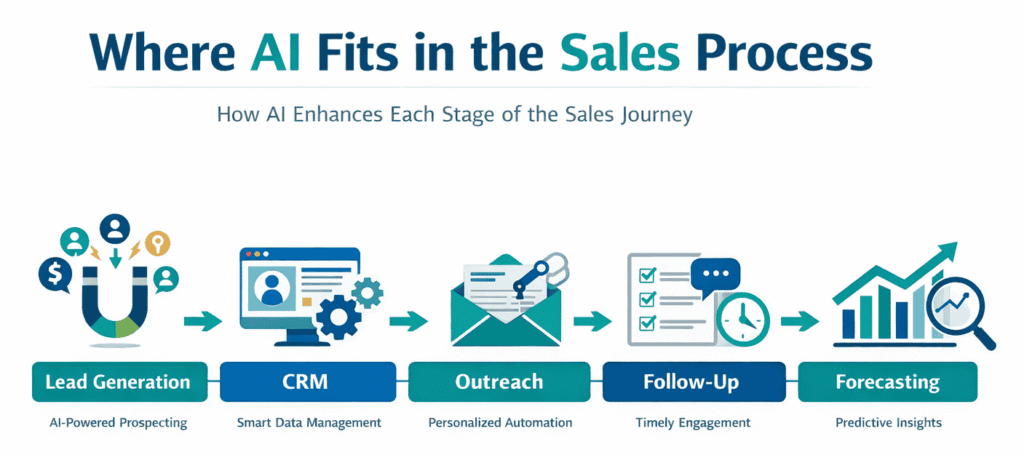
AI is not limited to one part of the sales process. It supports multiple stages—from finding leads to closing deals and analyzing performance.
Instead of replacing sales teams, AI enhances their efficiency by handling repetitive tasks and providing data-driven insights.
In most small business sales workflows, AI is commonly used for:
- Finding and generating high-quality leads
- Scoring and prioritizing prospects
- Automating outreach and follow-ups
- Personalizing communication at scale
- Tracking customer behavior
- Forecasting sales trends
Each of these areas plays a critical role in improving conversions and reducing manual effort.
In the next sections, we’ll break down exactly how AI is transforming each part of the sales process with practical examples.
1. AI-Powered Lead Generation
One of the biggest ways AI is transforming sales is through smarter, faster lead generation.
For small businesses, finding the right prospects is often the most time-consuming part of the sales process. Traditional methods rely on manual research, guesswork, and inconsistent data—leading to low-quality leads and wasted effort.
AI changes this completely by turning lead generation into a data-driven, automated process.
How AI Improves Lead Generation
AI tools analyze large amounts of data to identify and target the right prospects more accurately.
They can:
- Analyze customer data to understand patterns and buying behavior
- Identify your ideal customer profile (ICP) based on real data
- Find lookalike prospects similar to your best customers
- Enrich contact information automatically (emails, roles, company data)
- Continuously update and refine lead lists
Instead of manually searching through databases or directories, AI helps you build high-quality, targeted prospect lists in minutes.
What This Means for Small Businesses
This shift has a direct impact on efficiency and results.
With AI-powered lead generation, you can:
- Spend less time on research and more time on selling
- Reduce dependency on large marketing budgets
- Target the right audience from the start
- Improve lead quality and conversion rates
Even small teams can now access insights and data that were previously available only to larger companies.
Simple Example
Imagine you run a small B2B service.
Without AI:
- You manually search for companies
- Guess who might be interested
- Spend hours building a list
With AI:
- The tool identifies companies similar to your best customers
- Filters decision-makers automatically
- Provides verified contact details
👉 You get a ready-to-use, high-quality lead list within minutes
Why This Matters
Lead generation is the foundation of your sales process. If your leads are not relevant, even the best outreach strategy won’t work.
AI helps you start with better data, better targeting, and better opportunities.
Key Takeaway
AI-powered lead generation removes guesswork and replaces it with precision.
For small businesses, this means:
- Higher-quality leads
- Faster prospecting
- Better use of time and resources
👉 The result is a more efficient and scalable sales process without increasing costs
👉 If you’re just getting started, check out our complete guide on Best AI lead generation tools for small businesses to find high-quality prospects faster.
2. AI-Based Lead Scoring
Not all leads are equal—and treating them the same is one of the biggest reasons small businesses struggle with conversions.
AI-based lead scoring helps you identify which prospects are most likely to convert, so you can focus your time and effort where it matters most.
Instead of relying on guesswork, AI uses real data to rank and prioritize leads automatically.
How AI Improves Lead Scoring
AI analyzes multiple data points to determine the quality and intent of each lead.
It can:
- Analyze user behavior such as website visits, email engagement, and interactions
- Evaluate demographic data like job role, company size, and industry
- Assign scores based on engagement level and buying signals
- Continuously update scores as new data comes in
- Identify patterns from past conversions to improve accuracy
This ensures your sales team focuses on leads that are more likely to take action.
What This Means for Small Businesses
For small teams, time is limited—and chasing the wrong leads wastes valuable resources.
AI-powered lead scoring helps you:
- Prioritize high-intent leads automatically
- Reduce time spent on low-quality prospects
- Improve conversion rates with better targeting
- Align sales efforts with real customer interest
👉 You spend less time guessing and more time closing deals
Simple Example
Imagine you have 50 leads in your pipeline.
Without AI:
- All leads are treated equally
- You manually decide who to contact first
- High-quality leads may be missed or delayed
With AI:
- Leads are scored based on behavior and profile
- High-intent prospects are prioritized automatically
- Your team focuses on the most valuable opportunities
👉 You increase efficiency and improve conversion chances
Why This Matters
One of the biggest challenges in sales is knowing where to focus.
AI solves this by:
- Highlighting the most promising leads
- Reducing wasted effort
- Improving decision-making
This leads to a more efficient and results-driven sales process
From Guesswork to Data-Driven Prioritization
Traditional approach:
- Follow up based on intuition
- Treat most leads the same
AI-driven approach:
- Rank leads based on real data
- Focus on those most likely to convert
- Continuously improve scoring accuracy
👉 This creates a smarter and more predictable sales workflow
Key Takeaway
AI-based lead scoring helps small businesses prioritize the right opportunities.
It allows you to:
- Focus on high-value leads
- Improve efficiency and conversions
- Make better decisions using data
👉 The result is a more targeted and scalable sales process without increasing effort
👉 Want to prioritize high-converting leads? Read our guide on AI lead scoring tools and how they work.
3. AI-Powered Sales Outreach Automation
Sales automation has evolved far beyond basic workflows and scheduled emails.
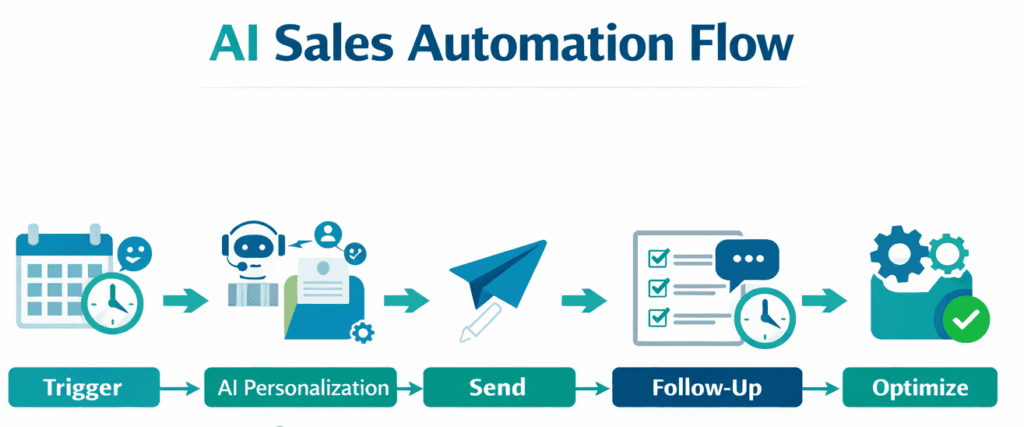
Today, AI-powered sales automation helps small businesses scale outreach, personalize communication, and respond to leads at the right time—without increasing workload.
Instead of manually managing every step, AI handles repetitive tasks while optimizing them for better results.
How AI Improves Sales Automation
Modern AI tools don’t just automate—they continuously learn and improve performance based on data.
They can:
- Send personalized cold emails at scale based on lead data
- Adjust follow-up timing based on user engagement (opens, clicks, replies)
- Optimize subject lines and email content using performance insights
- Segment audiences dynamically based on behavior and profile
- Trigger workflows automatically when users take specific actions
This ensures your outreach is not just automated, but also relevant and timely.
What This Means for Small Businesses
For small teams, managing outreach manually limits growth.
AI-powered automation allows you to:
- Reach more prospects without hiring additional sales reps
- Maintain consistency in follow-ups
- Reduce manual effort and repetitive tasks
- Improve response rates with smarter timing and personalization
👉 You can scale your outreach while keeping your process efficient and manageable.
Simple Example
Imagine you want to reach 100 potential leads.
Without AI:
- You write and send emails manually
- Follow-ups are inconsistent or delayed
- Personalization is limited
With AI:
- Emails are automatically personalized for each lead
- Follow-ups are triggered based on engagement
- The system adjusts timing for better response rates
👉 You achieve higher outreach efficiency with less effort
Why Strategy Still Matters
While AI makes automation powerful, it should not be used blindly.
Over-automation can lead to:
- Generic messaging
- Lower engagement
- Reduced trust
👉 The key is to combine automation with thoughtful messaging and clear targeting
Key Takeaway
AI-powered sales automation helps small businesses scale outreach without increasing resources.
It allows you to:
- Automate repetitive tasks
- Improve timing and personalization
- Maintain consistent communication
👉 When used strategically, it becomes a powerful way to grow your sales pipeline efficiently
👉 To explore tools that can automate and personalize your outreach, read our detailed comparison of Top AI cold email tools for sales automation.
4. AI-Powered Email Personalization
Today’s buyers don’t respond well to generic messages—they expect communication that feels relevant and tailored to their needs.
AI makes this possible by helping small businesses deliver personalized customer engagement at scale, without spending hours manually customizing every interaction.
Instead of sending the same message to everyone, AI allows you to adapt your communication based on real customer behavior and preferences.
How AI Enables Personalization
AI analyzes customer data from multiple touchpoints to understand what each lead is interested in.
It can:
- Customize email content based on user behavior (pages visited, actions taken)
- Recommend products or services intelligently based on past interactions
- Personalize offers and messaging for different audience segments
- Analyze customer sentiment from responses and interactions
- Adjust communication timing based on engagement patterns
This ensures every interaction feels relevant, timely, and valuable.
What This Means for Small Businesses
Personalization used to require significant time and effort—but AI makes it scalable.
With AI-powered engagement, you can:
- Build stronger relationships with prospects and customers
- Increase email open and response rates
- Deliver more relevant offers without manual work
- Improve customer experience across the sales journey
👉 Even with a small team, you can create experiences that feel highly personalized and professional
Simple Example
Imagine a potential customer visits your pricing page and downloads a guide.
Without AI:
- You send a generic follow-up email
- The message may not match their interest
With AI:
- The system tracks their behavior
- Sends a follow-up email tailored to the pricing page
- Recommends relevant solutions or offers
👉 The message feels more relevant, increasing the chances of a response
Why This Matters
Personalized communication directly impacts trust and engagement.
When customers feel understood:
- They are more likely to respond
- They engage more with your content
- They move faster through the sales process
AI helps you deliver the right message to the right person at the right time
Key Takeaway
AI-powered personalization transforms how small businesses connect with their audience.
It allows you to:
- Move beyond generic outreach
- Deliver meaningful, targeted communication
- Build trust and improve conversions
👉 The result is stronger engagement and better sales outcomes without increasing effort
How AI improves subject lines and inbox placement — especially when combined with proper authentication setup like SPF, DKIM, and DMARC guide here.
5. AI for Customer Behavior Tracking
Understanding how your prospects interact with your business is key to improving conversions—and this is where AI makes a major difference.
AI-powered customer behavior tracking helps small businesses monitor, analyze, and act on user activity in real time, turning raw data into actionable insights.
Instead of guessing what a lead is interested in, you can clearly see what they do, when they engage, and how ready they are to buy.
How AI Tracks Customer Behavior
AI tools collect and analyze data from multiple touchpoints across your sales and marketing channels.
They can track:
- Website visits and page interactions (e.g., pricing, product pages)
- Email opens, clicks, and response patterns
- Content downloads and engagement levels
- Time spent on specific pages or actions taken
- Repeated visits or returning users
This data is continuously analyzed to identify patterns and intent signals.
What This Means for Small Businesses
For small teams, it’s difficult to manually track every customer interaction.
AI simplifies this by helping you:
- Identify high-intent leads based on behavior
- Understand what your prospects are interested in
- Time your outreach more effectively
- Personalize communication based on real actions
👉 You no longer rely on assumptions—you act on real user behavior
Simple Example
Imagine a visitor comes to your website multiple times and checks your pricing page.
Without AI:
- You may not notice this behavior
- No follow-up is triggered
With AI:
- The system tracks repeated visits
- Flags the lead as high intent
- Triggers a follow-up email or alert
👉 You engage at the right moment, increasing conversion chances
Why This Matters
Customer behavior is one of the strongest indicators of buying intent.
AI helps you:
- Focus on leads that are actively interested
- Avoid wasting time on low-engagement prospects
- Improve timing and relevance of your outreach
This leads to higher engagement and better results.
Key Takeaway
AI-powered behavior tracking turns user activity into actionable insights.
For small businesses, this means:
- Better understanding of prospects
- Smarter follow-ups
- Higher conversion potential
👉 You move from guessing to data-driven engagement
6. AI Chatbots for Lead Qualification
Another powerful way AI is transforming sales is through intelligent chatbots that engage and qualify leads automatically.
Instead of waiting for manual responses, AI chatbots interact with visitors instantly, helping you capture and qualify leads 24/7.
How AI Chatbots Improve Lead Qualification
AI chatbots are designed to simulate human-like conversations and guide users through the initial stages of the sales process.
They can:
- Ask qualifying questions based on user responses
- Collect contact information automatically
- Recommend products or services based on needs
- Route high-quality leads directly to sales teams
- Handle common queries instantly
This ensures that every visitor is engaged without delay.
What This Means for Small Businesses
For small teams, responding to every inquiry in real time is difficult.
AI chatbots help you:
- Capture leads even outside business hours
- Reduce response time to zero
- Pre-qualify leads before human interaction
- Save time on repetitive conversations
👉 You never miss an opportunity due to delayed responses
Simple Example
A visitor lands on your website and has a question.
Without AI:
- They may leave if no one responds
- You lose a potential lead
With AI:
- A chatbot engages instantly
- Asks a few questions
- Captures contact details
- Routes the lead based on interest
👉 You convert more visitors into qualified leads
Why This Matters
Speed and responsiveness are critical in sales.
AI chatbots help you:
- Engage visitors instantly
- Improve user experience
- Increase lead capture rates
This gives small businesses a significant advantage.
Key Takeaway
AI chatbots automate the first step of your sales process—engagement and qualification.
They allow you to:
- Capture more leads
- Qualify prospects efficiently
- Improve response speed
👉 The result is a more efficient and scalable sales funnel
7. AI for Sales Forecasting
Sales is no longer just about reacting to leads—it’s about anticipating what will happen next.
AI-powered predictive analytics helps small businesses move from guesswork to data-driven forecasting and proactive decision-making.
Instead of relying on assumptions, AI analyzes historical and real-time data to identify patterns that influence sales outcomes.
How AI Uses Data to Predict Sales Outcomes
AI tools process large amounts of data across your sales activities to uncover trends and insights.
They analyze patterns in:
- Buying cycles and customer journey timelines
- Customer behavior across different touchpoints
- Deal progression and pipeline movement
- Seasonal trends and market fluctuations
By identifying these patterns, AI can predict what is likely to happen next in your sales pipeline.
What This Means for Small Businesses
Predictive analytics gives small teams the ability to make smarter decisions without needing complex analysis.
With AI, you can:
- Forecast revenue more accurately
- Allocate time and resources more efficiently
- Identify high-value prospects early in the process
- Detect potential churn or lost deals before it happens
👉 This helps you stay ahead instead of reacting too late
Simple Example
Imagine you’re tracking multiple deals in your pipeline.
Without AI:
- You estimate which deals will close
- Forecasting is based on assumptions
- Missed risks lead to lost opportunities
With AI:
- The system analyzes past deal patterns
- Predicts which deals are likely to close
- Alerts you about deals at risk
- Provides realistic revenue forecasts
👉 You make decisions based on data, not guesswork
Why This Matters
One of the biggest challenges for small businesses is uncertainty.
AI reduces this by giving you:
- Clear visibility into future performance
- Early warning signals for potential issues
- Confidence in planning and strategy
This leads to more consistent and predictable growth.
From Reactive to Proactive Sales
Traditional sales is reactive:
- Follow up after problems appear
- Adjust strategy after results drop
AI-driven sales is proactive:
- Identify opportunities early
- Act before problems occur
- Optimize strategy continuously
👉 This shift is a major competitive advantage
Key Takeaway
AI-powered predictive analytics helps small businesses make smarter, forward-looking decisions.
It allows you to:
- Anticipate trends
- Reduce risk
- Improve planning and performance
👉 The result is a more strategic, efficient, and scalable sales process
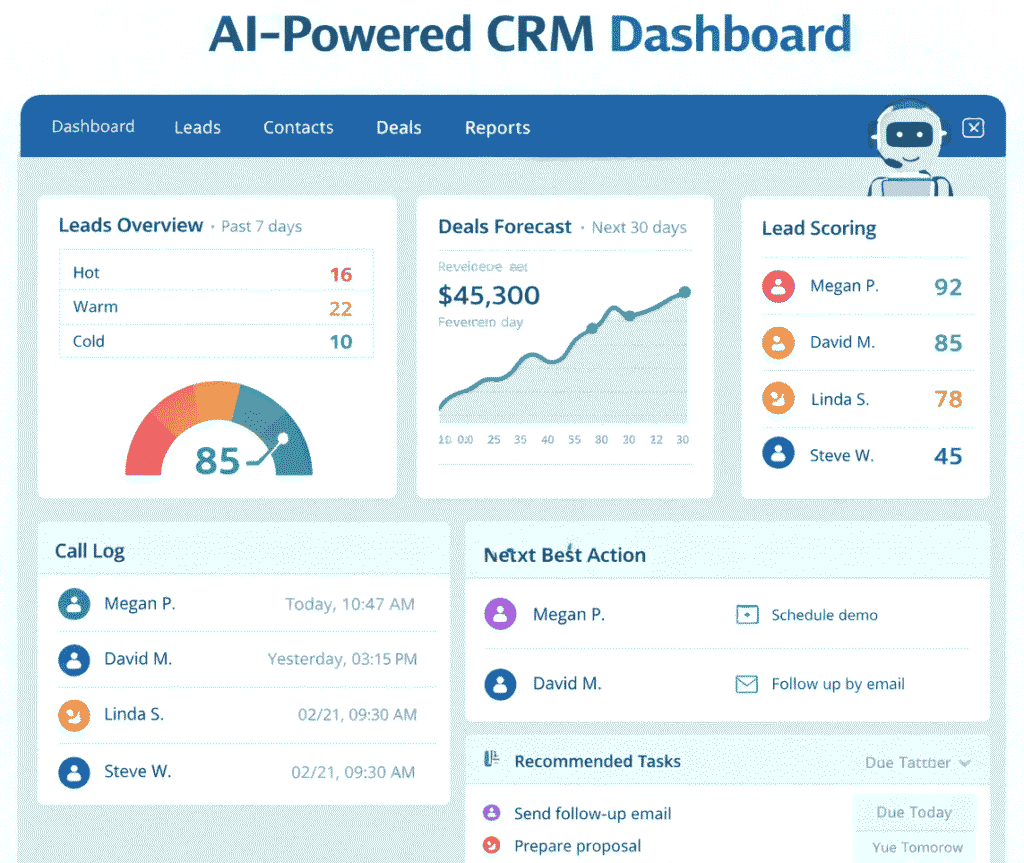
8. AI-Powered CRM & Pipeline Management
Traditional CRM systems are designed to store customer data—but on their own, they don’t tell you what to do next.
AI-powered CRM systems go a step further by analyzing data, identifying patterns, and guiding your sales decisions in real time.
Instead of acting as a static database, your CRM becomes an active sales assistant that helps you prioritize, follow up, and close deals more efficiently.
How AI Enhances CRM Systems
Modern AI CRM tools use data from your pipeline, interactions, and customer behavior to provide actionable insights.
They can:
- Predict which leads are most likely to convert based on past patterns
- Recommend the next best action (follow-up, call, email, demo)
- Automate follow-ups to avoid missed opportunities
- Detect deal risks, such as inactivity or low engagement
- Provide accurate sales forecasting insights
This transforms your CRM into a decision-making system, not just a storage tool.
What This Means for Small Businesses
For small teams, managing multiple leads and deals manually can quickly become overwhelming.
AI-powered CRM systems help you:
- Stay organized without constant manual updates
- Focus on high-priority deals
- Reduce the chances of missing follow-ups
- Make faster, data-driven decisions
👉 Instead of tracking everything yourself, the system highlights what actually matters.
Simple Example
Imagine you have 20 active leads in your pipeline.
Without AI:
- You manually track each lead
- Decide who to follow up with
- Risk missing important opportunities
With AI:
- The CRM identifies the top 5 leads most likely to convert
- Suggests immediate follow-ups
- Alerts you about deals that are going cold
👉 You focus your time where it has the highest impact
Why This Matters
As your business grows, managing your sales pipeline becomes more complex.
AI ensures that:
- No lead is ignored
- No opportunity is missed
- Every action is based on real data
This leads to a more consistent and scalable sales process.
Key Takeaway
AI-powered CRM systems turn your sales data into actionable insights.
For small businesses, this means:
- Better pipeline visibility
- Smarter decision-making
- Higher conversion efficiency
👉 Your CRM evolves from a simple tool into a powerful growth engine
👉 For a deeper understanding, explore our breakdown of AI-powered CRM tools for small business sales teams.
If you’re exploring HubSpot CRM but want to understand the basics first, check out our beginner-friendly guide to CRM systems.
9. AI-Powered Email Deliverability & Optimization
Getting emails delivered is just as important as writing them.
Even the best outreach strategy fails if your emails don’t reach the inbox. This is where AI helps small businesses improve email deliverability and campaign performance with data-driven optimization.
Instead of relying on trial and error, AI continuously analyzes what works—and adjusts your email strategy for better results.
How AI Improves Email Deliverability
AI tools monitor multiple factors that affect whether your emails land in the inbox or spam folder.
They can:
- Optimize subject lines based on performance data
- Determine the best send timing for higher open rates
- Adjust email frequency to avoid over-sending
- Detect spam trigger words and risky patterns
- Analyze engagement signals to improve sender reputation
This ensures your emails are not just sent—but successfully delivered and opened.
What This Means for Small Businesses
For small teams relying on cold email or outbound campaigns, deliverability is critical.
AI-powered optimization helps you:
- Increase inbox placement rates
- Improve open and response rates
- Avoid spam filters and domain issues
- Maintain a healthy sender reputation
👉 You get more results from the same outreach effort
Simple Example
Imagine you send 100 cold emails.
Without AI:
- Some emails land in spam
- Timing may be ineffective
- Subject lines may not perform well
With AI:
- Emails are sent at optimal times
- Subject lines are optimized for opens
- Spam risks are minimized
- Engagement is tracked and improved
👉 More emails reach inboxes, leading to better engagement
Why This Matters
Email deliverability directly impacts your sales performance.
If your emails don’t reach the inbox:
- Your message is never seen
- Your effort is wasted
- Your conversion potential drops
AI ensures your outreach is effective from the first step—delivery
From Sending Emails to Optimizing Performance
Traditional approach:
- Send emails and hope for results
AI-driven approach:
- Test, analyze, and optimize continuously
- Improve performance with every campaign
👉 This creates a more reliable and scalable outreach system
Key Takeaway
AI-powered email optimization helps small businesses maximize the impact of their outreach.
It allows you to:
- Improve deliverability
- Increase engagement
- Protect your sender reputation
👉 The result is better performance without increasing effort
Strong lead generation also depends on email deliverability. To make sure your campaigns reach the inbox instead of spam, read our Cold Email Deliverability Guide (2026): How to Avoid Spam & Land in the Inbox.
Key Areas Where AI Improves Sales
Before we look at the overall benefits, let’s quickly summarize where AI makes the biggest impact in the sales process.
AI is not limited to one function—it improves multiple stages of the sales workflow, helping small businesses operate more efficiently and strategically.
Here are the key areas where AI delivers the most value:
- Lead generation – finding high-quality prospects faster
- Lead scoring – prioritizing the most valuable opportunities
- Sales automation – scaling outreach without manual effort
- Personalization – delivering relevant communication at the right time
- Customer behavior tracking – understanding intent and engagement
- Chatbots and qualification – capturing and filtering leads instantly
- Predictive analytics – forecasting trends and improving decisions
- CRM optimization – managing pipelines with better insights
- Email deliverability – improving inbox placement and performance
👉 Together, these capabilities transform sales from a manual process into a data-driven, scalable system
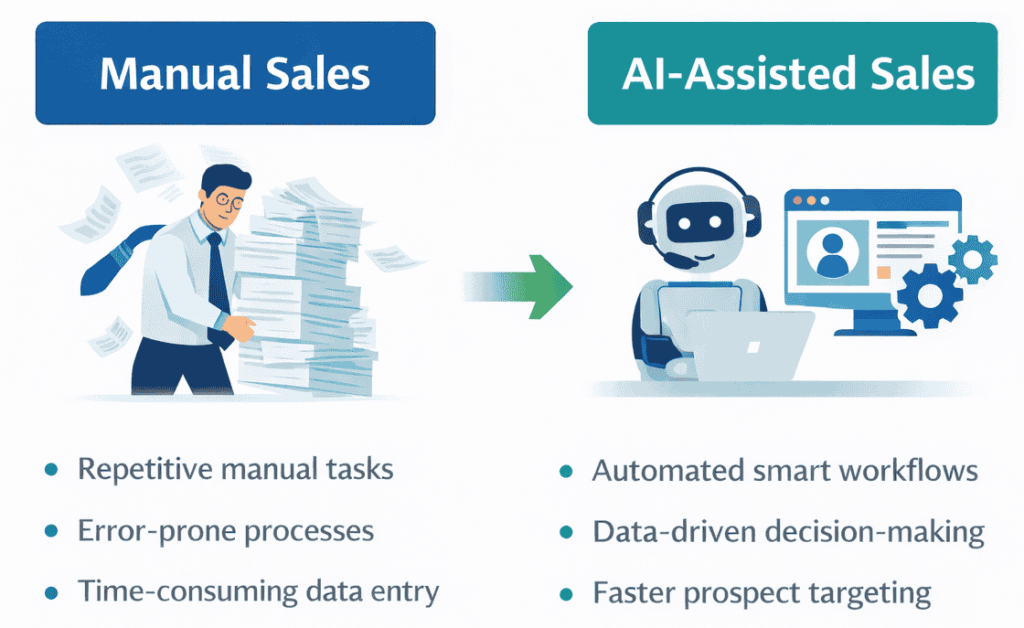
🔄 AI Sales vs Traditional Sales
Understanding the difference between traditional sales and AI-powered sales helps you see why AI is becoming essential—not optional.
While traditional sales methods rely heavily on manual effort and intuition, AI-driven sales focuses on automation, data, and efficiency.
Here’s a clear comparison:
| Traditional Sales | AI-Powered Sales |
|---|---|
| Manual lead research | Automated lead generation using data |
| Guesswork-based decisions | Data-driven insights and predictions |
| Slow and inconsistent follow-ups | Automated and timely follow-ups |
| Generic messaging | Personalized communication at scale |
| Limited tracking of customer behavior | Real-time behavior tracking and insights |
| Reactive approach | Proactive and predictive strategy |
| Time-consuming processes | Efficient and scalable workflows |
| Inconsistent performance | Optimized and consistent results |
What This Means in Real Scenarios
In traditional sales:
- You spend hours finding leads manually
- Follow-ups depend on memory or manual tracking
- Messaging is often broad and less targeted
In AI-powered sales:
- Leads are identified automatically based on your ideal customer profile
- Follow-ups are triggered based on real user behavior
- Messaging is personalized and optimized continuously
👉 This shift allows small businesses to work smarter instead of harder
Why This Shift Matters for Small Businesses
Small businesses often face:
- Limited time
- Smaller teams
- High competition
AI helps overcome these challenges by:
- Reducing manual workload
- Improving efficiency
- Increasing conversion opportunities
👉 It allows small teams to perform at a level similar to larger organizations
Key Insight
The biggest difference is not just automation—it’s intelligence.
- Traditional sales = effort-driven
- AI-powered sales = data-driven + optimized
👉 This is what creates a competitive advantage
Key Takeaway
AI is not replacing traditional sales—it’s enhancing and evolving it.
Businesses that combine:
- Human strategy
- AI-powered execution
👉 Will achieve faster, more scalable, and more predictable results
📊 Real-Life Example: How a Small Business Uses AI in Sales
Understanding concepts is useful—but seeing how they work in a real scenario makes it practical.
Let’s look at how a small business can use AI to improve its sales process step by step.
Scenario: Small B2B Service Business
Imagine you run a small B2B service business (for example, a marketing agency or SaaS support service).
Your challenges:
- Low-quality leads
- Inconsistent follow-ups
- Time spent on manual outreach
- Difficulty tracking which leads are actually interested
Step 1: Lead Generation with AI
Instead of manually searching for prospects, you use an AI-powered tool to:
- Identify companies that match your ideal customer profile
- Find decision-makers automatically
- Build a targeted lead list
👉 Result: You get high-quality leads faster with less effort
Step 2: Lead Scoring and Prioritization
Once leads are generated, AI helps rank them based on behavior and profile.
- Website visits and engagement are tracked
- High-intent leads are assigned higher scores
- Low-quality leads are filtered out
👉 Result: You focus only on leads that are more likely to convert
Step 3: Outreach Automation and Personalization
Next, you set up AI-powered outreach campaigns.
- Emails are personalized based on user data
- Follow-ups are automated based on engagement
- Messaging is optimized over time
👉 Result: You maintain consistent communication without manual effort
Step 4: Behavior Tracking and Engagement
As leads interact with your emails and website:
- AI tracks their activity (clicks, visits, responses)
- Identifies buying intent signals
- Triggers timely follow-ups
👉 Result: You reach out at the right moment, increasing response rates
Step 5: CRM and Pipeline Optimization
All lead data is managed inside an AI-powered CRM.
- Deals are tracked automatically
- AI suggests next actions
- Alerts are triggered for high-priority leads
👉 Result: Your pipeline becomes organized and easier to manage
Step 6: Predictive Insights and Optimization
Over time, AI analyzes performance data.
- Identifies what type of leads convert best
- Suggests improvements in outreach strategy
- Predicts which deals are likely to close
👉 Result: Your sales process becomes smarter and more efficient
Final Outcome
By combining these steps, the business:
- Generates better leads
- Saves time on manual tasks
- Improves follow-up consistency
- Increases conversion rates
👉 What once required a full sales team can now be handled by a small, AI-powered workflow
Key Takeaway
AI doesn’t replace your sales process—it enhances every stage of it.
👉 The real value comes from connecting all these steps into a single, optimized system
Benefits of AI in Sales for Small Businesses
Adopting AI in sales is not just about using new tools—it’s about improving how your entire sales process works.
For small businesses, the impact is even more significant because AI helps overcome common limitations like limited time, smaller teams, and restricted budgets.
Here are the key benefits of using AI in sales:
Increased Efficiency and Time Savings
AI automates repetitive and time-consuming tasks such as:
- Lead research
- Data entry
- Follow-up emails
- Tracking customer interactions
This allows your team to focus on high-value activities like selling and relationship building.
👉 Instead of doing more work, you start doing the right work
🟢Better Lead Quality and Targeting
AI helps you identify and prioritize leads based on real data.
- Filters out low-quality prospects
- Highlights high-intent leads
- Improves targeting accuracy
👉 This leads to higher conversion rates and less wasted effort
👉 One of the most popular tools for lead generation and outreach is Apollo.io—read our complete Apollo.io review to see how it works for small businesses.
🟢Improved Personalization at Scale
Personalized communication increases engagement—but doing it manually is difficult.
AI makes it possible to:
- Tailor messages based on behavior
- Send relevant offers to different segments
- Customize outreach without extra effort
👉 You create better customer experiences without increasing workload
🟢Faster Response and Engagement
Speed plays a crucial role in sales.
AI enables:
- Instant responses through chatbots
- Automated follow-ups
- Timely outreach based on user behavior
👉 Faster engagement increases the chances of converting leads
👉 If you’re focused on automation, check our detailed Reply.io review for AI-powered sales engagement and outreach workflows.
🟢Data-Driven Decision Making
AI replaces guesswork with insights.
It helps you:
- Understand what works and what doesn’t
- Track performance accurately
- Make informed decisions
👉 This leads to more consistent and predictable results
🟢Scalable Sales Process
One of the biggest advantages of AI is scalability.
With AI, you can:
- Handle more leads without hiring more staff
- Expand outreach without increasing workload
- Maintain consistency across processes
👉 Your sales system grows with your business
🟢Improved Conversion Rates
When you combine:
- Better targeting
- Personalized outreach
- Timely follow-ups
👉 The result is higher conversions.
AI ensures every part of your sales process is optimized for better outcomes.
🟢Reduced Costs and Better ROI
Hiring and managing a large sales team can be expensive.
AI helps you:
- Reduce operational costs
- Minimize wasted effort
- Maximize results from existing resources
👉 You achieve better ROI without increasing spending
🟢Competitive Advantage
AI levels the playing field for small businesses.
You can:
- Compete with larger companies
- Respond faster to opportunities
- Deliver better customer experiences
👉 This gives you an edge in a competitive market
🟢More Consistent Sales Performance
Manual processes often lead to inconsistent results.
AI brings:
- Standardization
- Automation
- Continuous optimization
👉 This leads to more reliable and predictable sales outcomes
Key Takeaway
AI in sales is not just a trend—it’s a practical way for small businesses to improve efficiency, increase conversions, and scale operations.
By integrating AI into your sales process, you can:
- Work smarter
- Focus on the right opportunities
- Grow your business more effectively
👉 The result is a faster, more efficient, and data-driven sales system
Challenges Small Businesses Should Consider When Using AI in Sales
While AI offers powerful advantages, adopting it without a clear strategy can lead to poor results or wasted effort.
For small businesses, the goal is not to use more tools—but to use the right systems in the right way.
Understanding the common challenges early helps you avoid mistakes and build a more effective, scalable sales process.
Where Most Small Businesses Go Wrong
AI is often misunderstood as a quick solution. In reality, it works best when combined with strong fundamentals.
Here are the most common challenges to watch out for:
🟠Automating Before Validating Messaging
Many businesses jump into automation before testing what actually works.
- Unproven messaging gets scaled
- Campaigns fail faster at a larger scale
- Response rates drop
👉 Always validate your messaging manually before automating it
🟠Using Too Many Tools at Once
It’s easy to get overwhelmed with multiple AI tools.
- Tools don’t integrate properly
- Workflows become complex
- Time is wasted managing systems
👉 Start with a few essential tools and expand only when needed
🟠Ignoring Email Deliverability Setup
One of the most critical yet overlooked areas is deliverability.
- Emails may land in spam
- Domain reputation can be damaged
- Campaign performance drops
👉 Proper email setup and warm-up are essential before scaling outreach
🟠Over-Relying on Automation
Automation is powerful—but too much of it can hurt engagement.
- Messages feel generic
- Conversations lose human touch
- Trust decreases
👉 Use AI to support communication, not replace it completely
🟠Not Training Team Members Properly
AI tools are only as effective as the people using them.
- Teams may misuse features
- Opportunities are missed
- Tools are underutilized
👉 Invest time in training and understanding how each tool works
What This Means for Small Businesses
AI can amplify both strengths and weaknesses.
- If your process is strong → AI improves results
- If your process is weak → AI scales inefficiencies
👉 This is why strategy matters more than tools
How to Approach AI the Right Way
To get the best results from AI in sales:
- Start simple and build gradually
- Focus on one area (e.g., lead generation or outreach)
- Test and optimize before scaling
- Combine automation with human interaction
- Continuously monitor and improve performance
👉 Treat AI as a system you refine over time—not a one-time setup
Key Takeaway
AI is a powerful multiplier—but it is not a replacement for sales fundamentals.
Small businesses that succeed with AI:
- Use it strategically
- Focus on quality over quantity
- Combine data with human judgment
👉 When used correctly, AI enhances your process instead of complicating it
How Small Businesses Can Start Using AI in Sales
Getting started with AI in sales doesn’t require a complex setup or multiple tools. The key is to start simple, focus on fundamentals, and scale gradually.
Many small businesses fail with AI because they try to do too much too quickly. Instead, the goal should be to build a clear, step-by-step system that improves over time.
Step 1: Define Your Ideal Customer Profile (ICP)
Before using any AI tool, you need clarity on who you’re targeting.
Identify:
- Industry and company size
- Job roles (decision-makers)
- Common pain points
- Buying behavior
👉 AI works best when it has clear input data. A well-defined ICP ensures better targeting, scoring, and personalization.
Step 2: Start with One AI Tool (Keep It Simple)
Avoid the common mistake of stacking multiple tools at once.
Instead:
- Choose one tool based on your immediate need (lead generation, outreach, or CRM)
- Learn how it works fully
- Build your workflow around it
👉 This reduces confusion and helps you get real results faster
Step 3: Test Automation in Small Batches
Don’t automate everything from day one.
Start by:
- Running small outreach campaigns
- Testing different messages
- Monitoring engagement
👉 This allows you to identify what works before scaling
Step 4: Validate and Refine Your Messaging
Your messaging matters more than the tool itself.
Focus on:
- Clear value proposition
- Personalized communication
- Relevance to the audience
👉 If your messaging doesn’t work manually, automation will only scale poor results
Step 5: Monitor Key Performance Metrics
AI tools provide valuable data—but you need to track the right metrics.
Focus on:
- Open rates
- Response rates
- Conversion rates
- Lead quality
👉 These insights help you understand what’s working and what needs improvement
Step 6: Optimize and Scale Gradually
Once you find what works:
- Increase outreach volume
- Expand campaigns
- Add automation layers
- Integrate additional tools if needed
👉 Scaling should always come after optimization, not before
Step 7: Combine AI with Human Strategy
AI is powerful, but human judgment is still essential.
- Use AI for data and automation
- Use human input for strategy and relationships
👉 The best results come from combining technology with thoughtful execution
Common Beginner Mistake to Avoid
Many small businesses:
- Start with too many tools
- Skip testing
- Automate too early
👉 The better approach is:
Start small → test → refine → scale
Key Takeaway
Starting with AI in sales is not about complexity—it’s about clarity and consistency.
If you:
- Focus on the right audience
- Use tools strategically
- Improve step by step
👉 You can build a scalable and efficient sales system without overwhelming your workflow
Start simple. Scale smart.
🛠️ Recommended AI Sales Tools for Small Businesses
Choosing the right tools is what turns AI from a concept into a working sales system.
Instead of using multiple tools at once, small businesses should focus on a few high-impact tools that cover the core sales workflow—lead generation, outreach, and CRM management.
Below are some of the most effective categories of AI sales tools and how they help you get results.
AI Tools for Lead Generation
These tools help you find and build targeted prospect lists based on your ideal customer profile.
They can:
- Identify decision-makers automatically
- Provide verified contact data
- Enrich lead information with company insights
👉 Best for: Businesses struggling to find high-quality leads consistently
👉 Not sure which tool to choose? See our full comparison of Apollo.io vs Reply.io to find the best fit for your sales strategy.
AI Tools for Sales Outreach & Automation
These tools help you scale your outreach without losing personalization.
They can:
- Send personalized cold emails at scale
- Automate follow-ups based on engagement
- Optimize subject lines and messaging
👉 Best for: Businesses looking to increase response rates and scale outreach
👉 Check our comparison of top AI cold email tools for outreach automation
AI Tools for Lead Scoring & Analytics
These tools help you prioritize leads and make smarter decisions.
They can:
- Score leads based on behavior and intent
- Identify high-converting prospects
- Provide performance insights
👉 Best for: Businesses that want to focus on leads most likely to convert
👉 Learn more in our guide on AI lead scoring tools and strategies
📊 AI CRM & Pipeline Management Tools
These tools help you manage your entire sales pipeline with data-driven insights.
They can:
- Track deals and interactions automatically
- Suggest next actions
- Forecast sales outcomes
👉 Best for: Businesses managing multiple leads and deals
👉 Explore our review of AI-powered CRM tools for small businesses
AI Tools for Email Deliverability & Optimization
These tools ensure your emails actually reach the inbox and perform well.
They can:
- Monitor deliverability and sender reputation
- Optimize email timing and frequency
- Detect spam risks
👉 Best for: Businesses running cold email or outbound campaigns
👉 Read our guide on improving email deliverability with AI tools
How to Choose the Right Tool
Don’t choose tools based on features—choose based on your current need.
- If you lack leads → Start with lead generation tools
- If outreach is slow → Use automation tools
- If conversions are low → Focus on lead scoring
- If processes are messy → Use CRM tools
👉 Start with one tool, master it, then expand
Key Takeaway
AI tools are most effective when used as part of a simple, focused system—not a complex stack.
For small businesses:
- Start small
- Choose tools based on need
- Optimize before scaling
👉 The right tools can significantly improve your sales efficiency and results
The Future of AI in Small Business Sales
AI in sales is not just a short-term trend—it’s rapidly becoming a core part of how modern businesses operate and grow.
As technology continues to evolve, small businesses will gain access to even more powerful capabilities that were once limited to large enterprises.
The future of AI in sales is focused on making processes more intelligent, more personalized, and more automated—without increasing complexity for users.
What’s Changing in the Future of AI Sales
AI is moving beyond basic automation and entering a phase of intelligent decision-making and real-time optimization.
Here’s what small businesses can expect:
✳️Deeper Personalization at Scale
AI will go beyond basic customization and deliver highly tailored experiences.
- Messages will adapt based on real-time behavior
- Offers will be personalized to individual needs
- Customer journeys will feel more relevant and seamless
👉 Every interaction will feel more human, even when automated
✳️More Advanced Predictive Intelligence
AI will become better at forecasting outcomes and identifying opportunities.
- More accurate sales predictions
- Early identification of high-value leads
- Smarter recommendations for next actions
👉 Decision-making will become faster and more reliable
✳️Smarter CRM and Workflow Automation
CRM systems will evolve into fully intelligent platforms.
- Automated pipeline management
- Real-time deal insights
- Intelligent reminders and task prioritization
👉 Sales teams will spend less time managing data and more time closing deals
✳️AI-Generated Outreach and Content
AI will play a bigger role in creating sales communication.
- Automated email generation based on context
- Personalized follow-ups without manual input
- Continuous optimization of messaging
👉 Outreach becomes faster, smarter, and more effective
✳️Voice AI and Conversational Assistants
Voice-based AI is becoming more advanced and accessible.
- AI assistants handling calls and queries
- Real-time conversation analysis
- Improved customer interaction experiences
👉 Businesses can provide faster and more interactive support
✳️Fully Automated Lead Nurturing
AI will manage long-term engagement with leads.
- Automated email sequences based on behavior
- Dynamic content delivery
- Continuous engagement without manual effort
👉 Leads are nurtured consistently until they are ready to convert
What This Means for Small Businesses
The future of sales will favor businesses that can adapt quickly and use AI strategically.
Small businesses that embrace AI will be able to:
- Compete with larger companies
- Scale operations efficiently
- Deliver better customer experiences
- Make smarter, data-driven decisions
On the other hand, businesses that delay adoption may face:
- Slower processes
- Lower efficiency
- Reduced competitiveness
How to Stay Ahead
You don’t need to adopt everything at once.
Instead:
- Start with simple AI use cases
- Focus on areas with immediate impact
- Continuously learn and adapt
👉 The goal is to evolve with the technology—not chase it
Key Takeaway
AI is reshaping the future of sales by making it more efficient, personalized, and scalable.
For small businesses, this presents a major opportunity:
- To grow faster
- Operate smarter
- Compete effectively
👉 Those who adopt AI strategically today will be better positioned for tomorrow’s sales landscape
Final Thoughts
AI in sales for small businesses is no longer optional—it’s quickly becoming a core part of staying competitive and growing sustainably.
From generating high-quality leads to predicting outcomes and optimizing outreach, AI is reshaping how small teams operate, make decisions, and close deals.
But tools alone don’t create results.
Real success comes from combining:
- Clear strategy
- Strong, validated messaging
- Smart and controlled automation
- Continuous testing and optimization
When these elements work together, AI stops being just a tool—and becomes a scalable growth system.
The advantage today is not about who has the biggest team, but who uses data and automation more effectively.
Small businesses that start early, learn gradually, and apply AI strategically will:
- Build more efficient sales processes
- Improve conversion rates
- Compete confidently with larger players
At the same time, those who delay adoption risk falling behind in a sales environment that is becoming increasingly data-driven and automated.
The good news is—you don’t need to implement everything at once.
Start small. Focus on one area. Improve step by step.
👉 Over time, these small improvements compound into a powerful, high-performing sales system
Final Takeaway
AI is not here to replace sales—it’s here to enhance it.
Used wisely, it becomes more than automation.
👉 It becomes your growth engine for smarter, faster, and more predictable sales 🚀
FAQs
-
What is AI in sales for small businesses?
AI in sales for small businesses refers to using artificial intelligence tools to automate tasks, analyze data, and improve decision-making in the sales process. It helps with lead generation, scoring, outreach, personalization, and forecasting—allowing small teams to work more efficiently.
-
How can small businesses use AI in sales?
Small businesses can use AI in sales by starting with one key area such as lead generation, outreach automation, or CRM management. They can then gradually expand by adding tools for lead scoring, personalization, and analytics while continuously optimizing their process.
-
What are the main benefits of AI in sales?
The main benefits of AI in sales include:
Increased efficiency and time savings
Better lead targeting and higher conversion rates
Improved personalization at scale
Faster response and follow-ups
Data-driven decision-making -
Is AI in sales expensive for small businesses?
No, many AI sales tools are affordable and designed specifically for small businesses. Instead of hiring large sales teams, businesses can use AI tools to automate processes and achieve better results at a lower cost.
-
Can AI replace sales teams?
No, AI does not replace sales teams. It supports them by automating repetitive tasks and providing insights. Human interaction, relationship-building, and strategic decision-making are still essential in the sales process.
-
What is AI lead scoring?
AI lead scoring is the process of using data and machine learning to rank leads based on their likelihood to convert. It analyzes behavior, engagement, and profile data to help sales teams focus on high-intent prospects.
-
How does AI improve email outreach?
AI improves email outreach by optimizing subject lines, send timing, and follow-ups. It also personalizes messages based on user behavior and helps ensure emails reach the inbox, increasing open and response rates.
-
What are the best AI tools for sales?
Some of the best AI tools for sales include platforms for lead generation, outreach automation, CRM management, and analytics. The best tool depends on your business needs, such as prospecting, email automation, or pipeline management.
-
When should a small business start using AI in sales?
A small business should consider using AI in sales when:
Lead volume starts increasing
Manual processes become time-consuming
Follow-ups are inconsistent
Conversion rates need improvement -
What are common mistakes when using AI in sales?
Common mistakes include:
Automating before testing messaging
Using too many tools at once
Ignoring email deliverability setup
Over-relying on automation
Not tracking performance metrics -
Is AI useful for B2B sales?
Yes, AI is especially useful for B2B sales. It helps identify decision-makers, track engagement, personalize outreach, and manage longer sales cycles more effectively.
-
How does AI help with sales forecasting?
AI analyzes past sales data, customer behavior, and pipeline activity to predict future outcomes. This helps businesses forecast revenue, identify risks, and make better strategic decisions.