How to Choose the Right AI Sales Tool: Beginner Decision Guide (2026)
Choosing the right AI sales tool can feel overwhelming — especially when every platform claims to boost leads, replies, and revenue. But the truth is: The best AI sales tool depends entirely on your business model, sales process, and goals, not hype or feature lists.
This beginner-friendly guide walks you through a simple, step-by-step decision framework so you can confidently choose an AI sales tool that actually improves your sales — without wasting money or time.
Whether you’re a solopreneur, SMB owner, startup founder, or freelancer, this guide is built for real-world use.
Why Choosing the Right AI Sales Tool Matters
Most businesses fail with AI tools not because the software is bad — but because they choose the wrong type of tool for their sales motion.
Common mistakes include:
- Buying enterprise tools for small teams
- Using outbound tools for inbound funnels
- Paying for AI features that never get used
- Choosing tools that don’t integrate with CRM
The result?
❌ Low adoption
❌ Poor ROI
❌ Tool fatigue
Choosing correctly means:
✅ Faster setup
✅ Higher response rates
✅ Better pipeline visibility
✅ Real revenue impact
Step 1: Identify Your Sales Motion
Before tools, you need clarity on how you sell.
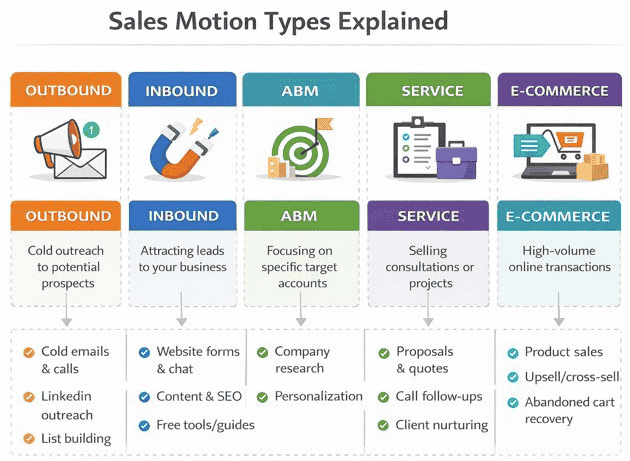
🔹 Common Sales Motions
| Sales Motion | Description | Tool Type Needed |
|---|---|---|
| Cold Outbound | Email, LinkedIn, prospecting | AI prospecting + outreach tools |
| Inbound Leads | Website leads, demo requests | AI CRM + lead routing tools |
| Account-Based Sales | Targeting specific companies | Data enrichment + personalization tools |
| E-commerce | High-volume transactions | AI chatbots + recommendation engines |
| Service-Based Business | Consultations, proposals | AI CRM + follow-up automation |
👉 If you’re unsure, start with outbound + CRM — most SMBs benefit from this foundation.
You can also explore how browser-based prospecting works in our Apollo.io Chrome extension guide.
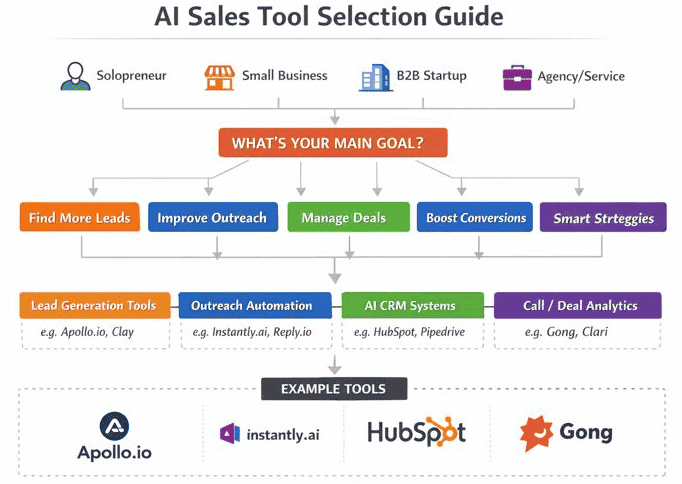
Step 2: Match Your Core Business Goal to Tool Category
Instead of searching for “best AI sales tool,” start with what problem you want to solve.
| Your Goal | AI Tool Category | What It Does |
|---|---|---|
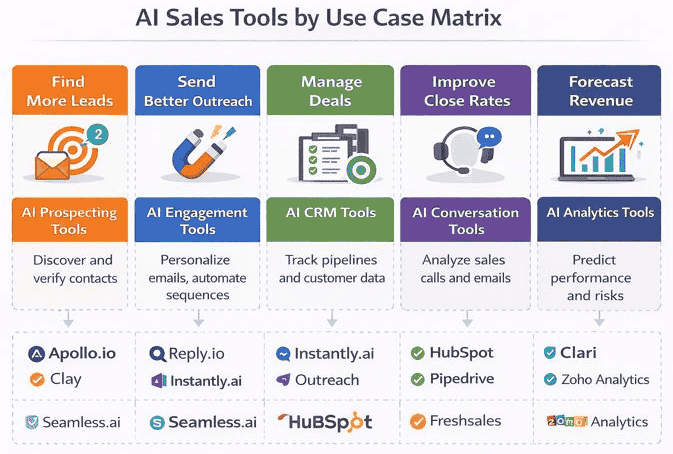
| Find more leads | AI Prospecting Tools | Discover and verify contacts |
| Send better outreach | AI Engagement Tools | Personalize emails, automate sequences |
| Manage deals | AI CRM Tools | Track pipelines and customer data |
| Improve close rates | AI Conversation Tools | Analyze calls and emails |
| Forecast revenue | AI Analytics Tools | Predict performance and risks |
👉 Most businesses need 2–3 tool categories, not everything.
👉 If you’re evaluating cold email platforms, see our detailed Reply.io review for features, pricing, and real use cases.
Step 3: Assess Your Constraints (Reality Check)
Before picking tools, evaluate these 5 constraints honestly:
🔹1. Budget
- Solopreneurs: $0–$50/month
- SMB teams: $50–$300/month
- Scale-ups: $300+
🔹2. Team Size
- Solo → Needs automation, simplicity
- Small teams → Needs CRM + workflows
- Larger teams → Needs analytics + coaching
🔹3. Tech Skills
- Non-technical → Choose no-code tools
- Technical → Can stack APIs and workflows
🔹4. Existing Stack
- Already using HubSpot, Notion, Google Sheets?
- Tool should integrate — not replace everything
🔹5. Compliance
- GDPR, CAN-SPAM, SOC2?
- Choose tools with verification, consent, and opt-out handling
Beginner Decision Framework (Fast Path)
Use this simplified logic:
If you want to → Choose → Example Tools
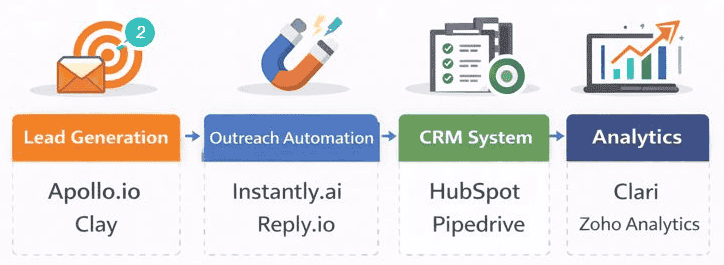
- Find leads → AI prospecting → Apollo.io, Clay
- Send cold emails → Outreach automation → Instantly.ai, Reply.io
- Manage pipeline → AI CRM → HubSpot, Pipedrive
- Improve conversions → Conversation intelligence → Gong
- Predict revenue → Forecasting → Clari
👉 Most beginners should start with:
AI Prospecting + Outreach + CRM
👉 Before launching any outreach, read our guide on why cold emails go to spam and How tools fix it to protect your domain reputation.
Tool Stack Examples by Business Type
🔹Solopreneurs & Freelancers
- Lead gen + email automation + simple CRM
- Example stack:
- Apollo.io + Instantly.ai + Google Sheets/Notion
🔹Small Businesses (2–10 sales reps)
- Prospecting + outreach + CRM + reporting
- Example stack:
- Apollo.io + Reply.io + HubSpot
🔹B2B SaaS Startups
- Data enrichment + CRM + conversation analytics
- Example stack:
- Clay + HubSpot + Gong
🔹Agencies & Service Businesses
- CRM + automation + follow-up tracking
- Example stack:
- Pipedrive + Instantly.ai + Zapier
Common Mistakes Beginners Make (Avoid These)
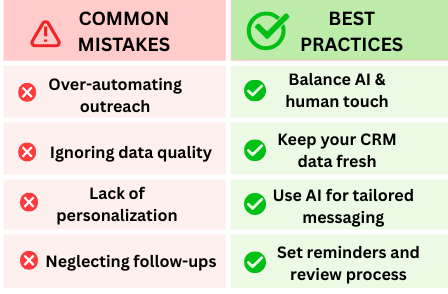
❌ Buying enterprise tools too early
❌ Using 5 tools instead of mastering 2
❌ Ignoring CRM setup
❌ Over-automating without personalization
❌ Skipping email verification
❌ Not tracking pipeline metrics
How to Evaluate Any AI Sales Tool (Checklist)
Before purchasing, test:
✔ Lead quality accuracy
✔ Email deliverability features
✔ CRM integrations
✔ Workflow automation
✔ Reporting dashboards
✔ Customer support quality
✔ Pricing scalability
✔ Free trial availability
How Long Until You See Results?
| Timeline | What to Expect |
|---|---|
| Week 1 | Tool setup + onboarding |
| Week 2–3 | First campaigns live |
| Month 1 | Lead flow improvement |
| Month 2–3 | Reply rates stabilize |
| Month 3+ | Revenue attribution |
When You Should Switch Tools
Switch if:
- Your team outgrows feature limits
- Data quality declines
- Integrations break
- Reporting becomes insufficient
- Costs exceed ROI
FAQs
1. What is the best AI sales tool for beginners?
Apollo.io and Instantly.ai are best for beginners because they combine lead generation, automation, and usability with affordable pricing and minimal setup complexity.
2. Do small businesses really need AI sales tools?
Yes. AI tools allow small teams to compete with larger sales organizations by automating prospecting, follow-ups, personalization, and CRM updates.
3. Should I use one AI sales tool or multiple?
Most businesses need 2–3 tools: one for leads, one for outreach, and one for CRM. Avoid over-stacking early.
4. How much do AI sales tools cost?
Solopreneurs can start with $0–$50/month. SMBs typically spend $100–$300/month depending on team size and features.
5. Are AI sales tools safe for cold email?
Yes — if they include email verification, warm-up, throttling, and compliance controls. Always avoid scraped or unverified lists.
6. Can AI sales tools replace salespeople?
No. AI tools enhance sales reps by automating research and admin work — not replacing human relationship-building.
7. What’s the difference between AI CRM and AI outreach tools?
AI CRMs manage pipeline and customer data. AI outreach tools automate email and multichannel engagement. They serve different purposes.
8. How long before I see ROI from AI sales tools?
Most teams see measurable improvements in lead flow and replies within 30–60 days, and revenue impact within 60–90 days.