Cold Email Personalization Examples That Get Replies (With Templates & AI Prompts)
Cold emails don’t fail because of bad offers.
They fail because they sound mass-produced.
If your email looks like it was sent to 1,000 people at once — it probably was.
In this guide, you’ll learn:
- What real personalization means
- 12 cold email personalization examples that get replies
- How to scale personalization using AI tools
- Mistakes that kill reply rates
What Is Cold Email Personalization (Really)?
Most beginners think personalization = first name.
Wrong.
Real personalization shows:
- You understand their role
- You understand their company
- You understand their current situation
- You connect your solution to their reality
3 Levels of Personalization
- Basic → First name, company name
- Contextual → Role, recent activity, tech stack
- Insight-driven → Pain points, growth stage, hiring signals
If you want a deeper walkthrough, check out my detailed guide on How to find verified B2B data with Apollo where I break down the exact step-by-step process.
12 Cold Email Personalization Examples That Get Replies
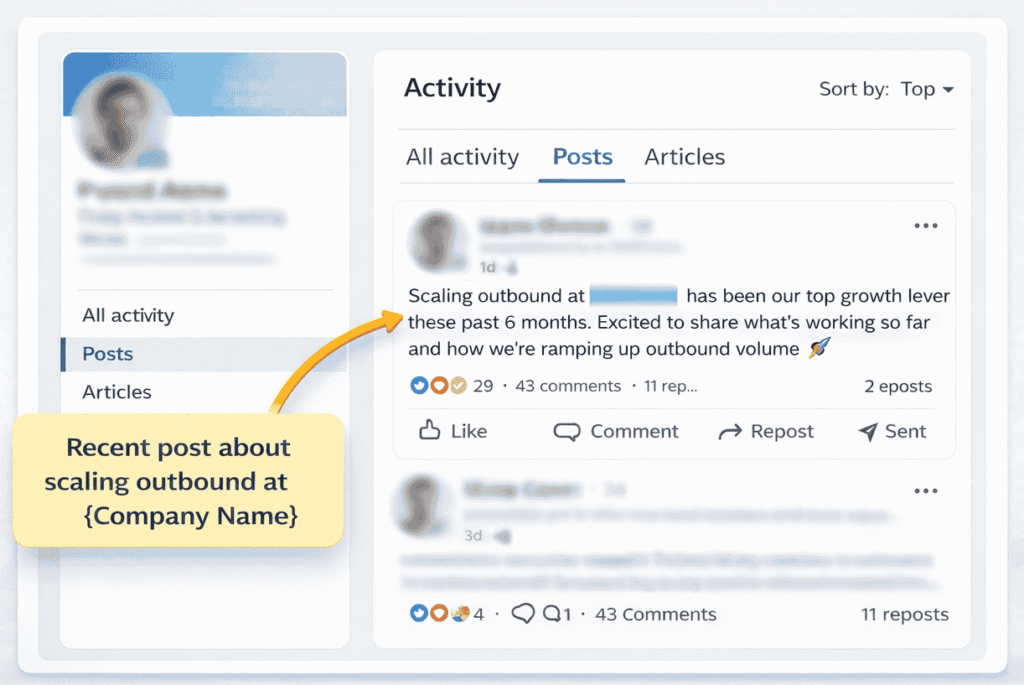
1. Recent LinkedIn Activity Personalization
“Loved your recent post about scaling outbound at [Company]. Curious — how are you handling follow-ups currently?”
Why it works:
- Shows attention
- Feels human
- Opens conversation
2. Job Change Trigger
“Congrats on your new role as Head of Sales at [Company]. Most leaders in their first 90 days focus on pipeline acceleration — is that on your radar too?”
Why:
- Job changes = buying window
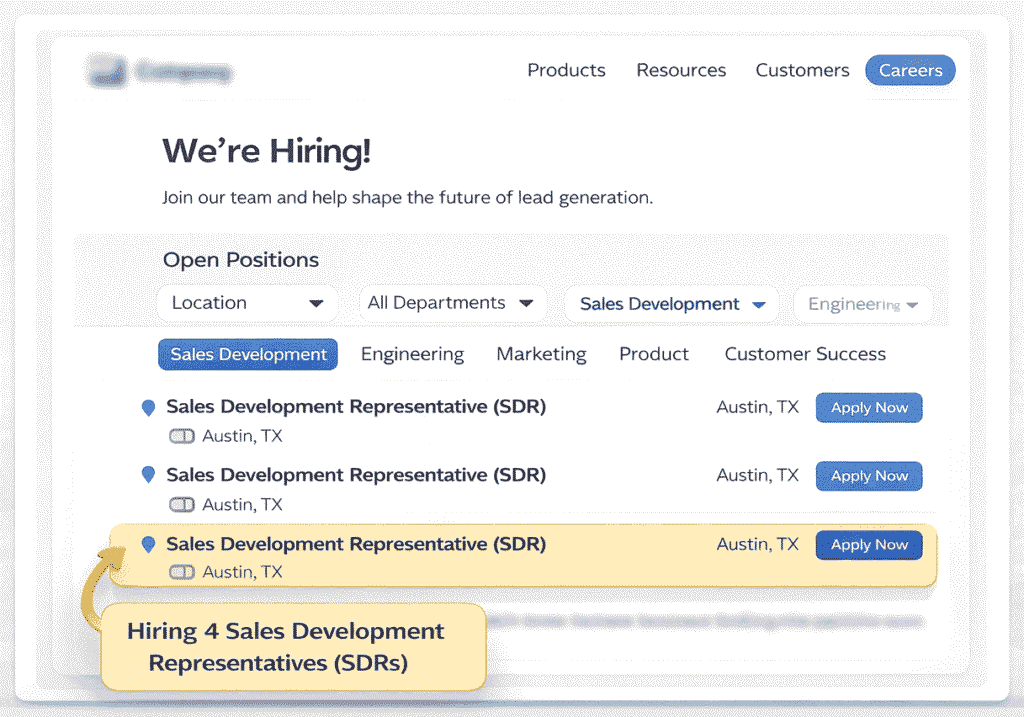
3. Hiring Signal Personalization
“Saw you’re hiring 4 SDRs. That usually means outbound volume is ramping up…”
Why:
- Hiring = growth intent
- High reply potential
4. Tech Stack Personalization
“Noticed you’re using HubSpot. Many teams struggle syncing outbound data back into CRM…”
Why:
- Hyper relevant
- Specific pain awareness
5. Competitor Mention (Soft Comparison)
“We recently helped a similar SaaS company in your space improve reply rates by 37%.”
Why:
- Social proof
- Reduces skepticism
6. Location-Based Personalization
“Helping several fintech startups in Austin improve outbound ROI…”
Why:
- Feels local & familiar
7. Content Gaps: What Your Business Might Be Missing
As a business owner, you may already be doing many things right — but still leaving opportunity on the table without realizing it.
For example, imagine a real estate company that actively promotes:
- “Luxury homes for sale”
- “Premium apartments in the city”
But they don’t talk about:
- First-time homebuyer guidance
- Mortgage process education
- Neighborhood comparisons
- Investment property advice
That’s not a marketing failure.
It’s a content gap.
What This Means in Simple Terms
You may be visible for one part of what you offer — but not the full journey your customer goes through.
Buyers don’t only search for:
“Property for sale.”
They also look for:
- “How to buy a home step by step”
- “Best neighborhoods for families”
- “How much down payment do I need”
- “Is now a good time to invest in property”
If your business only speaks about listings, but not about decisions, concerns, and comparisons — you’re missing part of the conversation.
Why This Matters for Any SMB
Content gaps don’t just affect online visibility.
They affect:
- Customer trust
- Perceived expertise
- Lead quality
- Buying confidence
When your business covers only one angle of your service, customers may see you as a seller — not as an advisor.
The Bigger Insight
Every business has:
- What they sell
- What customers worry about
- What customers compare
- What customers need clarity on
If you’re only communicating the first one, you’re leaving growth untapped.
How to Identify Your Own Gaps (Simple Test)
Ask yourself:
- What questions do customers repeatedly ask me?
- What objections do they raise before buying?
- What decisions confuse them?
- What comparisons do they struggle with?
If those topics aren’t clearly addressed in your messaging, website, or content — that’s a gap.
Why This Is Powerful
Closing content gaps:
- Positions you as a trusted authority
- Reduces repetitive explanation
- Improves lead quality
- Shortens sales cycles
- Builds long-term brand strength
And this applies whether you’re in:
- Real estate
- Healthcare
- Manufacturing
- Consulting
- Retail
- Local services
Every industry has blind spots.
The businesses that grow faster are not always the loudest —
They are the ones that guide buyers through the full journey.
8. Website Insight Personalization
“Saw your homepage focuses on lead generation — curious how much of that is inbound vs outbound?”
9. Event-Based Personalization
“Congrats on raising Series A last month…”
Funding = strong buying signal.
10. Pain-Point Hypothesis Personalization
“Many RevOps leaders tell me data accuracy is their biggest issue…”
Works because:
- Assumes problem
- Invites correction
11. Micro-Case Study Personalization
“We helped a B2B SaaS reduce bounce rate from 9% to 2%…”
For a deeper understanding of maintaining inbox placement and avoiding spam filters, refer to this guide on Cold email deliverability best practices.
12. AI-Generated Smart Personalization
Many businesses are now using AI-powered tools such as Apollo, Clay, ChatGPT, and Reply.io to make outreach more relevant without increasing manual workload.
Instead of sending generic messages, AI can help tailor communication based on a prospect’s role, industry, or recent activity.
For example, a business owner in commercial real estate might use a prompt like:
“Write a personalized opening line for an Operations Director at a mid-sized logistics company expanding warehouse locations in Texas.”
Or a marketing agency owner might use:
“Write a personalized opening line for the Marketing Manager of a regional retail chain launching new stores.”
This approach keeps outreach structured and scalable, while making messages feel more specific and thoughtful.
The objective is simple: improve engagement and response rates without adding complexity to the team’s workflow.
How to Scale Personalization Using AI (Without Sounding Robotic)
Step 1: Collect Data
- Hiring pages
- Tech stack
- Recent news
Step 2: Use AI for Enrichment
Prompt template:
“Summarize this LinkedIn profile in 2 lines focusing on outbound challenges.”
Step 3: Insert into Email Framework
Structure:
- Personalized opener
- Problem bridge
- Offer
- Soft CTA
Personalization Mistakes That Kill Reply Rates
- Over-personalization (too creepy)
- Fake personalization tokens
- Long personalized paragraphs
- Irrelevant flattery
- Personalizing the wrong part of the email
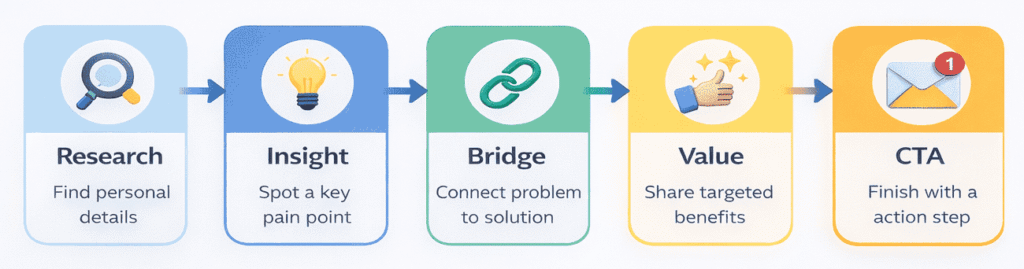
Cold Email Personalization Framework
Research → Insight → Bridge → Value → CTA
Personalization Templates (Copy & Use)
Template 1 – Hiring Signal
Subject: Quick question about SDR ramp
Hi {{First Name}},
Noticed you’re hiring SDRs at {{Company}} — usually that means outbound growth is a priority.
How are you currently handling prospecting scale without hurting deliverability?
Open to sharing something that helped similar teams reduce bounce rates by 40%.
— {{Your Name}}
Template 2 – Tech Stack Trigger
Subject: HubSpot + outbound question
Hi {{First Name}},
Saw you’re using HubSpot — many teams struggle syncing outbound data cleanly.
Is that something you’re facing too?
Happy to share what’s working for others.
How Personalization Impacts Deliverability
Explain connection:
- Higher opens
- More replies
- Better engagement signals
- Stronger sender reputation
Tools That Help With Cold Email Personalization
You can add affiliate strategy here:
- Apollo.io (data & signals)
- Reply.io (automation)
- Clay (advanced enrichment)
- ChatGPT (copy assistance)
Final Thoughts
Personalization is not about sounding smart.
It’s about sounding relevant.
The difference between:
“Just checking in…”
vs
“Saw you’re hiring 4 SDRs…”
That’s the difference between spam and conversation.
FAQs
1️⃣ What is cold email personalization?
Cold email personalization means customizing your email message based on specific details about the recipient — such as their company, role, recent activity, or industry — instead of sending a generic template to everyone.
Personalization increases:
- Open rates
- Reply rates
- Trust
- Deliverability
2️⃣ Why is personalization important in cold emails?
Personalization improves engagement signals (opens, replies, clicks), which directly affect inbox placement.
When emails feel relevant:
- Spam complaints decrease
- Reply rates increase
- Domain reputation improves
Search intent match: “why personalize cold emails”
3️⃣ How much personalization is enough?
For beginners, aim for:
- First name
- Company name
- One specific observation (recent post, service, website detail)
Even 1–2 custom lines can significantly improve response rates.
Avoid over-personalization that feels forced or automated.
4️⃣ What are examples of good cold email personalization?
Examples include:
- Mentioning a recent LinkedIn post
- Referring to a blog article they published
- Complimenting a specific service page
- Noticing a hiring announcement
- Referencing a recent product launch
Specific beats generic every time.
5️⃣ Can AI tools help with cold email personalization?
Yes. AI tools can:
- Generate personalized intro lines
- Analyze LinkedIn profiles
- Summarize company websites
- Suggest customized value propositions
However, always review AI output to ensure it sounds natural and accurate.
6️⃣ What personalization mistakes should I avoid?
Common mistakes:
- Fake personalization (“Loved your recent post” with no context)
- Wrong name or company
- Overly long intros
- Copy-paste personalization errors
- Making it about you instead of them
Even one mistake can damage trust instantly.
7️⃣ Does personalization improve cold email deliverability?
Yes — indirectly.
When recipients:
- Open your email
- Reply
- Don’t mark as spam
Email providers see positive engagement signals, which improves sender reputation and inbox placement.
8️⃣ Should every cold email be personalized?
If you’re sending:
- 10–100 emails/day → Yes, personalize each.
- 1,000+ emails/day → Use structured personalization variables.
Quality > Quantity for small businesses.
9️⃣ What is the difference between basic and advanced personalization?
Basic personalization:
- Name
- Company
- Industry
Advanced personalization:
- Trigger-based outreach (job change, funding, launch)
- Custom value proposition
- Behavioral personalization
For beginners → start simple.
🔟 How long should a personalized cold email be?
Ideal length:
- 75–125 words
- 3–5 short lines
- Clear CTA
Personalization should enhance clarity, not add fluff.
1️⃣1️⃣ Is personalization better than offering discounts in cold emails?
Yes.
Relevance converts better than incentives.
People reply because:
- You understand their problem
- You speak directly to their situation
- Your message feels intentional
1️⃣2️⃣ How do I personalize cold emails at scale?
Steps:
- Segment your list by industry or role
- Use custom intro variables
- Use AI carefully
- Keep templates flexible
- Always test small batches first
Scale without sacrificing relevance.