AI Workflows for Small Businesses: Automate Sales, Marketing & Operations
Table of Contents
Understanding AI Workflows for Small Businesses
Running a small business today isn’t just about selling—it’s about managing a constant flow of tasks like lead generation, outreach, follow-ups, and customer tracking.
When these processes are handled manually, problems show up quickly:
- Leads slip through the cracks
- Response times slow down
- Follow-ups become inconsistent
- Growth becomes unpredictable
👉 This is where AI workflows make a real difference.
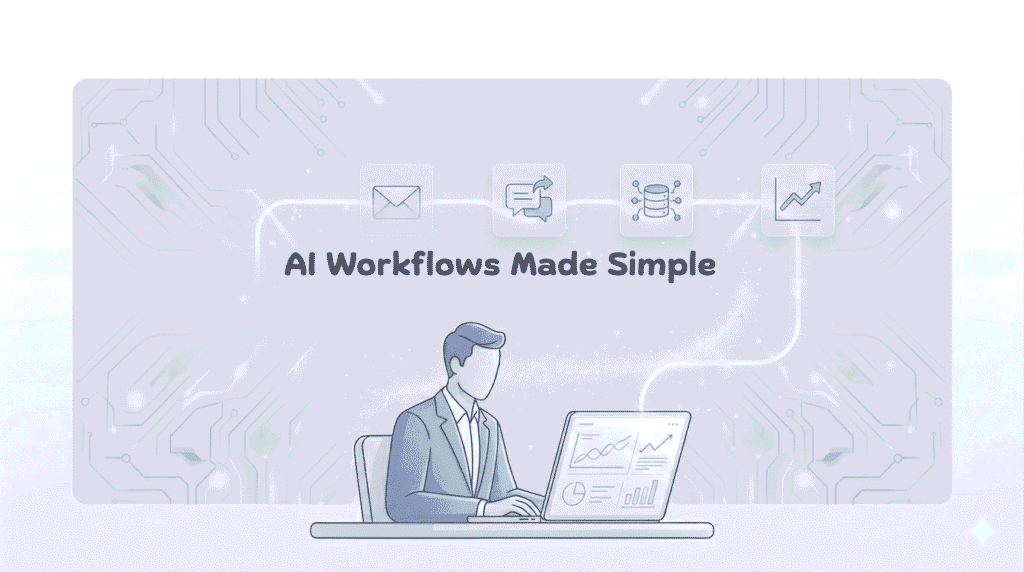
AI workflows connect your tools and automate repetitive actions, so tasks happen automatically in the background—capturing leads, triggering follow-ups, and updating your pipeline without manual effort.
💡 Key Insight:
Instead of doing more work, AI workflows help you build a system that works for you, ensuring every lead is tracked, engaged, and moved toward conversion efficiently.
What Is an AI Workflow?
An AI workflow is a structured, step-by-step system where tasks are automatically handled by connected tools instead of being done manually. It combines automation, data tracking, and decision-making rules so your business processes run smoothly in the background.
Instead of managing each task separately, an AI workflow creates a continuous flow where every action triggers the next step. For example:
Lead captured → Qualified → Contacted → Followed up → Converted
In a real business scenario, this means when a lead fills out a form, their data is instantly stored, evaluated based on predefined criteria, assigned a score, and moved into an outreach sequence without any manual input. If the lead engages, the system can automatically trigger follow-ups or notify the sales team.
The real value of AI workflows is not just automation—it’s consistency and speed. Every lead is handled the same way, without delays or missed steps. This ensures that no opportunity is lost due to human error or time constraints.
AI workflows also allow you to scale your operations without increasing workload. Whether you have 10 leads or 1,000, the system processes them efficiently using the same logic and structure.
Key Insight:
AI workflows don’t replace your business decisions—they remove repetitive tasks, reduce friction, and allow you to focus on strategy, communication, and closing deals while the system handles execution in the background.
Core AI Workflows Every Small Business Should Use
1. Lead Generation Workflow
A lead generation workflow is the starting point of your entire sales system. Instead of manually collecting and managing contacts, this workflow ensures that every potential customer is captured, organized, and prepared for the next step automatically.
How It Works
In a practical setup, leads are collected from multiple sources such as website forms, landing pages, or external databases. Once a lead enters your system, the workflow immediately stores the data, analyzes it, and filters out irrelevant contacts.
AI tools then identify prospects that match your target audience based on factors like industry, job role, or behavior. This allows you to focus only on leads that are more likely to convert instead of wasting time on unqualified contacts.
Tools You Can Use
Apollo.io helps you find, enrich, and organize lead data efficiently. It allows you to target the right audience and build a qualified lead database without manual research.
What You Get From This Workflow
- A steady and predictable flow of leads
- Better targeting with higher-quality prospects
- Less manual effort in collecting and organizing data
Why This Matters
Without a structured lead generation system, businesses often rely on random or inconsistent efforts. This leads to poor-quality leads and wasted time.
With a proper workflow in place, every lead entering your system is filtered, organized, and ready for the next stage—making your entire sales process more efficient and scalable.
Simple Flow
Visitor → Lead Captured → Data Filtered → Qualified Leads Stored
Example
A visitor fills out a form on your website. The system automatically captures their details, checks if they match your target audience, and stores them in your database without any manual input.
When to Use This Workflow
- When you struggle to consistently generate new leads
- When leads are scattered across different platforms
- When manual data collection is time-consuming
2. Lead Qualification Workflow
A lead qualification workflow ensures that not every lead is treated the same. Instead of spending time on all contacts, this process helps you identify which leads are actually worth your attention based on their behavior and intent.
How It Works
Once leads enter your system, they are evaluated using predefined criteria such as actions taken, engagement level, and interest signals. This may include activities like visiting pricing pages, opening emails, downloading resources, or requesting demos.
Based on these signals, each lead is assigned a score. Higher scores indicate stronger buying intent, while lower scores suggest that the lead may need further nurturing. This allows your system to automatically prioritize leads and move the most relevant ones toward sales outreach.
What You Get From This Workflow
- Clear visibility into which leads are sales-ready
- Better prioritization of high-intent prospects
- Reduced time spent on low-quality leads
Why This Matters
Without proper qualification, businesses often waste time chasing leads that are not ready to buy. This slows down the sales process and reduces overall efficiency.
With a structured qualification workflow, your team focuses only on leads that show real intent, improving both conversion rates and productivity.
To implement this effectively, you can explore your detailed guide on lead scoring models and strategy, which explains how to build a reliable system for identifying high-quality leads.
Simple Flow
Lead Captured → Behavior Tracked → Score Assigned → High-Intent Leads Identified
Example
A lead visits your pricing page multiple times and opens your emails. Based on these actions, the system assigns a higher score and marks the lead as ready for sales outreach.
When to Use This Workflow
- When you have many leads but don’t know which ones to prioritize
- When sales teams spend time on low-quality prospects
- When conversion rates are low despite high lead volume
3. Lead Nurturing Workflow
A lead nurturing workflow helps you build relationships with potential customers over time instead of trying to sell immediately. It ensures that leads receive the right information at the right stage, guiding them from initial interest to becoming sales-ready prospects.
How it works:
• The workflow starts when a lead enters your system through a form, download, or signup. Instead of sending random messages, leads are segmented based on their interests, behavior, or source.
• Automated email sequences are triggered to educate leads with valuable content such as guides, case studies, product insights, or comparisons. This builds trust and keeps your brand top of mind.
• AI tools track user behavior like email opens, clicks, website visits, and downloads. Based on these actions, the system sends personalized follow-ups tailored to the lead’s level of interest.
• Leads who engage more frequently are gradually moved toward sales-focused communication, while inactive leads receive re-engagement messages to bring them back into the funnel.
• Once a lead shows strong intent (e.g., multiple clicks, demo request), they are automatically passed to the sales team for outreach.
Outcome:
• Warmer, well-informed leads before sales interaction
• Higher conversion rates with less effort
• Stronger trust and relationship with potential customers
• Reduced lead drop-off between stages
Why This Matters
Without a structured customer support workflow, businesses often deal with slow response times, missed messages, and inconsistent communication. This not only frustrates customers but also damages trust and brand reputation.
With a well-defined system in place, every query is handled promptly and professionally. Automation ensures faster responses, while structured processes help teams deliver consistent support—leading to better customer satisfaction, stronger relationships, and long-term retention.
Simple Flow
Customer Query → AI Chatbot Response → Ticket Creation → Agent Assignment → Issue Resolution → Follow-Up & Feedback
Example
A customer visits your website and asks a common question via live chat. The AI chatbot instantly provides an accurate answer. If the query requires deeper assistance, the system automatically creates a support ticket and assigns it to the appropriate team member.
The agent resolves the issue with full context, and once completed, the system sends a follow-up message or feedback request to ensure customer satisfaction—all without manual tracking.
When to Use This Workflow
- When your business receives frequent customer inquiries across multiple channels
- When response times are affecting customer satisfaction
- When your support team is spending too much time on repetitive queries
- When you want to scale support operations without increasing team size
- When improving customer experience and retention is a priority
4. Sales Outreach Workflow
A sales outreach workflow helps you consistently engage potential customers without relying on manual effort. Instead of sending individual emails one by one, this system allows you to reach the right prospects at the right time with personalized communication at scale.
How It Works
Once leads are qualified, they are automatically added to an outreach sequence. These sequences are designed to send a series of emails over a defined period, each tailored to guide the lead toward a response or action.
Personalization is handled using dynamic data such as name, company, role, or specific pain points. This ensures that even though emails are automated, they still feel relevant and targeted. The workflow also tracks engagement, such as opens and replies, and adjusts follow-ups based on user behavior.
Tools You Can Use
Reply.io allows you to create automated email sequences, personalize outreach, and manage follow-ups efficiently. It helps streamline communication while maintaining consistency across all leads.
What You Get From This Workflow
- Consistent and timely outreach to all qualified leads
- Improved response rates through personalized messaging
- Reduced manual effort in managing email campaigns
Why This Matters
Many businesses struggle with low response rates because outreach is either inconsistent or too generic. When follow-ups are missed or delayed, potential opportunities are lost.
With a structured outreach workflow, every lead receives timely and relevant communication, increasing the chances of engagement and conversion.
To go deeper, you can learn more in your article on automating email outreach at scale, where you’ll find step-by-step strategies to improve performance and efficiency.
Simple Flow
Qualified Lead → Email Sequence Triggered → Follow-ups Sent → Reply Received
Example
Once a lead is marked as qualified, they are automatically added to an email sequence. Over the next few days, they receive personalized messages, increasing the chances of getting a response.
When to Use This Workflow
- When outreach is inconsistent or delayed
- When response rates are low
- When sending emails manually takes too much time
5. Follow-Up Automation Workflow
A follow-up automation workflow ensures that no potential opportunity is lost due to delayed or missed communication. Instead of relying on manual reminders, this system automatically sends timely follow-ups based on user behavior and predefined rules.
How It Works
Once a lead enters your pipeline or interacts with your business, the workflow triggers a sequence of follow-up actions. These actions are based on specific behaviors such as opening an email, clicking a link, visiting a pricing page, or not responding within a certain timeframe.
For example, if a lead does not reply to your first email, the system can automatically send a follow-up after a set number of days. If the lead engages, the workflow can adjust by sending more relevant messages or notifying the sales team to take direct action.
This ensures that every lead is consistently engaged without requiring constant manual tracking.
What You Get From This Workflow
- Consistent and timely follow-ups for every lead
- Reduced chances of losing interested prospects
- Faster movement from interest to conversion
Why This Matters
Many businesses lose potential customers simply because they fail to follow up at the right time. Manual follow-ups are often delayed or forgotten, which reduces the chances of conversion.
With an automated system in place, every lead receives the right message at the right time, increasing engagement and improving overall conversion rates.
Simple Flow
Lead Interaction → Follow-Up Triggered → Reminder Sent → Engagement or No Response → Next Action
Example
A lead receives your initial email but doesn’t respond. After two days, the system automatically sends a follow-up message. If the lead clicks the link in the email, the workflow adjusts and sends a more targeted message or alerts the sales team.
When to Use This Workflow
- When follow-ups are inconsistent or often missed
- When leads show interest but don’t respond immediately
- When manual tracking of follow-ups becomes difficult
6. CRM Management Workflow
A CRM management workflow acts as the central system where all your leads, interactions, and sales activities are organized. Instead of tracking information across spreadsheets, emails, or multiple tools, everything is stored and updated in one place, giving you complete visibility over your pipeline.
How It Works
When a lead enters your system, their details are automatically stored in your CRM. Every interaction—emails, calls, meetings, or website activity—is recorded and linked to that contact. As the lead moves through different stages, the workflow updates their status and keeps your pipeline organized.
This allows you to see exactly where each lead stands, what actions have been taken, and what needs to happen next. It also helps teams collaborate better, since everyone has access to the same updated information.
Tools You Can Use
HubSpot is widely used for managing leads, tracking interactions, and organizing sales pipelines. It helps automate updates, assign tasks, and maintain a clear view of your entire sales process.
What You Get From This Workflow
- A centralized system to manage all leads and interactions
- Clear visibility into your sales pipeline
- Better tracking of progress and performance
Why This Matters
Without a structured CRM system, businesses often lose track of leads, miss follow-ups, and struggle to understand what’s working. This leads to confusion, inefficiency, and missed revenue opportunities.
With a CRM workflow in place, every lead is tracked from the first interaction to conversion, allowing you to make informed decisions and improve your overall sales strategy.
Simple Flow
Lead Captured → Stored in CRM → Interaction Tracked → Stage Updated → Customer Conversion
Example
A new lead fills out a form and is automatically added to your CRM. As emails are sent and opened, and meetings are scheduled, each interaction is recorded. The lead moves from “new” to “contacted” to “qualified,” giving you a clear picture of their journey.
When to Use This Workflow
- When lead data is scattered across multiple tools
- When it’s difficult to track conversations and progress
- When you want better visibility and control over your sales pipeline
7. Marketing Campaign Automation Workflow
A marketing campaign automation workflow helps you plan, execute, and optimize campaigns consistently across multiple channels without manual effort. Instead of managing emails, ads, and social posts separately, this system ensures everything runs in sync with clear goals and measurable results.
How it works:
• The workflow starts with defining campaign goals such as lead generation, product promotion, or customer engagement. Based on this, audiences are segmented using data like behavior, interests, or past interactions.
• Campaigns are then set up across multiple channels—email, social media, and paid ads. Instead of posting manually, content is scheduled in advance to ensure consistent delivery.
• AI tools assist in generating email copy, ad creatives, and social media captions, helping maintain quality and speed without heavy manual effort.
• Automation triggers campaigns based on user actions—for example, sending emails after signup, retargeting users who visited a page, or showing ads to specific audience segments.
• Performance is continuously tracked using metrics like open rates, clicks, conversions, and engagement. Based on this data, campaigns are optimized through A/B testing and adjustments.
Outcome:
• Consistent and timely campaign execution across all channels
• Improved engagement and conversion rates
• Better return on investment (ROI) from marketing efforts
• Reduced manual workload and fewer errors
Why This Matters
Without a structured campaign workflow, marketing efforts often become inconsistent, poorly timed, and difficult to track. This leads to wasted budget and missed opportunities.
With automation, campaigns run smoothly, reach the right audience at the right time, and continuously improve based on real data—making your marketing more effective and scalable.
Simple Flow
Campaign Planning → Audience Segmentation → Content Creation → Campaign Automation → Performance Tracking → Optimization
Example
You launch a product promotion campaign. Emails are automatically sent to subscribers, social media posts are scheduled for the week, and ads target users who previously visited your website.
If a user clicks but doesn’t convert, they are automatically retargeted with follow-up ads or emails. Meanwhile, the system tracks performance and helps you optimize the campaign for better results.
When to Use This Workflow
When you are running campaigns across multiple platforms
When marketing tasks are repetitive and time-consuming
When campaign performance is inconsistent or hard to track
When you want to scale marketing efforts without increasing workload
When improving ROI and campaign efficiency is a priority
8. Content Marketing Workflow
A content marketing workflow helps you consistently create and publish content that attracts, engages, and converts your target audience. Instead of posting randomly, this system ensures every piece of content is planned, optimized, and aligned with your business goals.
How It Works
The workflow starts with identifying topics based on what your audience is searching for. Instead of guessing, you focus on relevant keywords and problems your potential customers are trying to solve.
Once topics are planned, content is created in a structured way—covering clear sections, useful insights, and practical value. AI tools can assist in drafting, optimizing readability, and improving keyword usage without making the content feel unnatural.
After creation, the content is published and optimized for search engines with proper headings, internal links, and media. The workflow doesn’t stop there—it also includes updating existing content to keep it relevant and competitive over time.
What You Get From This Workflow
- Consistent and targeted content output
- Improved visibility in search results
- Long-term traffic growth from SEO
Why This Matters
Without a structured content process, businesses often publish inconsistently or create content that doesn’t rank or convert. This leads to wasted effort and slow growth.
With a proper workflow, every piece of content serves a purpose—attracting the right audience, building authority, and supporting your sales process.
Simple Flow
Topic Research → Content Creation → SEO Optimization → Publishing → Traffic Growth
Example
You identify a keyword your audience is searching for, create a well-structured article around it, optimize it with headings and internal links, and publish it. Over time, the content starts ranking and brings consistent traffic without additional effort.
When to Use This Workflow
- When your website is not getting consistent traffic
- When content is published irregularly
- When you want to build long-term visibility and authority
9. Conversion Rate Optimization (CRO) Workflow
A conversion rate optimization workflow helps you improve the percentage of visitors who take action on your website—such as signing up, booking a demo, or making a purchase. Instead of only focusing on increasing traffic, this system ensures you get better results from the traffic you already have.
How it works:
• The workflow begins by tracking user behavior across your website using analytics tools. This includes monitoring clicks, scroll depth, time on page, and drop-off points to understand how visitors interact with your pages.
• Based on this data, key problem areas are identified—such as high bounce rates, low form submissions, or users abandoning landing pages before converting.
• Different elements are then tested using A/B testing. This includes variations of headlines, call-to-action (CTA) buttons, page layouts, images, and forms to see what performs better.
• AI tools can assist by analyzing patterns, suggesting improvements, and even generating optimized copy for landing pages and CTAs.
• The best-performing variations are implemented, and the process continues as an ongoing cycle of testing and improvement.
Outcome:
• Higher conversions without increasing traffic
• Better performance from existing marketing efforts
• Improved user experience and engagement
• More revenue from the same audience
Why This Matters
Without CRO, businesses often focus only on driving more traffic while ignoring why visitors are not converting. This leads to wasted marketing spend and missed opportunities.
With a structured optimization workflow, every improvement is based on real data—helping you turn more visitors into leads and customers without increasing acquisition costs.
Simple Flow
User Behavior Tracking → Data Analysis → A/B Testing → Optimization → Conversion Growth
Example
You notice that many users visit your landing page but don’t sign up. After analyzing behavior, you find that users drop off at the form section.
You test two versions—one with a shorter form and another with a stronger CTA. The shorter form performs better, increasing sign-ups. You implement the winning version and continue optimizing other elements.
When to Use This Workflow
- When your website gets traffic but low conversions
- When users are dropping off without taking action
- When landing pages or forms are underperforming
- When you want to improve ROI without increasing ad spend
- When optimizing user experience and funnel performance is a priority
10. Customer Support Workflow
A customer support workflow helps businesses handle queries faster, provide consistent responses, and improve overall customer satisfaction. Instead of reacting to issues manually, this system ensures every customer request is managed efficiently using automation and structured processes.
How It Works
- The workflow starts by capturing customer queries from multiple channels such as website chat, email, or social media. Instead of handling everything manually, AI chatbots provide instant responses to common questions like pricing, product details, or basic troubleshooting.
- For more complex issues, the system automatically creates support tickets and routes them to the right team or agent. This ensures that urgent or high-priority queries are handled quickly without confusion or delays.
- AI tools can also assist support teams by suggesting replies, categorizing tickets, and pulling relevant customer history. This allows agents to respond faster with better context instead of starting from scratch every time.
- After resolving the issue, the workflow continues with automated follow-ups such as feedback requests or satisfaction surveys. This helps businesses understand customer experience and improve their support quality over time.
What You Get From This Workflow
- Faster response times with 24/7 availability
- Reduced manual workload for support teams
- Consistent and accurate customer communication
- Improved customer satisfaction and retention
Why This Matters
Without a structured support system, businesses often struggle with delayed responses, missed queries, and inconsistent communication. This leads to poor customer experience and lost trust.
With a proper workflow, every customer interaction is handled efficiently—ensuring quick resolutions, better communication, and stronger relationships.
Simple Flow
Query Capture → AI Response → Ticket Creation → Issue Resolution → Follow-Up & Feedback
Example
A customer visits your website and asks a common question through chat. The chatbot instantly responds with the correct information. If the issue is more complex, it creates a ticket and assigns it to a support agent. After the issue is resolved, the system sends a feedback email to the customer automatically.
When to Use This Workflow
- When customer queries are increasing
- When response times are slow
- When support teams are overwhelmed
- When you want to improve customer experience without hiring more staff
11. Customer Retention Workflow
A customer retention workflow helps you keep existing customers engaged, satisfied, and coming back for repeat purchases. Instead of constantly focusing only on acquiring new customers, this system ensures you build long-term relationships and maximize the value of every customer.
How it works:
- The workflow begins by identifying customer behavior using data such as past purchases, engagement history, and inactivity periods. Customers are then segmented into groups like active, inactive, or high-value buyers.
- Automated campaigns are triggered based on these segments. For example, inactive customers receive re-engagement emails or special offers, while active customers receive updates, product recommendations, or exclusive deals.
- Personalization plays a key role in this workflow. Messages are tailored based on previous interactions, purchase history, or preferences, making communication more relevant and effective.
- Loyalty programs, rewards, and reminders are also automated to encourage repeat purchases and keep customers engaged over time.
- The system continuously tracks customer responses and behavior, allowing you to refine your messaging and improve retention strategies.
Outcome:
- Higher repeat purchases from existing customers
- Increased customer lifetime value
- Stronger customer relationships and brand loyalty
- Reduced dependency on constant new lead generation
Why This Matters
Acquiring new customers is often more expensive than retaining existing ones. Without a retention strategy, businesses lose valuable customers after the first interaction, reducing long-term growth.
With a structured workflow, you stay connected with customers, provide ongoing value, and create reasons for them to return—leading to more stable and predictable revenue.
Simple Flow
Customer Data Tracking → Segmentation → Personalized Campaigns → Engagement & Offers → Repeat Purchases
Example
A customer makes a purchase from your website. After a few days, they receive a personalized follow-up email with product recommendations. If they don’t return, a re-engagement offer is sent after a few weeks. Loyal customers receive exclusive discounts or rewards, encouraging them to buy again.
When to Use This Workflow
- When repeat purchases are low
- When customers stop engaging after the first interaction
- When you want to increase customer lifetime value
- When building long-term relationships is a priority
- When reducing reliance on new customer acquisition is important
12. Analytics & Reporting Workflow
An analytics and reporting workflow helps you track, measure, and understand the performance of your sales and marketing efforts. Instead of relying on guesswork, this system ensures every decision is backed by real data and clear insights.
How it works:
- The workflow starts by automatically collecting data from multiple sources such as your website, CRM, email campaigns, ads, and social media platforms. All key metrics like traffic, conversions, revenue, and engagement are tracked in one place.
- This data is then organized into dashboards and reports that provide a clear overview of performance. Instead of manually compiling reports, the system updates data in real time so you can monitor progress continuously.
- AI tools analyze patterns in the data, identifying trends, opportunities, and potential issues. For example, they can highlight which campaigns are performing well, where users are dropping off, or which channels are generating the highest ROI.
- Based on these insights, businesses can adjust strategies, optimize campaigns, and allocate resources more effectively. Reporting can also be automated to send regular updates to teams or stakeholders.
Outcome:
- Data-driven decision making across sales and marketing
- Improved campaign performance and strategy optimization
- Clear visibility into what is working and what needs improvement
- Time saved by eliminating manual reporting processes
Why This Matters
Without proper analytics and reporting, businesses often make decisions based on assumptions rather than facts. This leads to ineffective strategies, wasted budget, and missed growth opportunities.
With a structured workflow, you gain complete visibility into your performance, allowing you to make smarter decisions, improve results, and scale your business more efficiently.
Simple Flow
Data Collection → Data Integration → Dashboard & Reporting → Insights & Analysis → Strategy Optimization
Example
You run multiple marketing campaigns across email, ads, and social media. The system automatically tracks performance and displays results in a dashboard. You notice that one campaign has a higher conversion rate, so you increase its budget while optimizing or pausing underperforming campaigns.
When to Use This Workflow
- When you are running multiple campaigns and need clear performance insights
- When tracking data manually is time-consuming
- When you want to improve ROI using real data
- When decision-making is based on assumptions instead of analytics
- When scaling your business requires better visibility and control
13. Social Media Automation Workflow
A social media automation workflow helps you plan, create, publish, and manage content consistently across platforms without manual effort. Instead of posting randomly, this system ensures your brand stays active, relevant, and engaging while saving time and improving performance.
How it works:
- The workflow begins with planning your content based on your target audience, goals, and content themes. Posts are organized in advance using a content calendar to maintain consistency and alignment with your marketing strategy.
- AI tools assist in generating captions, hashtags, and even creative ideas based on trends and audience preferences. This speeds up content creation while maintaining quality and relevance.
- Once content is ready, posts are scheduled and automatically published across platforms such as LinkedIn, Instagram, and X. This ensures consistent posting without needing to be active manually every day.
- The system also monitors engagement metrics such as likes, comments, shares, and reach. Notifications and automation help you respond quickly to comments or messages, improving interaction with your audience.
- Over time, performance data is analyzed to identify what type of content works best. Based on these insights, future posts are optimized for better engagement and reach.
Outcome:
- Consistent and active brand presence across social platforms
- Increased audience engagement and interaction
- Time saved through automated scheduling and publishing
- Better content performance through data-driven improvements
Why This Matters
Without a structured workflow, social media efforts often become inconsistent, leading to low engagement and missed opportunities to connect with your audience.
With automation, you can maintain a strong and consistent presence, engage with your audience more effectively, and grow your brand without spending excessive time on manual tasks.
Simple Flow
Content Planning → Content Creation → Scheduling & Publishing → Engagement Tracking → Optimization
Example
You plan a week’s worth of social media posts in advance. AI helps generate captions and hashtags, and all posts are scheduled to go live automatically. As users engage with your content, you receive notifications and respond quickly, while performance data helps you refine future content.
When to Use This Workflow
- When posting on social media is inconsistent
- When managing multiple platforms becomes time-consuming
- When engagement levels are low
- When you want to scale your social media presence efficiently
- When improving brand visibility and audience interaction is a priority
How to Connect These Workflows Together (End-to-End System)
Most businesses implement individual workflows like lead generation or outreach, but struggle to see how everything fits together. The real value comes when these workflows are connected into a single, structured system that moves a prospect from first interaction to long-term customer.
Instead of treating each workflow separately, think of it as one continuous journey where each step supports the next.
How the Complete System Works
A typical end-to-end workflow looks like this:
Lead Generation → Lead Qualification → Lead Nurturing → Sales Outreach → CRM Management → Conversion → Customer Retention
Each stage plays a specific role in moving the customer forward.
Lead generation brings in potential prospects. Qualification filters out low-quality leads so you focus only on the right audience. Nurturing builds trust and educates leads before selling. Outreach connects directly with prospects and drives responses.
Once leads engage, CRM systems track all interactions and manage the pipeline. Conversion happens when leads take action, such as booking a call or making a purchase. Finally, retention ensures customers stay engaged and continue buying over time.
Why Connecting Workflows Matters
When these workflows are disconnected, leads fall through gaps, follow-ups are missed, and opportunities are lost. You may generate leads but fail to convert them, or close deals but fail to retain customers.
By connecting everything into a single system, you create a smooth and consistent experience where:
• No lead is ignored or lost
• Every interaction is tracked and optimized
• Communication stays consistent across stages
• Conversions and retention improve over time
Simple Flow to Understand
Traffic → Leads → Qualified Leads → Engaged Leads → Sales Conversations → Customers → Repeat Customers
This simple view helps you understand how each workflow contributes to overall business growth.
Example
A user visits your website and signs up through a form. Their data is captured and qualified based on predefined criteria. They receive automated emails that educate them about your product.
Once they show interest, an outreach sequence is triggered. Their responses and activity are tracked in your CRM. After converting into a customer, they continue to receive follow-ups, offers, and support—encouraging repeat purchases.
Final Insight
Individual workflows bring results, but connected workflows build systems.
When everything works together, your business becomes more predictable, scalable, and efficient—turning scattered efforts into a structured growth engine.
AI Workflow Examples by Business Type
Not every business needs the same workflows. The real value of AI automation comes from applying the right workflows based on your business model, goals, and customer journey.
This section helps you understand how these workflows apply in real scenarios so you can choose what actually fits your business.
🔹Freelancer (Service-Based Individuals)
Freelancers usually focus on finding clients and converting them quickly. The goal is to keep a steady flow of projects without spending too much time on manual outreach.
Focus workflows:
• Lead Generation to find potential clients
• Sales Outreach to connect with prospects
• Follow-Up Automation to stay consistent
How it works:
You collect leads from platforms or databases, send personalized outreach emails, and automate follow-ups until you get a response or close the deal.
Value:
Consistent client flow without daily manual effort
🔹Agency (Marketing, Sales, or Service Agencies)
Agencies handle multiple clients and campaigns, so organization and reporting become critical.
Focus workflows:
• CRM Management to track clients and deals
• Marketing Campaign Automation to run campaigns
• Analytics & Reporting to measure performance
How it works:
Leads and clients are managed in a CRM, campaigns are automated across channels, and performance reports are generated for decision-making and client updates.
Value:
Better client management, scalable operations, and improved results
🔹SaaS (Software as a Service Businesses)
SaaS businesses rely heavily on user engagement, product experience, and long-term retention.
Focus workflows:
• Lead Nurturing to educate users
• Product-Led Engagement (emails, onboarding flows)
• Customer Retention to reduce churn
How it works:
Users sign up for a product, receive onboarding and educational emails, and are guided to experience value before converting into paying customers. Ongoing communication keeps them engaged.
Value:
Higher conversions and long-term recurring revenue
🔹Local Business (Shops, Services, Clinics, etc.)
Local businesses need visibility, quick responses, and strong customer relationships.
Focus workflows:
• Customer Support to handle queries
• Social Media Automation to stay active
• Review & Reputation Management
How it works:
Customers reach out via chat or social platforms, automated responses handle common queries, and follow-ups encourage reviews and repeat visits.
Value:
Better customer experience, more local visibility, and repeat business
How to Use This Section
Identify which category matches your business model and start with the workflows listed for that type. You don’t need to implement everything—focus only on what directly impacts your growth.
Final Insight
AI workflows are not one-size-fits-all.
The best results come from choosing workflows that match your business type and solving the right problems at the right stage.
Time & Cost Savings Breakdown
Most businesses care about one thing—results. AI workflows are valuable because they don’t just automate tasks, they save time, reduce costs, and improve returns. This section helps you understand the real impact of automation in practical terms.
▶️Time Saved Across Workflows
Manual processes take hours of repetitive work every day. AI workflows reduce this significantly by automating routine tasks.
Lead generation that takes hours of research can be done in minutes using automation. Outreach and follow-ups that require daily effort can run automatically in the background. Customer support queries can be handled instantly instead of waiting for manual replies.
Over time, this can save several hours per day, allowing you to focus on higher-value activities like strategy and growth.
▶️Manual vs Automated Comparison
Manual approach
Requires constant effort, repetitive tasks, and manual tracking. Processes are slower, inconsistent, and harder to scale.
Automated approach
Runs continuously with minimal input. Tasks are faster, more consistent, and can handle larger volumes without additional effort.
The key difference is not just speed—it’s reliability and scalability. Automation ensures nothing is missed, from follow-ups to customer responses.
▶️Cost and ROI Impact
AI workflows help reduce operational costs by minimizing the need for additional staff for repetitive tasks. Instead of hiring more people to handle outreach, support, or reporting, automation handles a large portion of the workload.
At the same time, better targeting, faster responses, and consistent follow-ups improve conversion rates. This means more revenue from the same effort.
Even simple improvements like increasing response rates or reducing missed leads can have a direct impact on your overall return on investment.
What This Means for Your Business
You spend less time on manual work and more time on growth activities
You reduce operational costs while improving output
You increase conversions without increasing traffic or effort
You build a more efficient and scalable system
Final Insight
AI workflows are not just about automation—they are about doing more with less.
When implemented correctly, they help you save time, reduce costs, and improve results at every stage of your business.
Common Results You Can Expect
Before implementing AI workflows, it’s important to set realistic expectations. While results can vary based on your business and execution, most businesses start seeing measurable improvements once workflows are properly set up and optimized.
➜ Faster Response Time
Automation allows you to respond instantly to leads and customers instead of waiting hours or days. Whether it’s email outreach, follow-ups, or support queries, responses happen in real time.
This speed improves user experience and increases the chances of engagement, especially in the early stages of the customer journey.
➜ Better Conversions
With structured workflows, leads are guided step by step instead of being left unattended. Qualification filters the right prospects, nurturing builds trust, and follow-ups ensure consistent communication.
This results in higher response rates, better engagement, and improved conversion performance without needing more traffic.
➜ Reduced Manual Workload
Repetitive tasks like sending emails, tracking leads, managing follow-ups, and responding to common queries are handled automatically.
This reduces daily workload and frees up time for more important activities like strategy, decision-making, and business growth.
➜ More Consistent Execution
Manual processes often lead to inconsistency—missed follow-ups, delayed responses, or irregular campaigns.
AI workflows run continuously in the background, ensuring every step is executed properly. This consistency improves overall performance and reliability.
➜ Improved Visibility and Control
With automation and tracking systems in place, you gain clear insights into what’s working and what’s not. You can monitor performance, identify gaps, and make data-driven improvements.
This gives you better control over your sales and marketing processes.
What This Means for Your Business
You respond faster and capture more opportunities
You convert more leads without increasing effort
You reduce time spent on repetitive tasks
You build a more predictable and scalable system
Final Insight
AI workflows don’t create instant success, but they create systems that consistently improve results over time.
When implemented correctly, they help you work smarter, respond faster, and grow more efficiently.
Manual vs AI Workflow Comparison
| Factor | Manual Workflow | AI Workflow |
|---|---|---|
| Speed | Slow, time-consuming | Fast, runs automatically |
| Accuracy | Prone to human errors | Consistent and data-driven |
| Scalability | Limited by time and team size | Easily scales without extra effort |
| Effort | Requires continuous manual input | Minimal ongoing effort after setup |
What This Means
Manual workflows require constant time and effort, making it difficult to scale. As workload increases, performance often becomes inconsistent.
AI workflows, on the other hand, run continuously in the background. They handle repetitive tasks efficiently, maintain consistency, and allow you to scale operations without increasing workload.
Final Insight
AI workflows don’t just replace manual work—they make your processes faster, more reliable, and easier to scale.
Tools Used Across These Workflows
To run these workflows effectively, businesses don’t rely on a single tool. Instead, they use a combination of tools—each designed for a specific function within the sales and marketing process.
While it may seem complex, you don’t need everything at once. The key is to start with a simple setup and expand as your business grows.
Starter Tool Stack (Beginner-Friendly Setup)
If you’re just starting, these three tools are enough to build a strong foundation:
Apollo (Lead Generation)
Helps you find and collect targeted leads based on filters like job role, industry, and company size. It simplifies prospecting and ensures you reach the right audience.
Reply (Outreach & Follow-Ups)
Used to send personalized cold emails and automate follow-up sequences. It allows you to scale outreach while maintaining a human touch.
HubSpot (CRM & Pipeline Management)
Acts as your central system to store leads, track interactions, and manage your sales pipeline. It keeps everything organized and helps you monitor progress.
Together, these tools cover the core workflow:
Lead Generation → Outreach → CRM Management
What This Setup Covers
With this basic stack, you can:
• Generate and collect leads
• Reach out with automated email sequences
• Track conversations and manage deals
• Build a simple, functional sales pipeline
This is enough to start generating leads and converting them into customers.
Where You May Need Additional Tools
As your business grows, you’ll need more advanced capabilities that go beyond the basics:
• Lead Nurturing & Email Marketing – for automated email journeys and engagement
• Content Marketing & SEO – to drive long-term traffic
• Marketing Campaign Automation – to run ads and multi-channel campaigns
• Conversion Optimization (CRO) – to improve website performance
• Social Media Management – to automate posting and engagement
• Customer Support Systems – to manage queries and tickets
• Analytics & Reporting – for deeper insights and decision-making
Recommended Expansion (When You’re Ready)
You can gradually add tools based on your needs:
• Email marketing tools for nurturing leads
• SEO tools and content platforms for traffic growth
• CRO tools for improving conversions
• Social media scheduling tools for consistency
• Helpdesk or chatbot tools for customer support
• Analytics tools for tracking performance
Simple Tool Flow
Lead Generation Tool → Outreach Tool → CRM → Marketing Tools → Support Tools → Analytics
Example
You collect leads using a prospecting tool and send them into your CRM. An outreach tool sends automated email sequences. Once leads engage, their activity is tracked in the CRM and moved through the pipeline.
As your system grows, you add email nurturing, content marketing, and analytics tools to improve performance and scale results.
How to Choose the Right Tools:
Start simple and focus on ease of use. Choose tools that integrate well with each other and avoid adding too many tools at once.
As your workflows become more advanced, expand your stack step by step based on actual needs—not trends.
👉 If you’re comparing tools, check your guide on Apollo.io vs Reply.io to understand how lead generation and outreach tools work together in a real workflow.
How to Choose the Right AI Workflow
Choosing the right AI workflow depends on where your business is currently struggling. Instead of trying to automate everything at once, the smart approach is to identify your biggest bottleneck and fix that first.
Start with Your Biggest Problem
Every business has one key gap that slows growth. Focus on that area first:
• Struggling with leads → Start with a Lead Generation Workflow to bring consistent prospects into your funnel
• Getting leads but not converting → Focus on Lead Qualification & Nurturing to filter and educate the right prospects
• No replies to emails → Improve your Sales Outreach Workflow with better targeting, personalization, and follow-ups
• Losing leads after first contact → Implement Follow-Up Automation to stay consistent and avoid missed opportunities
• Messy or unorganized pipeline → Use a CRM Workflow to track and manage all interactions
• Low website conversions → Work on CRO (Conversion Optimization) to turn visitors into leads
• Poor customer experience → Set up a Customer Support Workflow for faster and consistent responses
• Customers not returning → Focus on a Customer Retention Workflow to increase repeat business
Follow a Step-by-Step Approach
Instead of building everything together, use this simple progression:
Step 1: Fix lead flow (Generation)
Step 2: Improve lead quality (Qualification)
Step 3: Build trust (Nurturing)
Step 4: Increase responses (Outreach + Follow-ups)
Step 5: Organize and track (CRM)
Step 6: Improve conversions (CRO)
Step 7: Retain customers (Retention + Support)
This creates a strong and scalable system without overwhelm.
Why Starting Small Works
Trying to automate everything at once often leads to confusion, tool overload, and poor execution. Many businesses fail not because of lack of tools, but because they implement too much too quickly.
By focusing on one workflow at a time, you can:
• See faster results
• Understand what works and what doesn’t
• Build confidence before scaling
• Avoid wasting time and money
Simple Decision Framework
Ask yourself:
• Where am I losing the most opportunities?
• What task is most repetitive and time-consuming?
• Which process, if improved, will impact revenue the most?
Start there.
Example
If you’re getting website visitors but no leads, don’t focus on outreach. Instead, improve your lead generation and conversion process first.
If you already have leads but no responses, skip generation and optimize your outreach and follow-up system.
Final Tip
Start with one workflow, implement it properly, measure results, and then move to the next.
👉 Don’t build everything at once—build what your business actually needs right now, and scale step by step.
AI Workflow for Beginners (First 7 Days Plan)
Getting started with AI workflows can feel overwhelming, but you don’t need to build everything at once. This simple 7-day plan helps you take action step by step and set up a working system quickly without confusion.
Day 1–2: Set Up Lead Generation
Start by creating a system to collect leads. This could be through your website forms, landing pages, or lead databases.
Focus on identifying your target audience and setting up a simple process to capture their details. The goal here is to ensure you have a steady flow of potential customers entering your system.
Day 3–4: Set Up Sales Outreach
Once you have leads, the next step is to reach out. Create a simple email sequence with a clear message and value proposition.
Set up automated outreach so emails are sent consistently without manual effort. Keep the messaging simple, relevant, and personalized to improve response rates.
Day 5–7: Add Follow-Ups and CRM
Most conversions happen through follow-ups, not the first message. Set up automated follow-up sequences triggered by user actions or inactivity.
At the same time, organize all your leads in a CRM system. Track interactions, responses, and deal stages so nothing is missed.
What You Achieve in 7 Days
By the end of this plan, you will have:
• A working lead generation system
• Automated outreach in place
• Follow-up sequences running
• A structured CRM to manage everything
This creates a simple but complete sales workflow that can start generating results immediately.
Why This Approach Works
Instead of trying to implement multiple workflows at once, this plan focuses on building a core system step by step. Each stage builds on the previous one, making the process easier to understand and execute.
Final Insight
You don’t need weeks to get started.
With a focused plan, you can build a functional AI workflow system in just a few days and improve it as you grow.
AI Workflow Templates (Ready-to-Use Systems)
Understanding workflows is useful, but implementation is where most people get stuck. This section gives you simple, ready-to-use structures that you can apply immediately without overthinking the process.
These are not complex setups—just practical frameworks you can customize based on your business.
Cold Email Outreach Template
This is a simple structure to reach out to leads consistently without manual effort.
Flow:
Lead Added → Initial Email → Follow-Up 1 → Follow-Up 2 → Final Reminder
How it works:
Start with a clear and personalized initial email. If there is no response, follow up after a few days with a value-driven message. Continue with 1–2 more reminders before closing the loop.
What to focus on:
Keep emails short, relevant, and personalized. Avoid aggressive selling—focus on starting conversations.
Follow-Up Automation Template
Most conversions happen through follow-ups, not the first message.
Flow:
User Action or No Response → Trigger → Reminder → Final Follow-Up
How it works:
Set triggers based on user behavior such as no reply, link click, or form submission. Automatically send follow-up messages at the right time to keep the conversation active.
What to focus on:
Timing and consistency matter more than volume. Space out messages and keep them helpful, not repetitive.
Lead Nurturing Workflow Template
This helps build trust before selling, especially for cold or new leads.
Flow:
Lead Signup → Welcome Email → Educational Content → Value Content → Offer
How it works:
Once a lead enters your system, send a welcome message followed by useful content such as guides, insights, or case studies. Gradually introduce your product or service once trust is built.
What to focus on:
Provide value first. Avoid pushing offers too early.
Customer Retention Template
This ensures customers stay engaged and continue buying.
Flow:
Purchase → Thank You Message → Follow-Up → Offer or Recommendation → Re-Engagement
How it works:
After a purchase, send a thank you message and follow up with helpful content or product suggestions. If the customer becomes inactive, trigger re-engagement campaigns.
What to focus on:
Keep communication relevant to past behavior and preferences.
Why These Templates Matter
These templates simplify execution. Instead of building workflows from scratch, you can start with proven structures and adjust them as needed.
They help you:
Save setup time
Avoid confusion
Maintain consistency
Start faster with better clarity
Final Insight
Workflows explain the process, but templates help you execute.
Start with these simple structures, apply them to your business, and refine them as you gain results.
Tips to Implement AI Workflows Successfully
Implementing AI workflows is not about using more tools—it’s about using the right processes in the right way. A simple, focused approach will give you better results than trying to automate everything at once.
▪️Start with One Process
Begin with a single workflow that directly impacts your business, such as lead generation, outreach, or customer support. Trying to build multiple workflows at once often leads to confusion and poor execution.
Focus on one area, set it up properly, test it, and understand how it works before moving to the next. This builds a strong foundation and prevents overwhelm.
▪️Use Beginner-Friendly Tools
Choose tools that are easy to use and don’t require technical skills. Complex tools may offer more features, but they can slow you down if you’re just starting.
Look for tools with simple interfaces, ready-made templates, and good integrations. The goal is to implement quickly and start seeing results—not spend weeks learning complicated systems.
▪️Focus on High-Impact Tasks
Not every task needs automation. Prioritize processes that are repetitive, time-consuming, and directly linked to revenue or growth.
Examples include sending follow-ups, managing leads, responding to common queries, or running campaigns. Automating these tasks saves time and improves efficiency immediately.
Avoid automating areas that require human judgment, creativity, or relationship-building—at least in the early stages.
▪️Monitor Results and Optimize
Automation is not a one-time setup. Once your workflow is running, track key metrics such as response rates, conversions, engagement, and performance.
Identify what’s working and what’s not. Make small improvements—like adjusting email copy, timing, or targeting—to optimize results over time.
Continuous improvement is what turns a basic workflow into a high-performing system.
▪️Keep Your Workflow Simple and Clear
Avoid adding too many steps, tools, or conditions in the beginning. A simple workflow is easier to manage, troubleshoot, and scale.
As you gain experience and confidence, you can gradually add more advanced automation and integrations.
▪️Ensure Tools Work Together
Choose tools that integrate well with each other so data flows smoothly between systems. This reduces manual work and avoids errors.
For example, leads collected from one tool should automatically move into your CRM and trigger follow-ups without manual input.
▪️Test Before Scaling
Before applying automation to your entire system, test it on a small scale. Run a few campaigns, check responses, and fix any issues.
Once you’re confident that everything is working correctly, you can scale it across your business.
Final Tip
AI workflows are most effective when they support your business goals, not complicate them.
👉 Start simple, focus on what matters, and improve step by step for long-term success.
Common Mistakes to Avoid
🔸Automating everything without strategy
Many businesses rush into automation without a clear plan. This leads to disconnected workflows and poor results. Focus only on processes that directly impact growth, such as lead generation, outreach, or customer support. Always define a goal before automating anything.
🔸Ignoring personalization
Generic automation reduces engagement and trust. If your emails, messages, or responses feel robotic, users are less likely to respond. Use simple personalization like names, behavior-based triggers, or relevant content to make communication more effective.
🔸Using too many tools at once
Adding multiple tools too quickly creates confusion and slows down execution. It becomes harder to manage systems and maintain data accuracy. Start with a small set of essential tools and expand only when needed.
🔸Not tracking performance
Without tracking results, you won’t know what’s working. Many workflows fail because they are not monitored. Always track key metrics like response rates, conversions, and engagement, and improve based on data.
🔸Over-automating human tasks
Not everything should be automated. Tasks like relationship building, complex conversations, and decision-making still need a human touch. Use automation to support these areas, not replace them.
🔸Skipping testing before scaling
Launching workflows without testing can lead to errors and missed opportunities. Always test on a small scale, fix issues, and then expand once the system is working properly.
🔸Making workflows too complex
Complicated workflows are harder to manage and optimize. Keep your processes simple in the beginning. Once you see results, you can gradually add more steps and automation.
Final tip
Focus on clarity, simplicity, and continuous improvement. Start small, track results, and scale only what works.
Future of AI Workflows
AI workflows are evolving quickly, and businesses that adapt early will have a clear advantage. This section gives a forward-looking view so readers understand where things are heading and how to stay prepared.
💠More Advanced Automation
Automation will move beyond basic tasks into more intelligent systems. Instead of just triggering actions, workflows will make decisions based on data, behavior, and real-time inputs.
This means less manual intervention and more self-optimizing processes across sales, marketing, and operations.
💠Better Personalization at Scale
Future workflows will deliver highly personalized experiences for every user. Messages, offers, and interactions will be tailored based on individual behavior, preferences, and intent.
Businesses will be able to maintain a human-like experience while operating at scale, improving engagement and conversions significantly.
💠AI + Human Hybrid Systems
The most effective systems will combine automation with human input. AI will handle repetitive tasks, data analysis, and execution, while humans focus on strategy, creativity, and relationship building.
This balance will lead to better decision-making, stronger customer connections, and more sustainable growth.
What This Means for Your Business
You will need to focus more on strategy than manual execution
Systems will become smarter and more adaptive over time
Personalization will become a key competitive advantage
Human input will still play a critical role in high-value interactions
Final Insight
AI workflows are not just a trend—they are becoming a standard way of running businesses.
Those who start early and build strong systems now will be better positioned to scale, adapt, and stay competitive in the future.
Key Takeaway
AI workflows help you save time by automating repetitive tasks, improve efficiency by streamlining your processes, and increase conversions by guiding leads through a structured system.
The real goal is not just automation—it’s building smarter, more reliable systems that help your business grow consistently and scale without unnecessary effort.
FAQs
-
What are AI workflows for small businesses?
AI workflows are automated processes that use AI tools to handle tasks like lead generation, email outreach, customer support, and marketing campaigns. They help businesses save time and improve efficiency.
-
Do I need technical skills to use AI workflows?
No, most modern AI tools are beginner-friendly and designed for non-technical users. You can set up basic workflows using simple interfaces and templates without coding.
-
Which AI workflow should I start with?
Start with the workflow that solves your biggest problem. If you lack leads, focus on lead generation. If you’re not getting responses, improve outreach or follow-ups.
-
Are AI workflows expensive to implement?
Not necessarily. Many tools offer free plans or affordable pricing for small businesses. You can start with a basic setup and scale as your business grows.
-
Can AI workflows replace human work completely?
No, AI should support your work, not replace it entirely. Tasks like relationship building, strategy, and decision-making still require a human touch.
-
How long does it take to see results from AI workflows?
You can start seeing improvements within a few days to weeks, depending on the workflow. For example, outreach and follow-up automation can show faster results than content marketing.
-
What tools are best for AI workflows?
Popular beginner tools include Apollo for lead generation, Reply for outreach, and HubSpot for CRM. Additional tools can be added as your workflows expand.
-
How many workflows should I implement at once?
t’s best to start with one workflow, test it, and then gradually add more. Implementing too many at once can lead to confusion and poor results.
-
How do I know if my AI workflow is working?
Track key metrics like conversions, response rates, engagement, and revenue. If these improve, your workflow is effective.
-
What is the biggest mistake when using AI workflows?
The biggest mistake is automating everything without a clear strategy. Focus on high-impact tasks and build workflows step by step.
-
Can AI workflows improve customer experience?
Yes, workflows like customer support automation and personalized follow-ups can significantly improve response time and overall customer satisfaction.
-
Are AI workflows only for large businesses?
No, AI workflows are especially useful for small businesses because they help save time, reduce manual work, and scale operations efficiently.