How AI Is Transforming Sales for Small Businesses
Artificial intelligence is no longer a tool reserved for large corporations.
Today, AI in sales for small businesses is changing how startups, local companies, and growing teams generate leads, manage customers, and close deals.
What once required large sales teams and expensive infrastructure can now be automated, optimized, and scaled using AI-powered tools.
But how exactly is AI transforming sales?
And how can small businesses use it effectively without overcomplicating their process?
Let’s break it down.
Why Small Businesses Are Turning to AI for Sales
Small businesses face unique challenges:
- Limited budgets
- Small sales teams
- Time constraints
- High competition
- Manual processes
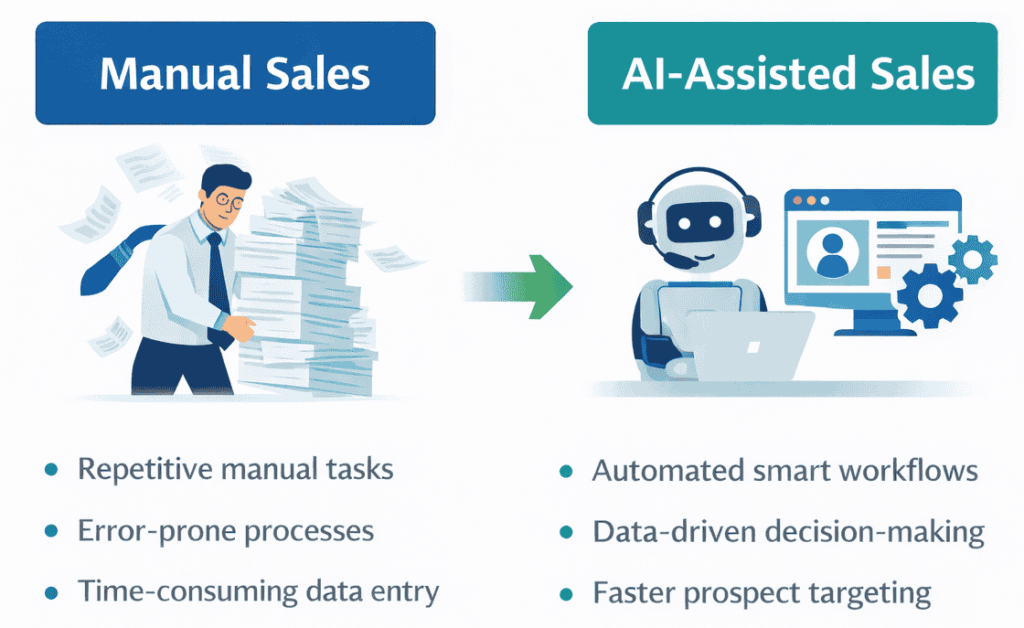
AI helps reduce manual workload while increasing efficiency.
Instead of hiring more staff, businesses can now use AI sales tools to:
- Automate outreach
- Score leads
- Personalize emails
- Track buyer behavior
- Predict sales trends
AI levels the playing field between small businesses and larger competitors.
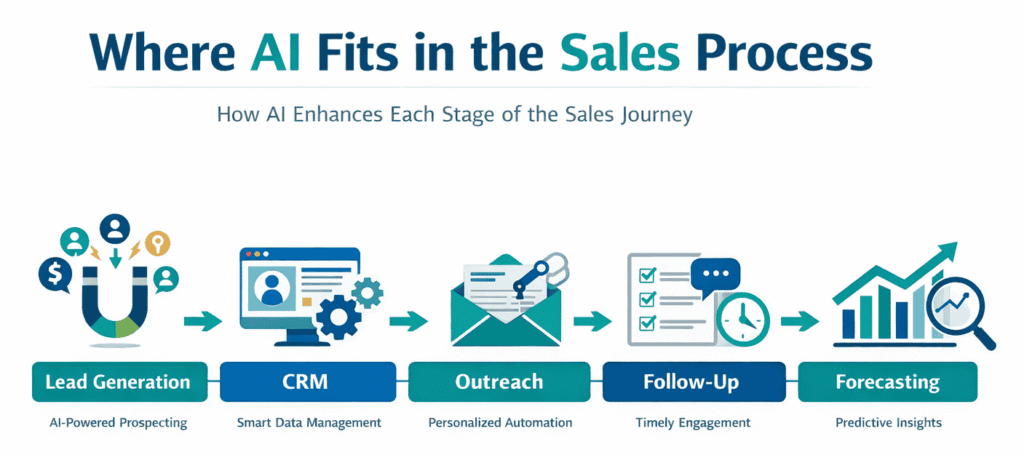
1. AI-Powered Lead Generation
One of the biggest transformations is in lead generation.
AI tools can now:
- Analyze customer data
- Identify ideal customer profiles
- Find lookalike prospects
- Enrich contact information automatically
Instead of manually searching for leads, AI can generate targeted prospect lists in minutes.
This reduces guesswork and improves conversion rates.
For small businesses, this means higher-quality leads without increasing marketing spend.
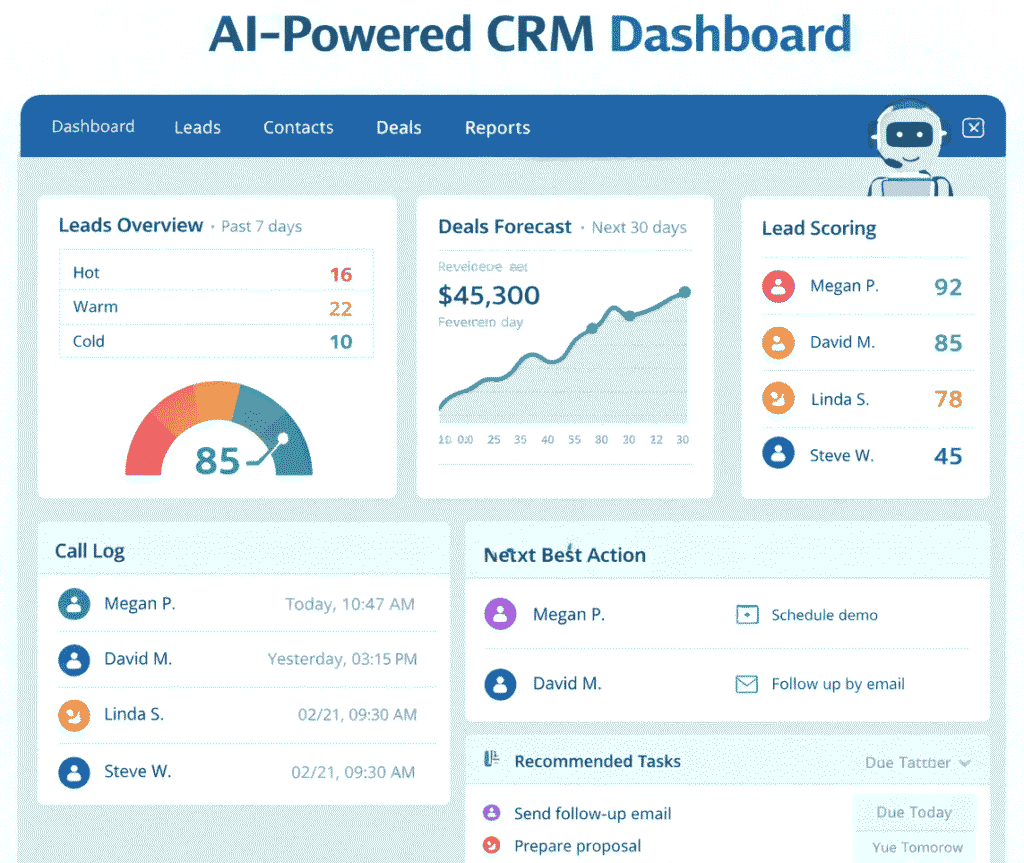
2. Smarter CRM Systems with AI
Traditional CRM systems store data.
AI-powered CRM systems analyze data.
Modern AI CRM tools can:
- Predict which leads are most likely to convert
- Recommend next best actions
- Automate follow-ups
- Detect deal risks
- Provide sales forecasting insights
This turns your CRM from a database into a decision-making assistant.
Small sales teams benefit significantly because AI reduces the need for manual tracking and analysis.
If you’re exploring HubSpot CRM but want to understand the basics first, check out our beginner-friendly guide to CRM systems.
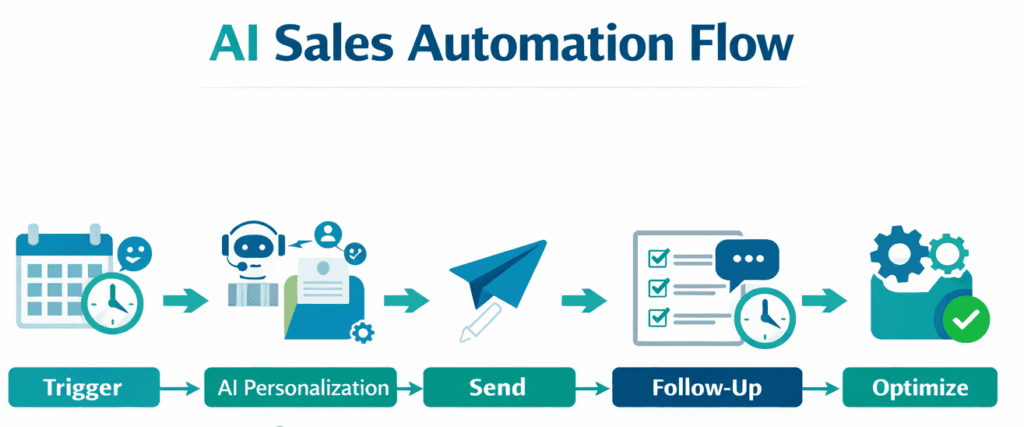
3. AI Sales Automation
AI sales automation goes beyond basic workflows.
Today, automation tools can:
- Send personalized cold emails at scale
- Adjust follow-up timing based on engagement
- Optimize subject lines using data
- Segment audiences dynamically
- Trigger workflows based on user behavior
For small businesses, this means scaling outreach without hiring additional sales reps.
However, automation must be used strategically — not blindly.
4. Personalized Customer Engagement
Buyers expect personalization.
AI enables small businesses to:
- Customize email content based on behavior
- Recommend products intelligently
- Personalize offers based on past interactions
- Analyze customer sentiment
Instead of generic outreach, AI helps deliver relevant communication at the right time.
This increases response rates and customer trust.
How AI improves subject lines and inbox placement — especially when combined with proper authentication setup like SPF, DKIM, and DMARC guide here.
5. Predictive Sales Analytics
AI can analyze patterns in:
- Buying cycles
- Customer behavior
- Deal progression
- Seasonal trends
Predictive analytics allows small businesses to:
- Forecast revenue
- Allocate resources efficiently
- Identify high-value prospects
- Detect potential churn
Instead of reactive selling, businesses move toward proactive strategy.
6. AI Chatbots and Conversational Sales
AI chatbots are transforming how small businesses capture leads.
They can:
- Respond instantly to inquiries
- Qualify prospects automatically
- Book meetings
- Provide product information
- Operate 24/7
This ensures no opportunity is missed, even outside business hours.
For small teams, this acts like an additional sales assistant.
7. Improved Email Deliverability and Optimization
AI tools now help optimize:
- Subject lines
- Send timing
- Email frequency
- Spam trigger detection
Some tools even analyze engagement patterns to improve inbox placement.
Better deliverability means better results from outbound campaigns.
Strong lead generation also depends on email deliverability. To make sure your campaigns reach the inbox instead of spam, read our Cold Email Deliverability Guide (2026): How to Avoid Spam & Land in the Inbox.
Benefits of AI in Sales for Small Businesses
Here’s what AI ultimately provides:
- Increased efficiency
- Reduced manual tasks
- Better targeting
- Improved personalization
- Data-driven decisions
- Higher scalability
AI reduces operational friction while improving performance.
Challenges Small Businesses Should Consider
Despite the benefits, AI adoption should be strategic.
Common mistakes include:
- Automating before validating messaging
- Using too many tools
- Ignoring deliverability setup
- Over-relying on automation
- Not training team members properly
AI is a multiplier, not a replacement for sales fundamentals.
How Small Businesses Can Start Using AI in Sales
If you’re just getting started:
- Define your ideal customer profile clearly
- Choose one AI sales tool (don’t stack 5 tools at once)
- Test automation in small batches
- Monitor performance metrics
- Refine messaging before scaling
Start simple. Scale smart.
The Future of AI in Small Business Sales
AI will continue evolving toward:
- Deeper personalization
- Better predictive intelligence
- Smarter CRM automation
- AI-generated outreach
- Voice AI assistants
- Fully automated lead nurturing
Small businesses that adopt AI strategically will gain a competitive advantage.
Those who ignore it may struggle to keep up.
Final Thoughts
AI in sales for small businesses is no longer optional — it’s becoming essential.
From lead generation to predictive analytics, AI is transforming how small teams operate and compete.
But success doesn’t come from tools alone.
It comes from combining:
Clear strategy
Strong messaging
Smart automation
And consistent optimization
Used wisely, AI becomes a growth engine.
FAQs
1. How does AI help small business sales teams?
AI helps small business sales teams by automating repetitive tasks, scoring leads based on buying intent, personalizing outreach messages, and predicting which prospects are most likely to convert.
2. Is AI expensive for small businesses?
Many AI sales tools now offer affordable plans specifically designed for startups and small teams. Businesses can start with basic automation features and scale as revenue grows.
3. What are the best AI tools for small business sales?
The best AI tools typically include AI-powered CRM platforms, automated email outreach tools, lead enrichment software, and predictive analytics systems that improve sales forecasting.
4. Can AI replace a small sales team?
No. AI does not replace sales teams. It supports them by handling repetitive work, organizing data, and providing insights so sales representatives can focus on closing deals and building relationships.
5. How does AI improve lead generation for small businesses?
AI improves lead generation by analyzing customer data, identifying ideal customer profiles, scoring leads automatically, and prioritizing high-intent prospects.
6. What is AI lead scoring?
AI lead scoring is a system that automatically ranks prospects based on their likelihood to convert, using behavioral data, engagement signals, and historical sales data.
7. Is AI useful for cold email campaigns?
Yes. AI can personalize email content, optimize subject lines, automate follow-ups, and analyze response rates to improve cold email performance.
8. How can beginners start using AI in sales?
Beginners should start by defining their ideal customer, choosing one AI tool (such as an AI CRM), testing automation on a small scale, and measuring results before expanding.
9. Does AI improve sales forecasting accuracy?
AI improves forecasting by analyzing historical deal data, identifying patterns, and predicting future revenue trends with greater accuracy than manual estimation.
10. What mistakes should small businesses avoid when using AI in sales?
Common mistakes include automating too early, relying entirely on AI without strategy, using too many tools at once, and ignoring data quality or email deliverability basics.