
Table of Contents
Cold Email Templates for B2B Sales That Actually Get Replies
Cold emailing remains one of the most powerful and cost-effective strategies for B2B lead generation. When executed correctly, it allows businesses to directly reach Decision-makers, Build meaningful connections, and Generate high-quality leads without relying on Paid Advertising.
In today’s competitive market, where inboxes are crowded and attention spans are short, a well-crafted cold email can be the difference between being ignored and starting a Valuable Business Conversation.
The real advantage of cold email is scalability. With the right strategy, businesses can consistently reach new prospects, test messaging, and refine their outreach process to improve results over time.
However, most cold emails fail for one simple reason — they sound Generic and Self-focused.
Prospects receive dozens of emails daily. If your message doesn’t immediately show relevance or value, it will likely be ignored or deleted within seconds.
That’s why successful cold emailing is not about sending more emails — it’s about sending better, more Targeted Emails.
In this guide, you’ll discover High-Performing Cold email Templates for B2B sales, along with proven strategies to:
• Increase open rates with better subject lines
• Improve response rates through personalization
• Deliver clear value propositions
• Convert prospects into qualified leads
Whether you’re in sales, marketing, or running a small business, these templates will help you create emails that Stand out, Get replies, and Drive real results.
Why Cold Emails Fail (And How to Fix It)
Before using any templates, it’s important to understand why most cold emails don’t perform well. Identifying these mistakes will help you avoid common pitfalls and improve your outreach effectiveness.
Many businesses approach cold emailing with the wrong mindset — focusing too much on selling rather than solving a problem.
As a result, their emails feel pushy, irrelevant, or easy to ignore.
Common Cold Email Mistakes
⚠️ Lack of Personalization
Sending the same message to everyone without tailoring it to the recipient’s role, company, or needs reduces engagement significantly.
⚠️ Too much focus on Selling
Starting with a sales pitch instead of providing value makes the email feel transactional rather than helpful.
⚠️ Long and Unclear messaging
Busy professionals don’t have time to read long emails. If your message isn’t clear within a few seconds, it will be skipped.
⚠️ No clear Call-to-action
If you don’t guide the reader on what to do next, they’re unlikely to respond.
How to Fix These Issues
To improve your cold email performance, shift your focus from selling to providing value and relevance.
Effective cold emails should:
➣ Address a specific problem the prospect may be facing
➣ Show that you’ve done basic research about them
➣ Offer a clear and simple benefit
➣ Include a low-friction call-to-action (like a quick reply or short call)
When your email feels Relevant, Helpful, and Easy to Respond to, your chances of getting replies increase significantly.
💡Key Insight:
Cold email success is not about volume — it’s about sending the Right Message to the Right Person at the Right Time.
Key Elements of a High-Converting Cold Email
Every successful cold email follows a simple structure, but what makes it effective is how well each element is executed. The goal is to capture attention quickly, provide value, and make it easy for the recipient to respond.
Let’s break down the key elements with a practical walkthrough.
1. Personalized Opening
The first line of your email determines whether the reader continues or ignores it.
A strong personalized opening shows that your email is not mass-sent and that you’ve taken time to understand the recipient.
Instead of starting with a generic introduction, reference something specific such as:
• Their recent LinkedIn post
• A company update or achievement
• Their role or responsibility
• A relevant industry trend
Example:
“Hi John, I noticed your team recently expanded your sales operations in the US market…”
This immediately grabs attention because it feels relevant.
Why it works:
Personalization builds trust and increases the chances of your email being read.
2. Clear Value Proposition
Once you have their attention, you need to quickly explain why you’re reaching out and how you can help.
Avoid vague statements like “We help businesses grow.” Instead, be specific about the outcome you can deliver.
Focus on:
• The problem you solve
• The result you provide
• Who you’ve helped before (If possible)
Example:
“We help B2B teams increase reply rates by 30% through optimized cold email strategies.”
This makes your message clear and outcome-driven.
Why it works:
Busy professionals care about results, not features. A clear value proposition shows immediate relevance.
3. Short and Simple Message
Cold emails should be easy to scan and understand within seconds.
Long paragraphs, complex language, or too much information will reduce your chances of getting a response.
Keep your email:
• Under 100–150 words
• Structured with short sentences
• Focused on one main idea
Think of your email as a conversation starter, not a full pitch.
Example structure:
Opening → Value → CTA
That’s it.
Why it works:
Short emails respect the reader’s time and increase readability, especially on mobile devices.
4. Strong Call-to-Action (CTA)
A cold email without a clear CTA leaves the reader confused about what to do next.
Your CTA should be:
• Simple
• Specific
• Low commitment
Avoid asking for too much upfront, like long meetings or detailed discussions.
Instead, use easy next steps such as:
• “Would you be open to a quick 10-minute call?”
• “Can I share a quick idea with you?”
• “Does this sound relevant to you?”
Why it works:
Low-friction CTAs increase the likelihood of a reply because they require minimal effort.
Putting It All Together
Here’s how these elements combine into a simple, effective cold email:
Hi [Name],
I noticed [personalized detail].
We help [target audience] achieve [specific result].
Would you be open to a quick chat this week?
💡 Key Insight:
A high-converting cold email is not about being clever or overly persuasive — it’s about being clear, relevant, and easy to respond to.
To scale your outreach efficiently, you can use AI tools for sales automation that help with prospecting, personalization, and follow-up emails.
10 Cold Email Templates for B2B Sales (High-Converting + Real Examples)
These are not just templates — they are proven frameworks used in real B2B outreach. Customize them based on your Audience, Offer, and Industry.
1. Problem–Solution Template
When to use
When you clearly know your Prospect’s Pain Point or Industry Challenge. It works best in targeted outreach where you know what they’re struggling with.
Template
Subject: Quick idea to improve [specific result]
Hi [Name],
I noticed that [specific observation]. Many companies in your industry face challenges with [problem].
We’ve helped teams solve this by [solution + result].
Would you be open to a quick 10-minute chat this week?
Best,
[Your Name]
Real Example (SaaS Company)
Hi John,
I noticed your team is scaling outbound sales. Many SaaS companies struggle with low cold email reply rates.
We’ve helped similar teams increase replies by 35% using optimized email frameworks.
Would you be open to a quick 10-minute chat this week?
Why It Works
Directly connects Problem → Solution → Result, making it highly relevant and purposeful. This reduces confusion and increases response intent.
2. Personalized Outreach Template
When to Use
Ideal when you can reference something specific like a LinkedIn post, Company update, or Recent achievement. Best for Warm Cold Outreach.
Template
Subject: Loved your recent work at [Company]
Hi [Name],
I came across your recent [post/work] about [specific detail], and it really stood out.
I work with teams like yours to [value]. Thought this might be relevant.
Would you be open to a quick conversation?
Real Example (Marketing Agency)
Hi Sarah,
I saw your LinkedIn post about scaling paid ads — your insights on budget allocation were spot on.
I help agencies improve lead quality through AI-driven targeting strategies. Thought it might be relevant.
Open to a quick chat?
Why It Works
Personalization makes your email feel Human and Thoughtful instead of automated. This builds Trust quickly and improves Open and Reply rates.
3. Value-First Template
When to use
Use this when you want to Lead with Value instead of pitching your service immediately. Great for first-touch emails.
Template
Subject:
Idea for [Company Name]
Email:
Hi [Name],
I had a quick idea that could help your team [specific benefit — e.g., generate more qualified leads without increasing ad spend].
We recently helped a similar company achieve [specific result — e.g., 25% more meetings booked].
Happy to share the exact approach if you’re interested — no pressure.
Would you like me to send it over?
Best,
[Your Name]
Example (Recruitment Consultant)
Hi John,
I had a quick idea that could help your team attract more qualified candidates without increasing job ad spend.
We recently helped a company streamline their outreach and improve candidate response rates by 40%.
Happy to share the exact approach if you’re interested — no pressure.
Would you like me to send it over?
Best,
Alex
Why this works
Curiosity + Low-pressure CTA = Higher replies. By offering value upfront, you reduce Resistance and create Curiosity. Prospects are more likely to engage when they feel they’re gaining something useful.
4. Follow-Up Template
When to Use
Send this 2–3 days after your initial email if there’s no response. Essential for any cold email sequence.
Template
Subject: Quick follow-up
Hi [Name],
Just wanted to follow up on my previous email — I know things get busy.
If improving [goal] is still a priority, I’d be happy to share a quick idea.
Let me know if you’d like me to send it.
Real Example
Hi John,
Just following up — I know things get busy.
If improving your cold email reply rates is still a focus, I can share a quick strategy that’s working well.
Interested?
Why It Works
Most prospects don’t reply to the first email due to timing, not disinterest. Follow-ups increase visibility and significantly improve overall response rates.
5. Case Study Template
When to Use
When you have real results or proof. Best when you have real results, metrics, or client success stories to share. Ideal for building credibility.
Template
Subject: How we helped [Company] achieve [result]
Hi [Name],
We recently worked with a company similar to yours and helped them [result].
They were facing [problem], and we implemented [solution].
I believe we could do something similar for your team.
Open to a quick call?
Real Example
Hi Sarah,
We recently helped a B2B SaaS company double their outbound reply rate in 30 days.
They were struggling with generic messaging, and we implemented personalized email workflows.
I believe we could do something similar for your team.
Open to a quick chat?
Why It Works
Uses social proof, which builds trust quickly. Social proof reduces skepticism and builds trust. When prospects see proven results, they’re more likely to believe you can help them too.
6. Question-Based Template
When to Use
To start conversations instead of pitching. Use this when you want to start a conversation rather than directly pitch your offer. Works well in early outreach stages.
Template
Subject: Quick question
Hi [Name],
Are you currently looking to improve [specific area]?
If yes, I’d love to share a quick idea that has worked well for similar teams.
Worth a quick chat?
Real Example
Hi Alex,
Are you currently looking to improve your B2B lead generation strategy?
If yes, I’d love to share a quick idea that’s working well for similar companies.
Worth a quick chat?
Why It Works
Questions trigger natural responses. Questions naturally invite responses and lower the pressure to commit. It makes your email feel like a conversation instead of a sales pitch.
7. Short & Direct Template
When to Use
Best for busy professionals like founders, CEOs, or senior executives who prefer quick communication.
Template
Subject: Can we help with [problem]?
Hi [Name],
We help companies solve [problem].
Would you be open to a quick 10-minute call?
Real Example
Hi John,
We help SaaS companies increase outbound conversions.
Open to a quick 10-minute call?
Why It Works
Straight to the point — respects time. It respects the reader’s time by being concise and clear. Short emails are easier to read and often get faster responses.
8. Referral Template
When to Use
When you have a mutual connection. Use this when you have a mutual connection or someone has referred you. Great for warm introductions.
Template
Subject: Referred by [Name]
Hi [Name],
[Referrer Name] suggested I reach out.
We help companies with [solution], and I thought it might be relevant for your team.
Would you be open to a quick chat?
Real Example
Hi Sarah,
Mark from GrowthX suggested I reach out.
We help agencies improve client acquisition through outbound strategies. Thought it might be relevant.
Open to a quick chat?
Why It Works
Leverages existing trust. Trust is instantly transferred through the referral. This makes your outreach more credible and increases the likelihood of a response.
9. Insight-Based Template
When to Use
When you have industry knowledge or trends. Ideal when you can share industry trends, data, or unique observations relevant to the prospect.
Template
Subject: Quick insight for your team
Hi [Name],
I’ve been noticing a trend in [industry] where companies struggle with [problem].
Some teams are solving this by [insight].
Happy to share more if you’re interested.
Real Example
Hi Alex,
I’ve been noticing that many SaaS companies struggle with low email deliverability.
Some teams are solving this with better domain warm-up strategies.
Happy to share more if you’re interested.
Why It Works
Positions you as an expert, not a seller. It positions you as someone knowledgeable rather than sales-focused. This builds authority and creates curiosity.
10. Free Value Template
When to Use
When you have a value resource . Use this when you have a helpful resource like a guide, checklist, PDF or report to share.
Template
Subject: Free resource for your team
Hi [Name],
I’ve created a quick resource on [topic] that could help your team.
Happy to share it — no strings attached.
Let me know if you’d like it.
Real Example
Hi John,
I’ve created a quick guide on improving cold email reply rates that might help your team.
Happy to share it — no strings attached.
Want me to send it?
Why It Works
Value-first = Builds trust instantly. Offering value without asking for anything builds trust quickly. It lowers resistance and encourages positive engagement.
Final Pro Tip
Don’t just copy templates.
👉 Personalize each email
👉 Test 2–3 variations
👉 Track reply rates
👉 Improve continuously
💡 Key Insight:
Cold email success is not about sending more emails — it’s about sending Relevant, Valuable, and Easy-to-Reply Messages.
To scale your outreach, consider using the Best cold email tools that help automate and optimize your campaigns.
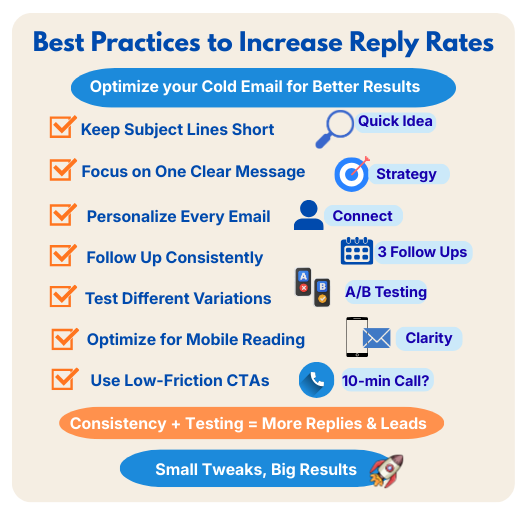
Best Practices to Increase Reply Rates
Getting replies from cold emails is not about luck — it’s about following a consistent and strategic approach. Small improvements in your messaging, targeting, and follow-up process can significantly increase your response rates over time.
Here are the most effective best practices to help you get better results from your cold email campaigns:
1. Keep Subject Lines Short and Curiosity-Driven
Your subject line is the first thing your prospect sees. If it doesn’t grab attention, your email won’t even get opened.
Keep subject lines:
• Under 6–8 words
• Simple and natural (not overly salesy)
• Curiosity-driven or benefit-focused
Examples:
• “Quick idea for your team”
• “Regarding your outbound strategy”
• “Can we help with this?”
👉 Avoid clickbait or spammy words like “FREE,” “URGENT,” or “LIMITED OFFER.”
2. Focus on One Clear Message
One of the biggest mistakes in cold emailing is trying to say too much.
Each email should have one goal and one message.
Instead of listing multiple features or ideas, focus on:
• One problem
• One solution
• One outcome
This makes your email easier to understand and increases the chances of a reply.
3. Personalize Every Email (At Least the First Line)
Personalization is no longer optional — it’s expected.
Even a small level of personalization can dramatically improve engagement.
You don’t need deep research. Start with:
• The prospect’s role
• Company activity
• LinkedIn posts or updates
• Industry trends
Example:
“I noticed your team is expanding your sales operations…”
👉 This instantly makes your email feel relevant.
4. Follow Up Consistently (Most Replies Come Here)
Many deals are closed not from the first email, but from follow-ups.
A good follow-up strategy:
• Send 2–3 follow-ups
• Space them 2–4 days apart
• Keep them short and polite
Most people don’t reply simply because they’re busy — not because they’re not interested.
Consistency here can double your response rate.
5. Test Different Variations
Cold email success comes from testing, not guessing.
Try experimenting with:
• Subject lines
• Opening lines
• Value propositions
• CTAs
Track what gets the most replies and improve over time.
Even small changes can lead to big improvements in performance.
6. Optimize for Mobile Reading
A large percentage of emails are opened on mobile devices.
Make sure your email is:
• Short and easy to scan
• Broken into small paragraphs
• Free from long blocks of text
If your email looks clean on mobile, it’s more likely to be read and answered.
7. Use Low-Friction CTAs
Avoid asking for big commitments upfront.
Instead of:
“Let’s schedule a 30-minute demo”
Use:
“Open to a quick 10-minute chat?”
“Want me to send more details?”
👉 The easier it is to respond, the higher your reply rate.
Key Takeaway
Consistency and testing are the foundation of cold email success.
You don’t need perfect emails — you need a system where you:
• Send consistently
• Test regularly
• Improve based on results
Over time, this approach will help you turn cold outreach into a predictable lead generation channel.
💡Pro Insight:
Even a small improvement in reply rate (from 2% to 5%) can significantly increase your leads and revenue — which is why optimizing cold emails is one of the highest ROI activities in B2B sales.
You can also learn How to find business emails from LinkedIn to build a highly targeted prospect list for your cold email campaigns.
Common Cold Email Mistakes to Avoid
Even with the right templates and strategies, small mistakes can significantly reduce your reply rates. Most cold emails fail not because the offer is bad, but because the execution is weak or misaligned with the reader’s expectations.
Avoiding these common mistakes can instantly improve your cold email performance.
1. Sending Long Emails
One of the biggest mistakes in cold emailing is writing emails that are too long.
Busy professionals don’t have time to read detailed pitches. If your email looks like a wall of text, it will likely be ignored.
What goes wrong:
• Too much explanation
• Multiple ideas in one email
• Long paragraphs
What to do instead:
Keep your email:
• Under 100–150 words
• Focused on one message
• Easy to scan within 5–10 seconds
👉 Think of your email as a conversation starter, not a full sales pitch.
2. Using Generic Templates
Generic emails are easy to spot — and easy to ignore.
If your email sounds like it was sent to hundreds of people, it won’t create engagement.
What goes wrong:
• No personalization
• Copy-paste messaging
• Irrelevant content
What to do instead:
Customize at least:
• The first line (personalized opening)
• The problem statement
• The value proposition
👉 Even small personalization can significantly increase reply rates.
3. Not Following Up
Most people don’t respond to the first email — not because they’re not interested, but because they’re busy.
Stopping after one email means you’re missing out on potential opportunities.
What goes wrong:
• Sending only one email
• Giving up too early
What to do instead:
• Send 2–3 follow-ups
• Keep them short and polite
• Space them 2–4 days apart
👉 Many successful deals happen after the second or third follow-up.
4. Being Too Sales-Focused
Starting your email with a hard pitch is one of the fastest ways to lose attention.
People don’t want to be sold to — they want solutions to their problems.
What goes wrong:
• Pushing your product immediately
• Talking only about features
• Sounding promotional
What to do instead:
Shift your focus to:
• The prospect’s problem
• The value you provide
• How you can help
👉 Make your email about them, not you.
5. Ignoring Personalization
Personalization is what separates high-performing emails from ignored ones.
Without it, your message feels irrelevant and easy to dismiss.
What goes wrong:
• Using generic greetings
• No reference to the prospect
• Irrelevant messaging
What to do instead:
Add simple personalization like:
• “I noticed your team is hiring…”
• “Saw your recent post about…”
• “Congrats on your recent launch…”
👉 This shows effort and increases trust instantly.
Key Takeaway
Most cold email mistakes come down to one issue — lack of relevance.
To improve your results:
• Keep emails short
• Personalize your message
• Focus on value
• Follow up consistently
💡Pro Insight:
Fixing just one of these mistakes can significantly improve your reply rates — but fixing all of them can turn cold emailing into a consistent and scalable lead generation system.
To make a better decision, check out this detailed comparison of Apollo.io and ZoomInfo for B2B lead generation.
Final Thoughts
Cold emailing is not about sending more emails — it’s about sending better ones.
By using the Right templates, Focusing on Personalization, and Providing Value, businesses can significantly improve their Outreach Results.
Start with these templates, test what works best, and refine your approach over time.
FAQs
-
What is a cold email in B2B sales?
A cold email is an outreach email sent to potential business clients who have had no prior interaction with your company. It is commonly used in B2B sales to generate leads, build relationships, and start conversations with decision-makers.
-
Do cold emails still work in 2026?
Yes, cold emails still work when done correctly. With proper personalization, clear value, and consistent follow-ups, cold emailing remains one of the most effective and cost-efficient strategies for B2B lead generation.
-
What is a good cold email response rate?
A good cold email reply rate typically ranges between 5% to 15%, depending on your targeting, personalization, and messaging quality. Highly optimized campaigns can achieve even higher response rates.
-
How long should a cold email be?
A cold email should ideally be 50 to 150 words. Short, clear, and focused emails perform better because they are easier to read and respond to, especially for busy professionals.
-
How many follow-ups should I send?
You should send 2 to 3 follow-up emails, spaced 2–4 days apart. Most responses come from follow-ups rather than the first email, so consistency is key.
-
What is the best subject line for cold emails?
The best subject lines are:
• Short (under 6–8 words)
• Personalized or relevant
• Curiosity-driven
Examples include:
• “Quick idea for your team”
• “Regarding your outbound strategy”
• “Can we help with this?” -
How do I personalize cold emails effectively?
You can personalize cold emails by referencing:
• the prospect’s role or company
• recent activities or updates
• LinkedIn posts or achievements
• industry-specific challenges
Even a simple personalized opening line can significantly increase engagement. -
Why do most cold emails fail?
Most cold emails fail due to:
• Lack of personalization
• Long and unclear messaging
• Overly sales-focused approach
• No clear call-to-action
• No follow-up strategy
Fixing these issues can dramatically improve your results. -
What should I include in a cold email?
A high-converting cold email should include:
• A personalized opening
• A clear value proposition
• A short and simple message
• A strong call-to-action
These elements help make your email relevant and easy to respond to. -
Is cold emailing legal?
Yes, cold emailing is legal in many countries, but you must follow regulations such as:
• Including your business identity
• Providing an option to opt out
• Avoiding misleading subject lines
Always check laws like GDPR or CAN-SPAM based on your target audience. -
What is the best time to send cold emails?
The best times to send cold emails are typically:
• Tuesday to Thursday
• Between 8 AM – 11 AM or 1 PM – 3 PM
However, testing different times is important to find what works best for your audience. -
How can I improve my cold email reply rates?
To improve reply rates:
• Personalize your emails
• Keep messages short and clear
• Focus on value, not selling
• Use simple CTAs
• Follow up consistently
Even small improvements can lead to significant results.